Seven months before a federal grand jury indicted 15 Minnesota anti-ICE activists on conspiracy charges, Michael Rabbitt of Chicago was traveling in Portugal with his wife. While celebrating their 30th wedding anniversary, he got an unexpected call from the FBI.
An agent told Rabbitt that a grand jury had indicted him on conspiracy charges for allegedly surrounding a federal agent’s vehicle in September and impeding its approach to a Chicago-area Immigration and Customs Enforcement facility.
Rabbitt recounted in an interview with MPR News that his stress escalated as he scrambled to find an attorney and return to the United States, where he was processed by federal agents, interviewed by pre-trial services and faced threats to his livelihood — all as a possible seven year prison sentence loomed.
A judge eventually dismissed the charges against Rabbitt and five others in May after finding that federal prosecutors had engaged in serious misconduct, including allegedly speaking with a grand juror outside the jury room.
Even if the conspiracy charges against the 15 defendants in Minnesota don’t stick, legal experts and the defendants’ supporters say the Trump Justice Department may still succeed in suppressing dissent and punishing people it sees as political enemies by using the court system.
“The government achieves the goal of, some would say, fear,” said Angi Porter, a professor at Washington College of Law at American University. “The chilling effect.”
Minnesota anti-ICE activists indicted
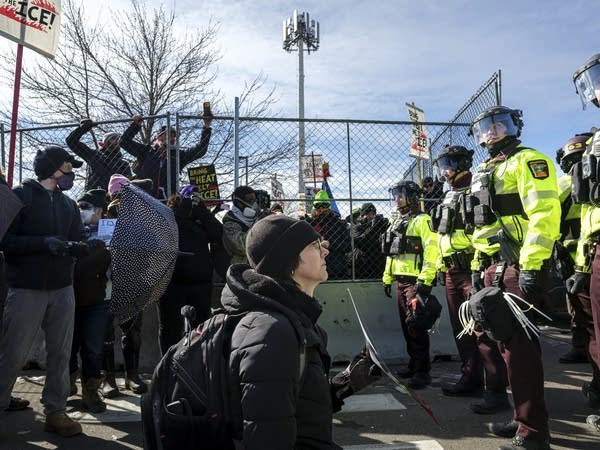
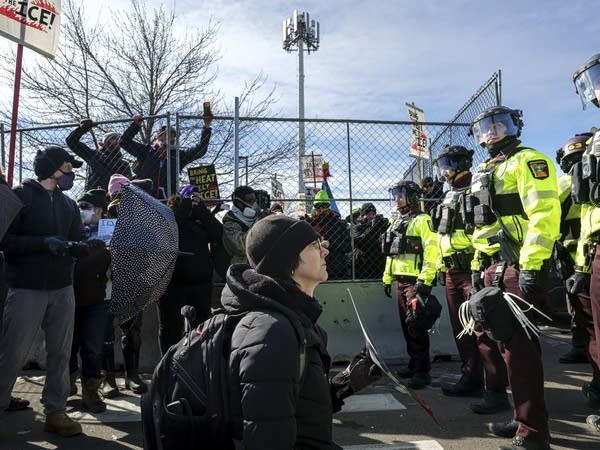
On June 11, a grand jury in Minneapolis indicted 15 Minnesota Twin Cities activists on conspiracy and other charges in connection with coordinated anti-ICE protests over the winter.
The indictment does not accuse any of the defendants of injuring officers. It’s largely based on Signal chats in which the group plans and discusses protest actions. Among the dozens of “overt acts” allegedly carried out in furtherance of the conspiracy, prosecutors note that one defendant, Isaac Sant, “wrote an article for Crimethinc., an anarchist-style blog” and took part in an “anarchist speaking tour.”
Sant’s attorney Kevin Riach called the charges against his client an insult to democracy and the rule of law.
“I’ve been practicing criminal defense in this district for a long time,” Riach said in an interview with MPR News. “This is the first indictment that I’ve ever seen where the government alleges that going on a speaking tour is somehow part of a conspiracy.”
At a June 16 news conference to announce the indictments, Minnesota U.S. Attorney Dan Rosen said the defendants are affiliated with Direct Action Minnesota, which he described as an antifa — or antifascist — affinity group. Rosen said the 15 were “charged not for what they said but what they did.”
He played a video clip that defendant Kyle Wagner allegedly posted to Facebook on Jan. 24, after a Border Patrol agent killed Alex Pretti in Minneapolis.
“This is not a f—ing joke. There’s nothing fun to chant about it. Get your f—ing guns and stop these f—ing people,” Wagner is heard saying in the video.
“There is a clear line that cannot be crossed when protest turns into rioting, violence or criminal activity,” added Homeland Security Investigations Special Agent in Charge Michael McCarthy. “It becomes unlawful, and it will not be tolerated. Unfortunately, some groups have crossed that line.”
While federal prosecutors in Minnesota have quietly dropped charges against other protesters after sworn affidavits from Homeland Security officials contradicted video evidence, protesters elsewhere have been convicted by juries.
In May, a jury in Spokane, Wash., found three people guilty of conspiracy for trying to block immigration officials from transporting two detained people to Tacoma.
Two federal judges in Texas on Wednesday handed sentences ranging from 30 to 100 years to eight people convicted in connection with a 2025 protest near a Dallas immigration detention facility in which Benjamin Song, a former Marine reservist, shot and wounded a police officer. Prosecutors accused the group of terrorism and said they were linked to the antifa movement. Jurors convicted Song of attempted murder.
After the eight defendants in Texas were sentenced, the U.S. Department of Justice posted a statement that included comments from FBI Director Kash Patel, who said “Today’s sentencings show the FBI remains committed to identifying, locating, and dismantling Antifa and its funding networks across the country.”
‘The ordeal itself causes mental anguish’
Conspiracy charges have been used in a broad range of cases where two or more people planned to commit a serious crime and then made overt acts to carry out that crime, Richard Painter, a professor at the University of Minnesota School of Law, told MPR News.
Painter, who served as President George W. Bush’s chief ethics lawyer two decades ago, said the vast majority of anti-ICE protesters in the state were peaceful, and there doesn’t appear to be evidence of a conspiracy to violently oppose the federal government. While some protesters may have used inflammatory rhetoric, Painter said that is typically protected under the First Amendment.
“Unfortunately, the Trump administration and their supporters concocted this false narrative that there was an insurrection in Minnesota,” Painter said. “It wasn't true. So now, months later, they're coming back with this criminal conspiracy charge against a handful of protesters.”
The conspiracy statute the 15 protesters are charged under is incredibly expansive, Porter said.
“We need merely intimidation or threats, not bodily injury threats, but merely threats to impede what officers or other federal agents were doing,” Porter said. “Things like the blockades, plans to make officers leave a place that they needed to be to carry out their duties. Surveillance [of federal agents] can be intimidation, injury to property, that counts.”
Porter said the conspiracy charges shouldn’t be taken lightly due to the potentially long sentences and the unpredictability of how a jury may interpret the charges.
In addition, defendants often need to procure expensive attorneys, attend hearings and carry the burden of explaining their role in a high-profile case to employers or potential landlords. At least eight of the 15 defendants have publicly-funded attorneys appointed through the Criminal Justice Act, which provides private defense attorneys for people who otherwise cannot afford them.
“Being a party in an investigation, it really takes its toll,” Porter said. “Regardless of the chance of guilt, because even if there is a 2 percent chance that a defendant will be found guilty, the ordeal itself causes mental anguish.”
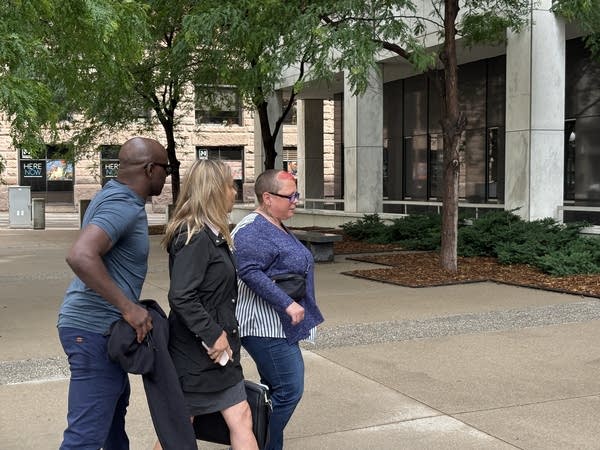
Natasha Rakotz is one of the 15 Minnesotans indicted this month . After her initial appearance, Rakotz told MPR News that she hadn’t done anything illegal and was simply trying to protect her community and neighbors from “the government’s violence.”
“It sickens me, and it makes me really sad that this is happening to me and others,” Rakotz said. “None of us deserve this — all we wanted to do is create a better world, a better community.”
‘Judicial procedures are being weaponized’
Minnesotans have stepped up to raise funds for people needing food or help with rent due to the federal government’s immigration enforcement effort. Michelle Gross, a longtime activist and president of Communities United Against Police Brutality, said these legal charges are just one more cost.
“People have stepped up and done what they needed to do, but now we've got to come up with more resources to defend our community members,” Gross said. “It’s basically meant to drain the community of resources.”
Gross said she believes the federal government is trying to push the narrative that people who opposed ICE are villains and that the federal agents are heroes. She points to the fact that none of the federal officers involved in the fatal shooting of two American citizens in Minneapolis this winter have been indicted.
“We made [Homeland Security] look pretty bad because they came here, they didn't expect the resistance, but we gave them the resistance,” Gross said. “They're basically trying to send a message to scare everybody else from doing the things that we've done — and it won't work.”
The conspiracy charges in Minnesota fit a trend that UNIDOS MN executive director Emilia Gonzalez Avalos has seen play out across the country.
“Regulatory procedures and judicial procedures are being weaponized, making the Constitution a discretionary document that can be enforced for political purposes,” Gonzalez Avalos said. “It is, in my opinion, a way to shift blame, a way to keep us distracted and also occupied.”
The U.S. Department of Justice did not respond to questions from MPR News about their motivations for pursuing the indictments or allegations that the agency has been weaponized to target peaceful protesters.
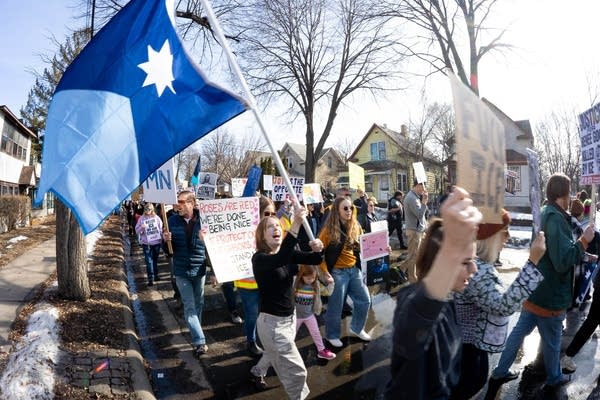
While he is out of immediate legal jeopardy, Rabbitt said mounting a defense was still “a nightmare.” Rabbitt, a progressive activist and Cook County Democratic Party committeeperson, racked up more than $300,000 in legal fees, which MPR News confirmed through invoices from his law firm. Rabbitt has been able to recoup just a fraction of that from donations. He said his co-defendants also have accrued large legal debts.
“Whether it's the effects on your finances, the legal stress, the reputational harm, it's something that no one should have to go through, and yet our government has been weaponized against its own people,” Rabbitt said. “The process is the punishment — we experienced that firsthand.”
Rabbitt said that he and his co-defendants are seeking to recoup some of their legal costs from the government under a seldom-used federal law. While he understands that the government’s goal may be to stifle resistance to the government’s immigration enforcement goals, he said he thinks the crackdowns have backfired and instead pushed more people to take up activism.
“It's always going to be in the back of my mind that this could happen to me again,” Rabbitt said. “But it doesn't change who I am at my core, and what I believe in and the social justice and human rights that I've been fighting for my whole career.”
MPR News reporter Feven Gerezgiher contributed to this report