Mille Lacs’ walleye return to same ‘hot spots’ to spawn


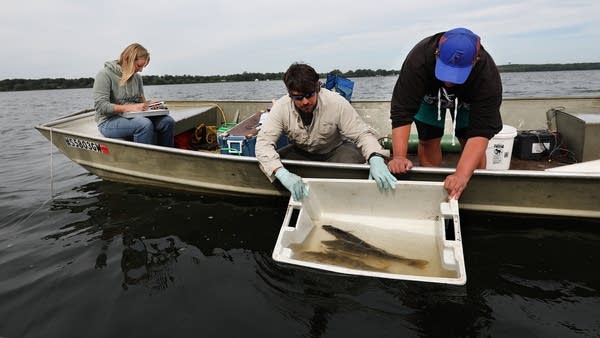
After the walleye are tagged and have recovered, they are released.

A newly released study found that walleye in Lake Mille Lacs consistently return to the same spots every year to spawn — preferably places with little or no shoreline development.

Researchers have tried to figure out why the central Minnesota lake’s walleye population declined in recent decades. The latest study suggests protecting certain places in the lake where walleye reproduce could boost their success.

Mille Lacs is one of the most heavily fished walleye lakes in Minnesota. It’s important both for recreational anglers and as a cultural and food resource for several Ojibwe tribes that retain harvesting rights under an 1837 treaty.

Previous studies found one of the primary causes of walleye’s decline is too few fish fry surviving to adulthood, said Kayla Lenz, a fisheries technician at the Great Lakes Indian Fish and Wildlife Commission. The commission partnered with the Mille Lacs Band of Ojibwe on the multi-year study.

Mille Lacs’ adult walleye “go out and spawn every year, but the percentage of the eggs that they lay that become adult fish is low,” said Lenz, who’s also a doctoral student at the University of Illinois Urbana-Champaign.

“So we want to make sure that these very early life stages have their greatest chance of success and survival,” she said.

Newly hatched walleye stay in spawning areas for a few weeks before they swim out into the larger lake, Lenz said. If the “nursery habitat” is good, they have a better chance of surviving longer, she said.

“The more fry that we can have, the more potential adult fish that we have,” Lenz said.

Tracking walleyes’ movement

Researchers placed a grid of more than 60 acoustic receivers at the bottom of Mille Lacs Lake in summer 2018. Then, they surgically implanted transmitters in about 70 adult walleye.

When the fish swam near one of the receivers, the transmitter recorded its location, depth, temperature and other information. The researchers collected data each spawning year from 2019 through 2021.
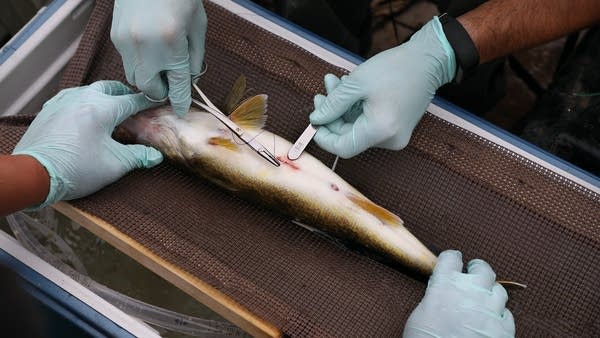
The procedure to insert the transmitter tag takes only a few minutes.
The Mille Lacs Band of Ojibwe received a nearly $200,000 grant from the U.S. Fish and Wildlife Service to use acoustic telemetry technology to study the walleye population on the popular central Minnesota lake.
Paul Middlestaedt for MPR News | 2018

They found 96 percent of the walleye detected returned to the same spawning area year after year — “a really high percentage,” as Lenz put it.

Researchers also identified three “hot spots” in Mille Lacs that are especially important spawning grounds. Those tended to be places with hard bottoms of sand or gravel, so walleye eggs were less likely to get buried in muck.

They’re also spots with a lot of wind and wave action, which helps scatter the eggs in a wider area, Lenz said.

Undeveloped shoreline is key

One of the key takeaways is shoreline development and alteration reduces walleye spawning habitat, Lenz said.

In all three of the spawning hot spots, the lakeshore was virtually undisturbed with little to no human development, such as houses, docks or marinas. Those untouched stretches of shoreline are relatively rare on Mille Lacs.

“Human activities on shore can cause stressors and damage the environment and inhibit spawning success,” Lenz said. “So it seems like they're kind of searching for what areas can have fewer of those stressors.”
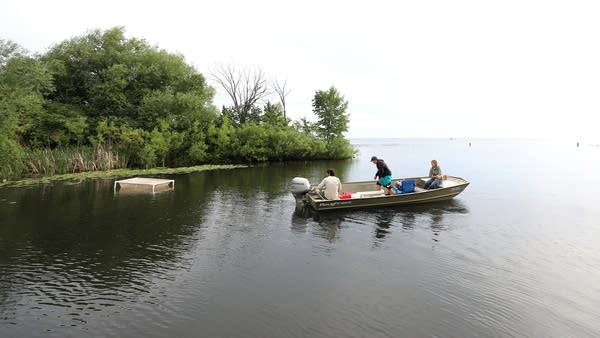
Researchers want to test a hypothesis that invasive species impact walleye.
Researchers used acoustic transmitters to track the movement of walleye in the lake, and learned the vast majority return to the same locations to spawn every year.
Paul Middlestaedt for MPR News | 2018

For example, removing trees and other vegetation along the shore can increase erosion. The dirt that washes into the lake can suffocate fish eggs, Lenz said.

Fertilizer applied to a lawn can wash into the lake and spur plant growth, which also can lessen walleye’s spawning success, she said.

If property owners are interested in helping protect spawning areas, they should maintain vegetation and limit their use of fertilizer and pesticides along the lakeshore, Lenz said.

They also should wait to install their dock until after walleye spawning season, which usually starts after the ice recedes and lasts for three to four weeks, she said.

Protecting spawning spots

The study recommended policy makers create conservation areas on or near the shoreline to protect walleye spawning areas in Mille Lacs.

To have abundant walleye for recreational anglers and tribes, “we need to help them get there and survive to adulthood,” Lenz said. “We can do that by helping to protect these spawning and nursery habitats.”

In a news release about the study, Kelly Applegate, natural resources commissioner for the Mille Lacs Band of Ojibwe, said the band cares deeply about the habitat of Ogaawag, the Ojibwe word for walleye.

“By learning more about important Ogaawag spawning sites, we can obtain valuable knowledge, allowing us to further build on our centuries-old reputation for successfully and sustainably managing our fisheries resources,” Applegate said.
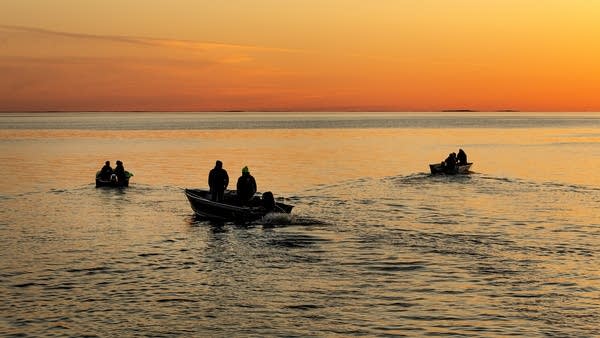
Fishing boats on a lake at sunset.
Fishermen head out from Liberty Beach in Isle to fish Mille Lacs Lake.
Paul Middlestaedt for MPR News | 2022

The study was published in the journal Frontiers in Fish Science. Its findings are useful not only for Mille Lacs Lake, but other lakes as well, Lenz said.

She said researchers are working on the next phase of the study, which involves getting more detail about the tagged walleye’s movements and behavior in the spawning hot spots.

Researchers acknowledged they tagged a relatively small number of walleye compared to Mille Lacs’ overall population, so there are likely other popular spawning locations around the lake.

Minnesota Department of Natural Resources officials said Mille Lacs’ walleye population has shown signs of recovery in recent years, in part due to stricter fishing restrictions.

As a result, the department has eased those regulations slightly. Anglers on Mille Lacs can keep up to three walleye of a certain size this summer.




Source link

Leave a Reply

Subscribe to Our Newsletter

Get our latest articles delivered straight to your inbox. No spam, we promise.

Recent Reviews


Two politicians speak at different events.

Minnesota’s U.S. Senate race got a preconvention jolt Wednesday when Democratic Rep. Angie Craig announced she would bypass the state DFL endorsement process entirely and go straight to a primary against Lt. Gov. Peggy Flanagan.

It comes just days before the two were to go head-to-head for the party endorsement at the DFL convention in Rochester. Flanagan was seen as the favorite and is now a virtual lock to get the seal of approval, which brings access to party-held voter data and other campaign resources.

As Craig filed for the primary ballot Wednesday, she said she would forgo the convention and said the endorsement process “just doesn’t reflect the full scope of the party that we are.”

“And the purple state that we have become. This is no ordinary moment. Donald Trump and Republicans are attacking Democracy itself, gutting the voting rights act, gerrymandering and threatening to interfere with elections,” Craig said. In prepared remarks, she added, “The only way we save democracy is through democracy, where every voice is heard, not just a few.”

Flanagan’s campaign was quick to declare victory.

“It’s clear that Peggy Flanagan is the consensus candidate,” said campaign spokesperson Lexi Byler.

The Flanagan team released details of its pre-convention push that expressed confidence she would easily secure the party endorsement. Now she could win the backing without real opposition.

In Minnesota, the endorsement is one step in the process. Candidates can file for the primary ballot without it. Some past Democrats of note, including Gov. Tim Walz and former Gov. Mark Dayton, both won their first races without the party endorsement. Dayton also prevailed over an endorsed candidate in his 2000 U.S. Senate race.

Flanagan’s campaign insists this year is different given the outrage over President Donald Trump’s actions and his immigration enforcement actions in Minnesota.

The primary could prove expensive and caustic. Craig has millions in her campaign fund but Flanagan has some prominent advocates on her side. TV ads on behalf of each have already started running.

The Republican nominee is also a question mark, with this weekend’s GOP convention potentially also setting the stage for an August primary.

The seat is open in November as U.S. Sen. Tina Smith prepares to retire.

DFL voters have been divided throughout the campaign over who to back.

Jim Drake sat to the side at a recent campaign event for Craig. Drake came to the event undecided in Minnesota’s Senate race and hoping for clarity.

“I tend to lean, you know, maybe a little more progressive, maybe more than Angie does,” Drake said. The Arden Hills voter says agenda isn't the only thing on his mind.

“It’s the electability and the track record that make me come back here,” he said. “Those are really important to me. Those are the first things I want done, is to get a Democrat elected in the fall.”

Drake said at the early May event that he wasn’t ready to commit his vote in the between Craig and Flanagan.

There are some similarities between the two. The stories of their childhoods, which they incorporate into their campaign stops, have parallels.

They were both raised by single mothers. Both spent some time as children on food assistance. Flanagan talks about having lived in Section 8 housing; Craig talks about living in a mobile home park.

“These are the programs that helped my mom care for me and to afford it all. And I'm here because of those investments, not in spite of them,” Flanagan said.

“So, this fight that we're in at this moment in time, it is personal,” Craig said, reflecting on her childhood.

A woman speaks from a podium
U.S. Rep. Angie Craig speaks to supporters at an event for her U.S. Senate campaign at Malcolm Yards in Minneapolis on May 8.
Peter Cox | MPR News

In many ways, there is plenty of crossover in issue positions at the center of their campaigns. Both highlight how they’ll focus on improving healthcare access, ending corruption, emphasizing affordability and protecting voting and civil rights.

But the differences are clear in both their approaches and philosophies.

Flanagan’s political journey can be traced back to the politics of the late Sen. Paul Wellstone. She worked for Wellstone Action, a group that sprang up after his death to train progressive political activists and candidates. She says Wellstone, an unapologetically progressive U.S. senator, greatly informed her approach.

Craig’s political career took root in the 2nd Congressional District, a swing district that had been in Republican hands for nearly two decades until she took office in 2019. To win there, she had to win over centrist and some Republican voters, which she’s done. She’s worked across the aisle and voted with Republicans from time to time, which is part of her pitch to voters.

Flanagan has hammered Craig’s backing of the Laken Riley Act, which Flanagan said set the stage for the Immigration and Customs Enforcement actions seen in Minnesota over the winter. Craig said in March that she regrets supporting that law.

Meanwhile, Craig has been going after Flanagan for the human service provider fraud that led to millions of dollars in payments to fraudulent providers. Craig said Flanagan and the Walz administration did not do enough to stop it from happening. Flanagan has said the administration has taken many steps to address the issue.

Craig stresses how Democrats need more than their hardcore base to succeed.

“The only way we win is by extending a hand, by meeting people where they are, by bringing more people into or back into the fold, and folks, I know how to do that,” Craig told an audience at Malcolm Yards in Minneapolis earlier this month.

Flanagan says voters are tired of timidly pushing for small changes.

“Everywhere I go, they're sick and tired of Democrats bending to Republicans fighting from a defensive crouch, nibbling around the edges, or governing by sternly worded letter,” Flanagan told a crowd at a recent rally. “We need senators with the heart of Minnesota and the backbone of Bernie Sanders.”

A woman speaks on stage
Lt. Gov. Peggy Flanagan campaigns for U.S. Senate at John Marshall High School in Rochester on May 2.
Peter Cox | MPR News

The Vermont senator and progressive kingmaker headlined a recent rally for Flanagan in Rochester. About 1,300 people showed up for what was called the “Fighting Oligarchy Tour.”

Sanders plugged his agenda over a 50-minute speech and left the stage with a final pitch.

“We're going to create a government that works for all of us, and one way to do that is making sure that Peggy Flanagan is the next U.S. senator from Minnesota,” he said.

Flanagan has racked up other endorsements from well-known liberals. That includes Sens. Elizabeth Warren and Tina Smith, whose seat is up for grabs in Minnesota.

One prominent Democrat withholding his endorsement for now is Gov. Tim Walz. Despite having his longtime second-in-command in the running, he’s remaining neutral. He won’t even be in Rochester, saying he has a scheduling conflict and thinks it’s time for him to step off the stage.

Pressed on MPR’s Politics Friday why he isn’t backing Flanagan after twice sharing a ticket with her, Walz said he has connections to both candidates.

“It’s also a dear friend in Angie Craig, who I encouraged to run for Congress and tried to support. I think we have two incredibly talented women,” he said. “I think it's important not to have the past, which is me, have a thumb on what the future is going to look like.”

A woman greets a crowd
U.S. Rep. Angie Craig speaks to striking Chisago County employees on May 8.
Peter Cox | MPR News

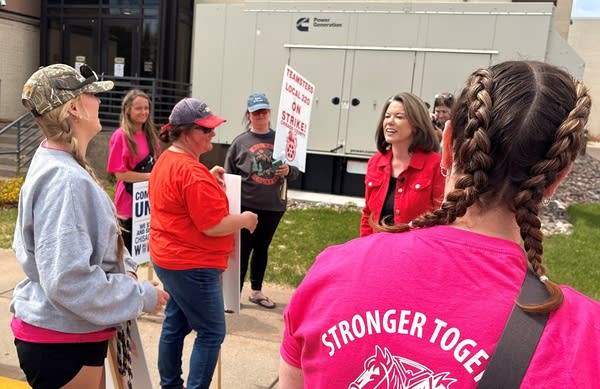
In early May, Craig joined a union picket line of striking Chisago County workers in Center City, an exurban town where Republicans usually dominate. It's the kind of place she isn't shy about going.

“My commitment to you is that I will always protect the right to organize and collectively bargain in this country, and that I will always show up on the damn picket line with you,” she said.

Craig has racked up substantially more money. But her haul often draws criticism from Flanagan, who emphasizes that she won't take money from corporate-connected political funds.

“If billionaires and big corporations can buy this seat, it will tell politicians everywhere that playing it safe is what gets rewarded,” Flanagan said.

Craig underscores how expensive the race will get as national Republicans eye Minnesota as a pickup target. She says she knows what a tough race takes.

“I've had $50 million spent against me by Republicans over the last 10 years, while I've been fighting every single election cycle to hold my seat in the second district and help Democrats hold the House majority,” Craig said.

The lack of a competitive convention race for Senate will lower the temperature in Rochester.

There are other races to be decided. Multiple DFL candidates are vying for an open state auditor spot — another choice for delegates this weekend.

Sen. Amy Klobuchar waves after a ribbon cutting ceremony, holding a piece of ribbon.
U.S. Sen. Amy Klobuchar holds a piece of the ribbon from the ribbon cutting celebrating healthcare company Solventum's new research and development hub in Eagan on April 1.
Cait Kelley | MPR News

Meanwhile, Klobuchar is the clear favorite to wrap up the party's backing for governor, but could face some skepticism from the more progressive wings of the party.

There are several challengers also looking for the DFL nod, but none that have Klobuchar’s name recognition or history in the state.

Klobuchar has a significant fundraising advantage over all of the Republicans seeking their party’s nomination. A low-strain endorsement and primary contest would allow her to conserve money and get organized for the fall campaign while the GOP field needs narrowing.

She’s likely to pick a running mate either before or at the convention.

Incumbent Attorney General Keith Ellison faces one DFL challenger, Dave Madgett, who served as a judge advocate general in the Air Force and has been in private practice for nearly two decades.

Incumbent Secretary of State Steve Simon is so far running unopposed for the DFL endorsement as he tries for a fourth term.

The DFL convention in Rochester begins Friday and runs through Sunday. The GOP convention in Duluth also begins Friday.


Source link