The Minneapolis City Council voted 9-2 on Thursday with one abstaining to repeal the longstanding ban on adult bathhouses and businesses where people can have sex in the city. The vote comes after work from advocates, city staff and council members who say the ban is rooted in homophobia.
The final step to repeal the ban is a signature from Mayor Jacob Frey, who previously told MPR News he supports the repeal.
Adult bathhouses are community spaces that were historically frequented by gay men in the 1970s and ‘80s where people could engage in sexual activity or relax after going out to bars. They were banned in Minneapolis in 1988 during the AIDS epidemic.
Council members LaTrisha Vetaw, Linea Palmisano and Michael Rainville joined the six co-authors in voting to repeal the ban.Council member Jamison Whiting, who previously voiced his support for repealing the ban, was absent and council member Jamal Osman abstained.
Council member Jason Chavez, the only out LGBTQ+ member of the council, was a co-author for the pair of ordinances to repeal the ban and worked with the Safer Sex Spaces coalition, an organization dedicated to overturning the ban.
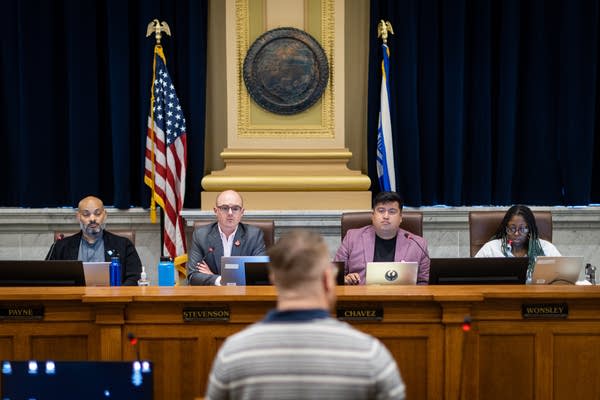
He spoke ahead of the vote, mentioning former council member Brian Coyle, a gay man who voted for the ban in 1988.
“Today is the first step and it will not be the last. And it is an important one,” he said. “I believe if Brian Coyle was here with us today with everything we know about public health he would be standing with us proudly and me on this council so I would not feel alone taking this vote.”
Council members emphasized that the vote doesn’t mean that bathhouses will become legal and ready to open immediately. Instead, it is the beginning of a long and technical process that sets the city up for a pathway to consider permitting bathhouses and other sex venues in the future.
How Minneapolis came to repeal the ban
The work for the repeal has been on and off for several years.
A few years ago, while working as a policy aide for the Minneapolis City Council, Claire Kingstad got an email from Phil Duran, the former legal director for OutFront Minnesota. People at the time were talking about Embrace North, a sauna in Linden Hills facing problems in part because of a different zoning code restricting saunas and bathhouses to downtown Minneapolis, and Duran wondered if Kingstad knew about his previous work attempting to repeal the bathhouse ban.
Duran and Karri Joe Plowman, the founder of Twin Cities Leather, worked together in 2017 to try to repeal the ban. Their work never came to an official vote. Plowman said while some people knew sex was happening in social group settings, they didn’t want to talk about it.
“That’s what I was saying in 2017, we deserve to be safe in a commercial space. And the city has a responsibility to make sure that space is safe. They do not have a responsibility to tell us what we can do in that space,” Plowman told MPR News in March.
Kingstad and Ben Carrier, another policy aide, created the Safer Sex Spaces Coalition. The two worked together in 2023 to amend the code, changing language that reflected advancements in treatment and prevention to HIV and removing language that advocates called stigmatizing to same-sex couples. All 13 council members voted in favor of the new language. Kingstad and Carrier also both worked closely with sex workers in the city who were in favor of the repeal.
For this most recent effort, the council ended up pursuing two separate ordinances to remove the ban and move building standards for sex venues under the same rules that govern strip clubs.
Repeal opens door for city to consider permitting bathhouses
Minneapolis had three adult bathhouses at its peak, and in 1979 police raided Locker Room Baths which later became known as the largest adult bathhouse raid in U.S. history. Locker Room was renamed 315 Health Club and closed just one day before the ban passed in 1988.
Chavez said that if Frey signs the repeal, then he will start the long process of working with staff to begin the zoning, planning and regulations component of a framework for an adult bathhouse in Minneapolis.
Any proposed ordinances to establish a framework for licensing adult bathhouses would again go in front of the council for feedback, public hearings and votes.
San Francisco in 2021 overturned its AIDS-crisis-era ban on sex in private rooms inside businesses, and in 2022 created “adult sex venue” zoning legislation. Some cities that never banned them to begin with, including nearby Chicago, already have bathhouses.
Public attitude toward bathhouses has evolved as HIV and AIDS prevention and treatment has improved. The medication PrEP, when taken consistently, reduces the chance of contracting HIV by about 99 percent. According to KFF, the number of new HIV infections declined by about 76 percent between 1984 and 2022.
In 2018, the city of Minneapolis signed on to be a fast track city and take on initiatives to end HIV. It follows the 90-90-90 goal, meaning 90 percent of people living with HIV are aware of their status, 90 percent of people diagnosed are on antiretroviral therapy and 90 percent of people on medication achieve viral suppression. The year to hit the goal is 2030, and Dylan Boyer, the development director for the Aliveness Project, said he isn’t sure the city will reach that goal. But, he thinks the bathhouse repeal could be part of the solution.
“These are big goals, it is going to take bold change, bold and radical change,” Boyer said. “[Bathhouses are] one of those spaces that we can really connect with folks that are on the outskirts of that care, and not knowing their status and not knowing what prevention looks like for them. This is a population that we’re able to tap into, that we are not currently able to reach.”