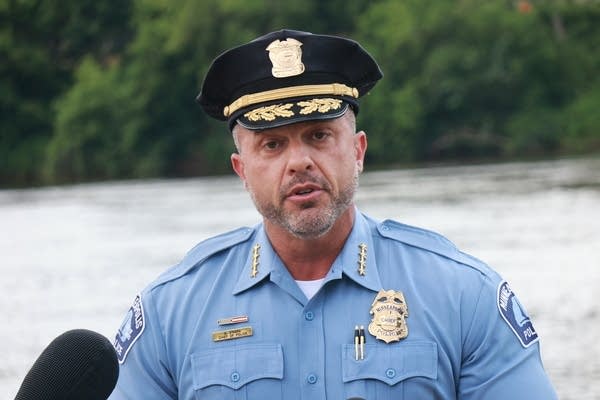

Minneapolis Mayor Jacob Frey is pushing back against a chorus of criticism from members of the city council over his handling of investigations into former police Chief Brian O’Hara, who resigned Tuesday after an outside investigation found that he likely interfered with investigations into his conduct.
Some Minneapolis council members are blaming Frey for a lack of transparency during the investigations and for nominating O’Hara to continue serving as police chief earlier this month, despite an active investigation into his conduct.
Council President Elliott Payne said Wednesday that the chief’s resignation was the right outcome, but that he’s concerned about the lack of transparency and accountability, including that the mayor renominated O’Hara to serve as police chief in early May despite the ongoing investigation into his conduct.
Payne said council members weren’t informed about the initial investigations or their findings.
“For us to do our oversight job, we need information, we need to know about allegations, we need to know about open investigations, we need to know about closed investigations, regardless of what their outcomes are,” Payne said.
The council president called for Frey to share the full results of last year’s investigations into O’Hara and to work closely with the council to identify new leadership for both the police department and the city’s Office of Community Safety. The council recently voted twice to reject another term for Community Safety Commissioner Todd Barnette.
O’Hara was investigated last year over allegations that he had sexual relationships with subordinates employed by the city. Two reports last summer by the law firm Forsgren Fisher McCalmont DeMarea Tysver LLP failed to substantiate those allegations. But new evidence emerged in December, which the law firm’s investigators followed up on after “Operation Metro Surge” ended.
Investigators this week concluded that O’Hara likely interfered in the initial investigation by deleting a contact off his work phone and discussing the investigation with at least one employee. Frey said in a written reprimand to O’Hara on Tuesday that interfering with the investigation “constitutes a significant breach of trust.” Frey said O’Hara offered his resignation.
Council Member Robin Wonsley said Wednesday that Frey should have followed the examples of other local police departments and put O’Hara on administrative leave when allegations triggered investigations.
“Mayor Frey continues to be unable to effectively manage the Minneapolis Police Department,” Wonsley said. “Though Frey has deflected this mismanagement over MPD to one chief after another, as well as on to one safety commissioner after another, the blame for the department's continued instability lies within Mayor Frey himself.”
Frey said in a statement to MPR News that he doesn’t take actions based on rumors or anonymous complaints. Frey’s office said he waited to inform the council until discipline against the chief was final, meaning it was public.
“I took action promptly after receiving the investigative report with substantiated findings. That’s accountability,” Frey said. “But decisions this serious have to be grounded in facts, evidence and completed investigations. Anything less would be irresponsible.”
Frey’s office said that he’s proud of how the investigation was handled, and that both he and Community Safety Commissioner Todd Barnette, who oversees public safety including police in the city, worked to ensure there was a thorough investigation from the time the original complaint was made.
Frey’s office said he’s committed to working with the council on the search for the next chief.
Council Member Jason Chavez said Wednesday that he was already concerned before the investigation emerged that Frey had moved forward with O’Hara’s nomination because of revelations that the police department went over budget last year by $20 million and questions about the department’s handling of recent cases, including the killing of Allison Lussier.
“The part that is often left out of the conversation here is that Mayor Frey has complete control over the Minneapolis Police Department,” Chavez said. “If this episode shows us anything, it's that Mayor Frey's judgment should be called into question.”
Assistant Chief of Operations Katie Blackwell will serve as acting chief as the city searches for a permanent replacement who can pass muster with the council.
A statement from O’Hara’s attorney Doug Kelley heralded the former chief’s efforts to rebuild the department following George Floyd’s killing in 2020 and the chief’s efforts to navigate Operation Metro Surge this winter.
“The circumstances of Chief O’Hara’s departure should not define his service,” attorney Doug Kelley said in a statement. “He understandably looks forward to returning to his young family in New Jersey.”