Prominent U.S. executives from Big Tech and Wall Street to agriculture and aerospace are joining President Donald Trump on his trip to China this week, according to a White House official.
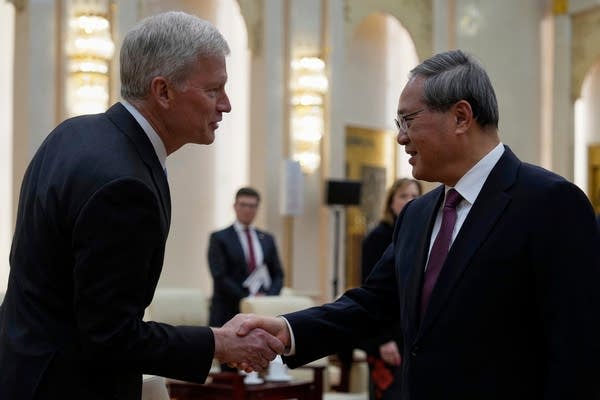
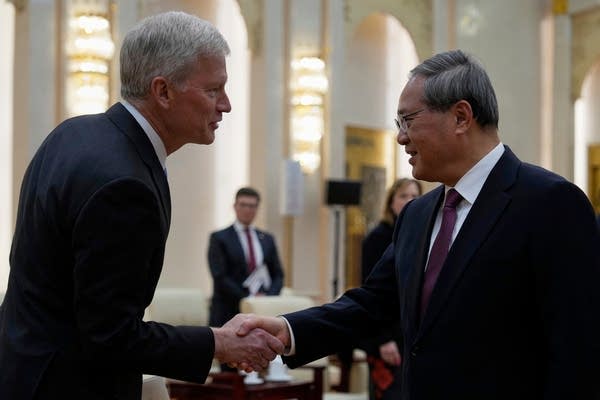
That includes Brian Sikes, chairman and CEO of Minnesota-based food and agricultural giant Cargill.
Trump is expected to arrive in Beijing Wednesday to meet with President Xi Jinping. Aside from discussions about Iran, the two leaders are expected to discuss trade and artificial intelligence.
Sikes has served as CEO of Cargill since 2023 and was elected as board chairman in 2024. He’s been with the company for 35 years. Cargill has more than 155,000 employees in 70 countries, including more than 5,000 employees in China.
Cargill has operated in China for decades, with the company listing business interests in agriculture, food products, energy, metals, transportation and other sectors.
Here’s a look at some of the other executives, according to the White House official, who was not authorized to comment publicly and spoke on the condition of anonymity.
Elon Musk
Musk, CEO of Tesla and SpaceX, led Trump's Department of Government Efficiency until leaving in the spring of 2025 before the controversial pop-up agency was shuttered in November. The billionaire, who also owns the social media platform X, feuded with Trump last summer in a war of words that included Musk claiming without evidence that the government was concealing information about the president’s association with infamous pedophile Jeffrey Epstein. Musk eventually said that he regretted some of his posts on X about Trump.
Since then, Musk has refocused his energy on Tesla and his other companies. Tesla has operations in China and Musk has visited there. He’s also been dealing with French prosecutors seeking charges against him and X for child sexual abuse images on the platform, deepfakes, disinformation and complicity in denying crimes against humanity by the platform’s artificial intelligence system, Grok. There’s also a trial pitting Musk against OpenAI CEO Sam Altman.
Tim Cook
Cook remains busy as his tenure at Apple winds down. The CEO announced last month that his 15-year reign as the head of the technology company will come to an end on Sept. 1, when he turns the CEO duties over to Apple’s head of hardware engineering, John Ternus. During Cook’s years as the top executive, Apple saw the its market value soar by more than $3.6 trillion during an iPhone-fueled era of prosperity. Cook will remain with the company as executive chairman.
Apple’s reliance on overseas manufacturing required Cook to master the art of political diplomacy, particularly while Trump waged trade wars with China during both his terms in the White House. After persuading Trump to exempt the iPhone and other products from Trump’s first-term tariffs, he faced a more daunting challenge during the current administration.
While insisting that Apple shift its iPhone manufacturing from China to the U.S., Trump imposed some tariffs on the device this time around. But Cook still managed to minimize the fees by shifting the production of iPhones destined for the U.S. market to India and also winning some exemptions after promising Apple would invest $600 billion in the U.S. during Trump’s second administration.
Jensen Huang
Nvidia CEO Huang heads to Beijing just months after the company received approval to sell one of its powerful AI chips to China, with conditions.
In January the Trump administration placed new security requirements on Nvidia’s semiconductor sales to China, but essentially greenlit the export of its H200 artificial intelligence chips.
Nvidia must ensure that there is an adequate supply in the U.S., and the H200 chips must undergo a third-party review before being exported to China, according to new rules set by the Commerce Department’s Bureau of Industry and Security. But the new rules lower the bar for exports.
China won’t be allowed to use the chips for military purposes and is not allowed to import more than 50 percent of the chips sold to U.S. customers.
The H200 is not Nvidia’s most advanced product. Those chips, called Blackwell and the upcoming Rubin, were not part of the approved chips for export.
Kelly Ortberg
Robert “Kelly” Ortberg, a former CEO at aerospace manufacturer Rockwell Collins, became CEO of Boeing in 2024. He’s spent time focusing on Boeing’s recovery, as the aerospace company was dealing with legal, regulatory and production problems and mounting financial repercussions when he took over.
A year ago Ortberg said that he didn’t expect the U.S. trade war with China to forestall Boeing’s financial recovery, nor prevent it from reaching aircraft delivery targets with Chinese airlines that were refusing to accept its planes. Beijing increased its import tax on American goods to 125 percent in April 2025 in retaliation for Trump raising the tariff on products made in China to 145 percent. China’s tariff would more than double the cost of passenger jets that Boeing, the largest exporter in the U.S., sells for tens of millions of dollars. But Beijing is less of a threat to Boeing now that it used to be, as it has started to send fewer of its finished planes there over time.
Boeing has been in ongoing talks with China over a possible large aircraft sale.
Who else is going
-
Blackrock Chairman and CEO Larry Fink
-
Blackstone Chairman, CEO and co-founder Stephen Schwarzman
-
Citi Chairman and CEO Jane Fraser
-
Coherent CEO Jim Anderson
-
GE Aerospace Chairman and CEO H. Lawrence Culp
-
Goldman Sachs Chairman and CEO David Solomon
-
Illumina CEO Jacob Thaysen
-
Mastercard CEO Michael Miebach
-
Meta President and Vice Chairman Dina Powell McCormick
-
Micron Chairman, President and CEO Sanjay Mehrotra
-
Qualcomm President and CEO Cristiano Amon
-
Visa CEO Ryan McInerney