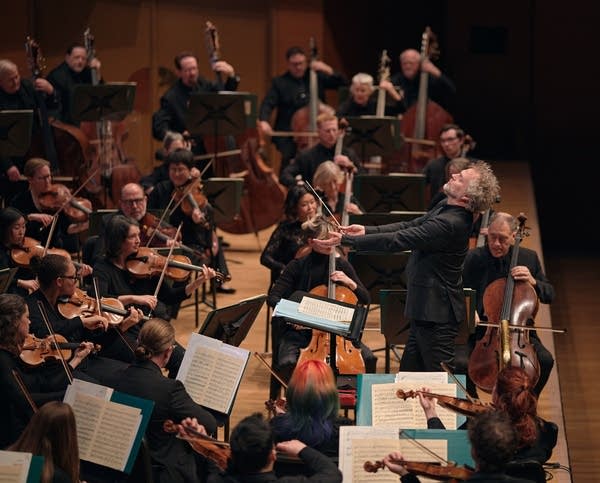
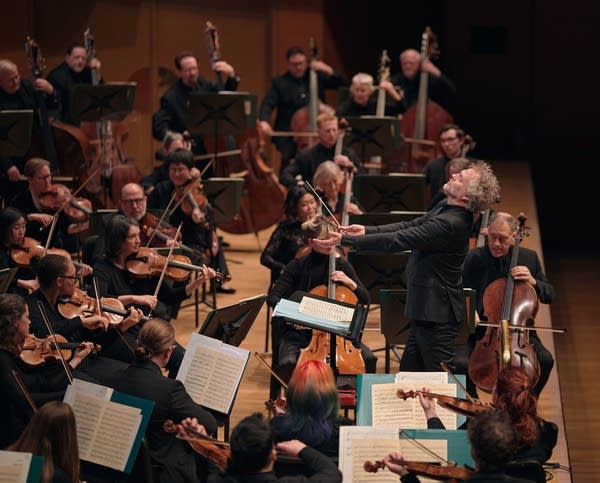
The Minnesota Orchestra welcomed 2026 with its annual “Nordic Soundscapes Festival” in January. With music by Jean Sibelius and Hans Abrahamsen, the festival was a bright spot of warmth during winter.
Lurking in the shadows, however, was the news that the Minnesota Orchestra was in a $4.2 million deficit from its previous fiscal year.
“We have very high fixed costs because we have a full-time orchestra,” said Isaac Thompson, who took over as the orchestra’s CEO and president in October 2025.
In fiscal year 2025, the orchestra had a higher audience attendance than previous seasons, returning to numbers similar to those pre-pandemic. They also saw a bump in revenue and a slight reduction in expenses. Still, the scales didn’t balance for the second year in a row.
“There is a structural kind of disconnect between those; the revenue piece, and the expense piece,” Thompson explained.

A look at new revenue streams
In an effort to close that structural gap, Thompson is exploring other revenue options for the orchestra. He’s been looking at models from other major orchestras, such as the Los Angeles Philharmonic and Cincinnati Symphony Orchestra.
“The Los Angeles Philharmonic has the Hollywood Bowl, which is a huge cash cow for them,” Thompson said.
The Hollywood Bowl is a major amphitheater in California that offers a variety of programs. The Minnesota Orchestra has invested in its own outdoor venue, the Community Performing Arts Center amphitheater in north Minneapolis.
“We’ve invested in that venue, and there will be a revenue piece of that, that comes back to the orchestra,” Thompson said.
The venue is part of the large Upper Harbor redevelopment project and will be operated jointly by the orchestra and music venue First Avenue.
“But also even beyond that, it helps kind of broaden the orchestra's brand into the community,” Thomson said. “We're also looking at opportunities like, what is our role within downtown Minneapolis? How can we activate the areas around Orchestra Hall?”

Putting the art front and center
The organization is also looking at cutting costs by changing hiring practices for personnel brought in for special programs. During certain times in a season, the orchestra has to hire extra musicians to meet the needs of a particular performance.
“When you do a massive Mahler symphony, it requires a different kind of set of forces than when you do, you know, a Haydn symphony,” Thompson said. For example, some of Joseph Haydn’s symphonies can be performed by a couple dozen performers, while Gustav Mahler’s 8th symphony requires over 100 musicians, a choir and several vocal soloists.
Thompson said these decisions will not affect programming, but that the change in process will save the orchestra an estimated $2 million over the next two years.
“There's going to be more due diligence in terms of making sure that we're certainly hiring for each of those pieces, but we're not necessarily going beyond that,” Thompson said.
That decision was part of the recent bargaining agreement that the orchestra and its unionized musicians came to in April.
“The organization is in a financial situation that we all understand, and need to help out as much as we can,” said R. Douglas Wright, the orchestra’s principal trombone and a member of the negotiating committee.
“I think that we've come to an agreement that really threads that needle between the financial issues, but at the same time protecting and growing the art form.”
That sentiment is something that both the musicians and Thompson seem to have in mind.
“[Thompson] has let it be known since he got here that the art is going to be front and center,” said Timothy Zavadil, a clarinetist/bass clarinetist who’s been with the orchestra since 2007.
“He is obviously much more well versed on the financial side of things than we are. We feel like we have a partner in understanding the artistic needs for the organization too.”
How the orchestra’s past affects its future
The new union contract also increases musicians' pay 2.5 percent annually for the next two years.
The agreement is a far cry from the infamous lockout in the early 2010s, triggered by a $6 million deficit at the orchestra. In an effort to shore up the deficit, the orchestra proposed massive pay cuts for its unionized musicians.
When the players rejected that plan, the organization locked them out for 15 months — leading to a whole season of canceled performances. MPR News reported at the time it was the nation’s longest running labor dispute at a concert orchestra.
“I think what came out of the lockout is a strengthening of the partnership between the orchestra and the community,” said Zavadil, who also serves on the union’s negotiating committee.
“I think what we learned after the lockout is that this entire organization — and I am including musicians, staff, board and just as important is our audience — we have all come together and taken ownership of this organization to create something that is bigger than ourselves,” he said.