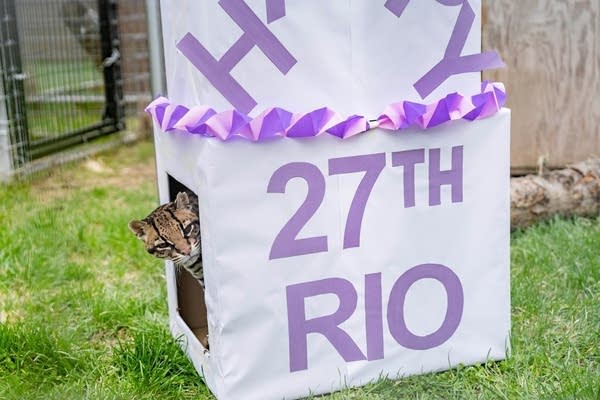
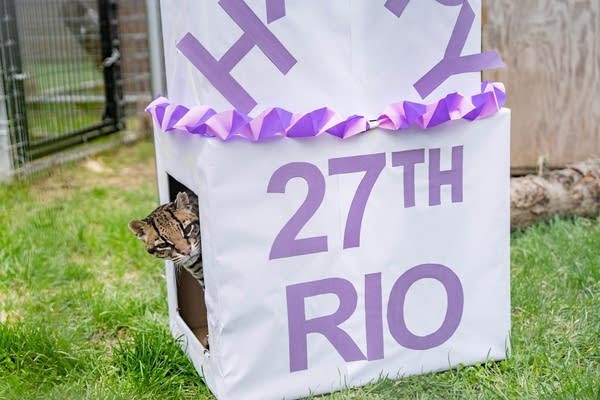
Rio the ocelot, a medium-sized wildcat living in a Minnesota sanctuary, celebrated her 27th birthday on Thursday, an impressive achievement because ocelots usually only live seven to ten years in the wild.
Staff and volunteers at the The Wildcat Sanctuary in rural Sandstone gave the 25-pound cat, which looks like a mini jaguar or leopard, a three-tiered “cake” made of boxes to play with, and one of her favorite treats.
“She got her favorite ‘bloodscile’ cake, which is frozen blood and chicken pieces, so gross for us but happy for her,” said Tammy Thies, founder and executive director of The Wildcat Sanctuary.
“It was really fun to watch her enjoy it all. She got a big party with enrichment and extra treats. We're thankful that we were able to provide her final retirement years."
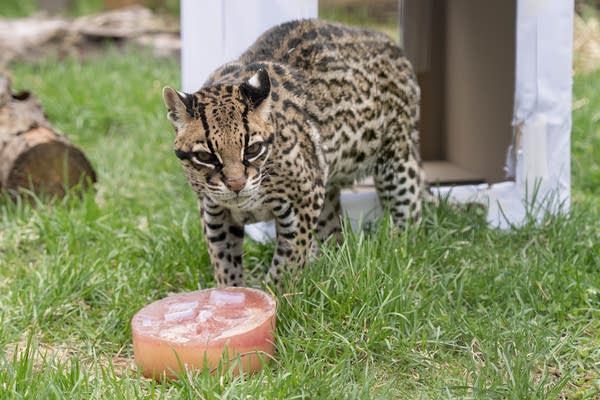
While she was especially spoiled on her big day, Rio and the 150 or so other cats at The Wildcat Sanctuary have become used to special treatment.
“Every day she gets whatever she wants. We are her servants, just like every other cat here at the sanctuary,” said Thies.
The nonprofit rescue sanctuary is not open to the public but is a natural and spacious safe haven for wildcats in rural Sandstone, about 90 miles north of the Twin Cities. Many of the cats, including big ones like lions, tigers, snow leopards, cougars and jaguars, as well as small and medium sized wildcats, like bobcats, lynx and ocelots, cannot survive in the wild because they were bred in captivity.
Thies says these exotic animals are all too often owned by people who abuse the cats or just fail to give them proper care because it can very expensive to properly house and feed them.
“We have a big cat and small cat crisis in the U.S., where people are captive breeding animals for entertainment, exploitation, cub petting,” said Thies. “If they've had them as a pet, they've never been seen by a vet, they might have not had proper nutrition.”
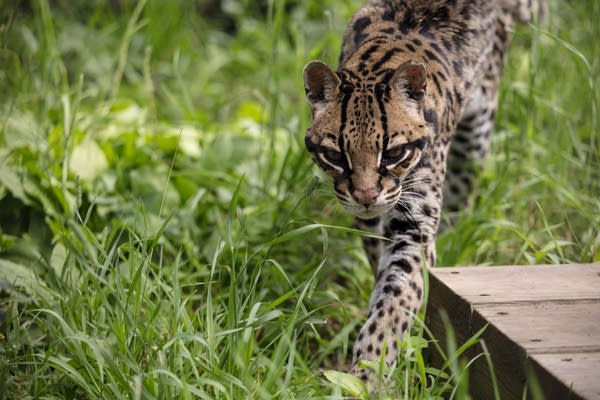
Rio has been around people her whole life, first in a species survival breeding facility for a conservation program in Texas, and then as a display animal in a zoo, before coming to her final home at the sanctuary two years ago.
Although ocelots are classified as being of “least concern” globally, meaning their population numbers are relatively strong, Rio’s species is considered endangered in some parts of the world, including Texas and parts of Mexico. One of the main threats they face is habitat destruction.
Thies says Rio has a big personality. If a sanctuary worker goes near her enclosure she will start making vocalizations, encouraging them to give her some attention.
“She'll do everything to get attention to make sure she's the focal point, and she sure deserves it,” said Thies.