Minnesota's Green energy growth slows, coal use is up


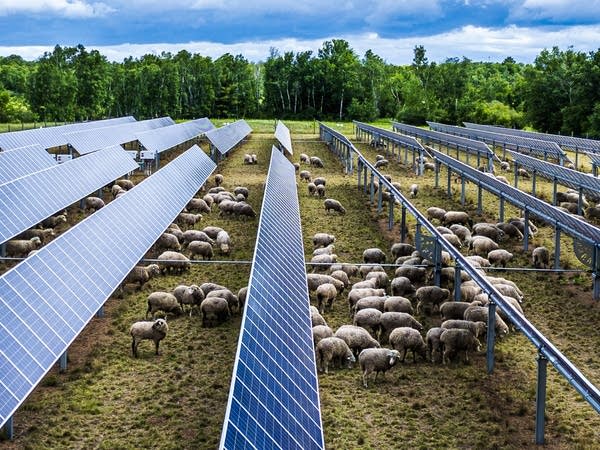
Sheep graze under solar panels

The majority of electricity used in Minnesota continues to come from carbon-free sources, but the growth of green energy generation has slowed, while the use of coal grew over the past year, according to a report released this week from Clean Energy Economy Minnesota and the Business Council for Sustainable Energy.

Zero-carbon sources including wind and solar power and nuclear energy supplied 55 percent of Minnesota’s electricity in 2025. That’s well over the national average of 43 percent, and it’s the sixth straight year clean energy has supplied more than half of the state’s power.

“Minnesota continues to be a leader at the forefront of the energy transition,” said Gregg Mast, executive director of Clean Energy Economy Minnesota at an event Thursday announcing the release of the 2026 Energy Factsheet.

But the total of the state’s electricity coming from renewable sources has remained flat since 2022. And significant growth is needed for the state is to meet its mandate to produce 100 percent of electricity from carbon-free sources by 2040.

Renewable sources have generated one-third of the state’s electricity for the past three years. Over the past year, the share of the state’s electricity generated by coal grew from 20 to 24 percent— although looking back over the past decade, the use of coal has dropped by 15 percent.

Nuclear energy’s use ticked up two points to 22 percent over the past year, and has held fairly steady over the past decade. Natural gas, which burns cleaner than coal but still produces greenhouse gas emissions, declined from 27 to 21 percent of the state’s energy mix last year. But over the past decade, the state’s use of gas has grown by eight percent.

The state’s greenhouse gas emissions held steady over the past year, after three consecutive years of declines. Minnesota has cut emissions nearly in half over the past 20 years, outpacing the national reduction of 38 percent.

Despite that progress, the state is not on pace to meet its goal of cutting greenhouse gas emissions in half by 2030, compared to 2005 levels, and to reach net-zero emissions by 2050.

Renewable energy development in Minnesota and nationwide has faced significant hurdles in President Donald Trump’s second term. The federal government has terminated billions of dollars in grants for renewable energy and electric grid modernization projects.

“Minnesota is not arguing, we are transitioning. It is only Washington, D.C. that is arguing against the clean energy transition,” said Pete Wyckoff, deputy commissioner of energy resources at the Minnesota Department of Commerce.

Still, headwinds remain. Residential solar installations, for example, have slowed since the federal government eliminated tax credits for them, said Marty Morud, president of TruNorth Solar in the Twin Cities.

“The phone has not been ringing nearly as often this year as it was last year,” said Morud, who added that some some homeowners have to wait years for utilities to interconnect their solar systems to the electric grid.

But Minnesota is part of a global trend showing a rapid transition to renewable energy, said Wyckoff. Around the world, wind and solar met 99 percent of new energy demand last year, Wyckoff said.

In Minnesota, wind and solar accounted for 98 percent of all new electric generation capacity added in the past five years. The state added 264 megawatts of new solar capacity in 2025, nearly ten times the amount of natural gas added to the state’s energy mix.

“In Minnesota, we don't tilt at windmills,” Wyckoff said. “We erect wind turbines, and more recently, solar panels, and we dig geothermal wells.”


Source link

Leave a Reply

Subscribe to Our Newsletter

Get our latest articles delivered straight to your inbox. No spam, we promise.

Recent Reviews


A Republican lawmaker charged in an alcohol-related driving offense won’t have to appear in court again until after the Legislature adjourns for the year.

A June 10 arraignment hearing is set for Rep. Elliott Engen, a Lino Lakes Republican who faces three misdemeanor charges following an arrest early Friday. He was stopped for speeding and other infractions in White Bear Lake; officers detected alcohol and he later tested well above the legal limit for driving, according to a citation.

Engen has apologized for a lapse in judgment; he promised to learn from his actions and “do better.” Aside from being a second-term legislator, he is also a candidate for state auditor.

A second lawmaker, GOP Rep. Walter Hudson, was in Engen’s truck at the time of the stop and an open bottle of alcohol was found in a rear seat. Hudson, a second-term legislator from Albertville, was in possession of a permitted handgun, which could cause him legal problems if he is determined to have been intoxicated.

Police officers wrote in their report that Hudson disclosed he had the gun as the truck was being searched. The report said police took the firearm for safekeeping and said he could pick it up at a later time, which Hudson agreed to.

“I regret the poor decisions that were made during this incident, and commend the White Bear Police Department for their professional response,” Hudson said in a written statement. “I’m grateful that no harm was done to ourselves and others.”

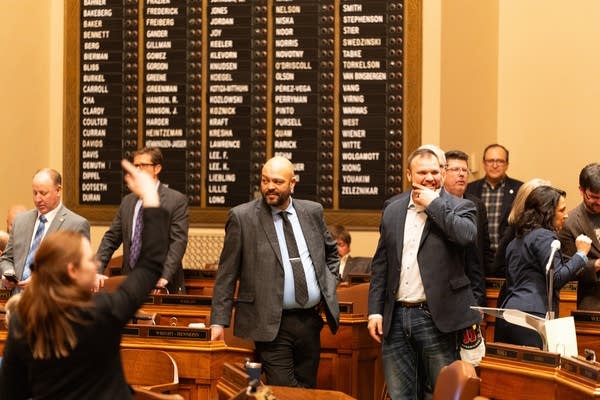
Two lawmakers stand and look around
Rep. Walter Hudson, R-Albertville, (center) and Rep. Bidal Duran, R-Bemidji, (right) join other Republican lawmakers gather in the House chambers Jan. 27, 2025.
Tim Evans for MPR News file

A third, unidentified passenger was in the truck as well, according to police. Hudson and that person were transferred to the police department until they could arrange rides.

The Minnesota lawmakers had been at the Capitol late into the evening Thursday as the House debated procedural motions on gun, immigration and social media legislation. The motions failed on 67-67 votes.

There is no indication yet that either Hudson nor Engen had been drinking on Capitol grounds, which would be a violation of a House rule against consumption of alcohol or drugs in spaces under that chamber’s control.

According to a White Bear Lake Police report, Engen initially said he had not been drinking when asked by the police officer who pulled him over — “nothing at all,” he is quoted as saying. He performed a field sobriety test, which the report says showed signs of impairment.

Engen gave a preliminary breath sample there, the report says, which estimated a 0.142 blood alcohol level. After he was taken by squad car to the police department “Engen spontaneously stated, ‘Sir, I had a drink three hours ago,’” the report says.

He told the Minnesota Star Tribune in an interview Monday that he had also consumed alcohol in the afternoon on Thursday as well.

Engen is charged with two impaired driving offenses and speeding. White Bear Lake police also said he was driving a vehicle with expired registration and an inoperable headlight.

Engen has not returned calls from MPR News. A court docket lists a “notice of appearance” on Tuesday.

He is being represented in the criminal case by Chris Madel, an Excelsior attorney who waged a brief Republican campaign for governor.


Source link