Postal Service releases special edition bald eagle stamps for America's 250th


Eagle Stamps

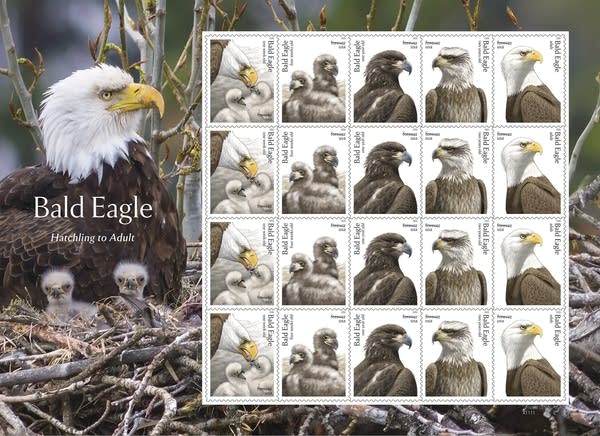
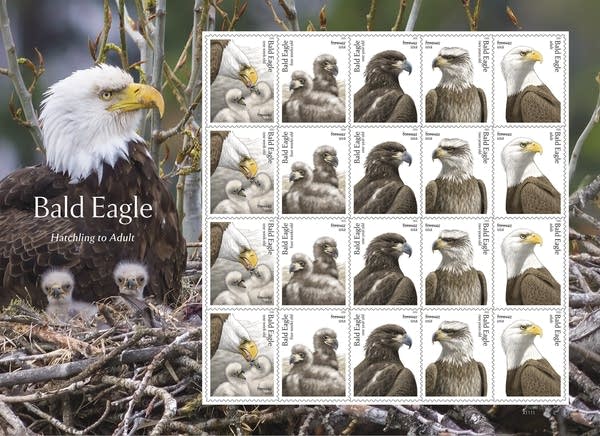
For America's 250th birthday, the U.S. Postal Service is releasing special edition stamps featuring one of the nation's icons: the bald eagle.

The stamps unveiled Thursday at the National Eagle Center in Wabasha, Minnesota, showcase the bird across five major life stages, from a fuzzy hatchling to the iconic white-headed adult depicted on the country's seal. They were available for immediate purchase across the United States.

“The fact that we’re seeing the eagles in all different stages of its life, it’s sort of making us look back at the stages of the life of our country,” said Steve Kochersperger, a historian at the Postal Service. “At one time, we were just fuzzy little hatchlings, too.”

The bald eagle has been a national emblem since Congress adopted the Great Seal in 1782, though it wasn't designated the national bird until 2024.

The bird has long symbolized American values like strength, freedom and independence, said Kochersperger. At the top of the food chain, the bald eagle dominates in the sky alone with its impressive wingspan and sharp talons.

Some believe Benjamin Franklin wanted the wild turkey to be the national bird because the eagle steals food from other birds, but Kochersperger said that's a myth.

There's another reason why it makes a strong American symbol: the bald eagle is a major conservation success story. In the 1960s, eagles became a rare sight in the U.S. because of poisoning by the pesticide DDT.

But that decline was reversed, thanks to a 1972 DDT ban and the bald eagles' listing as an endangered species in 1978.

“The public relations campaign brought greater awareness that, ‘Hey, this is our national symbol, but they may all be gone if we don’t change our ways,’” Kochersperger said. “And that turned out to be very effective.”

In 2007, the bald eagle was removed from the endangered list, and there are now more than 300,000 eagles in the continental United States, according to the U.S. Fish and Wildlife Service.

David Sibley, the Massachusetts-based artist and bird watcher behind the stamp collection, said the conservation story is part of what makes him think of the bald eagle as a symbol.

“Maybe seeing a bald eagle on the stamp as a bird, living its life from nestling to adult, will hopefully make people think about the natural world and how important things like eagles are, not as a symbol but as part of the ecosystem around us,” he said.

Sibley spent nearly a year working on the digital illustrations for the collection. As someone who usually draws life-sized birds, the tiny stamp size was perhaps the biggest challenge, so he chose to focus on the bald eagle’s head to show as much detail as possible.

Postage stamps have long served as a way to celebrate holidays and highlight American culture, but they can also be educational, if you look closely.

“A stamp does not demand your attention, but it rewards it,” Kochersperger said. “A tremendous amount of planning and effort went into producing that tiny little piece of paper.”


Source link

Leave a Reply

Subscribe to Our Newsletter

Get our latest articles delivered straight to your inbox. No spam, we promise.

Recent Reviews


Speaker of the House Mike Johnson, R-La., takes questions at a news conference at the U.S. Capitol on April 21, 2026.

Speaker of the House Mike Johnson, R-La., takes questions at a news conference at the U.S. Capitol on April 21, 2026.
Speaker of the House Mike Johnson, R-La., takes questions at a news conference at the U.S. Capitol on April 21.
J. Scott Applewhite | AP

The House of Representatives voted Thursday to reopen most of the Department of Homeland Security, ending the longest agency shutdown in U.S. history.

The House passed a bill funding DHS, minus dollars for Immigration and Customs Enforcement and Customs and Border Protection. The measure passed by voice vote on what was the 76th day of the shutdown.

Democrats refused to back funding for many of the agency's immigration functions in an unsuccessful effort to secure reforms including body-worn cameras and broad restrictions on face coverings after federal law enforcement killed two American citizens in Minnesota earlier this year.

The Senate, led by Republican Majority Leader John Thune, R-S.D., unanimously advanced this funding legislation in March. At the time, Speaker Mike Johnson, R-La., referred to the proposal as "a joke" and refused to bring it up for a vote. Many members of the House Republican conference refused to fund the agency in a piecemeal fashion and did not want to negotiate over reforms to immigration enforcement operations.

On April 1, Johnson reversed course. He announced the funding bill would be voted on "in the coming days." More than four weeks later, he finally made good on that commitment.

In an effort to appease his hardline members, Johnson waited to bring the Senate's proposal to a vote until that chamber's Republicans started the arcane procedural process, known as reconciliation, to fund all of DHS — including Immigration and Customs Enforcement (ICE) and Customs and Border Protection (CBP) — for the remainder of Trump's term without any backing from Democrats.

The funding bill comes as Secretary of Homeland Security Markwayne Mullin warned the agency was close to running out of funds to pay staff.

"We have reached all the emergency funds we can reach into," Mullin told Fox News on Friday. "I am completely out of the slush fund, I have no place to move at the end of the month."

Mullin said the agency was relying on appropriated funds from last year's One Big Beautiful Bill, which allocated more than $150 billion to DHS on top of its regular annual appropriations funding.

President Donald Trump signed a memo this month authorizing DHS to use some of the money from that legislation to fund the department's operations — potentially infringing on the powers granted to Congress by the Constitution to direct how taxpayer money is spent.

Copyright 2026, NPR


Source link