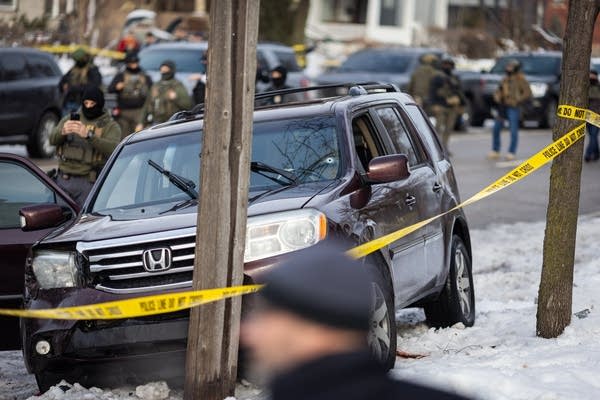
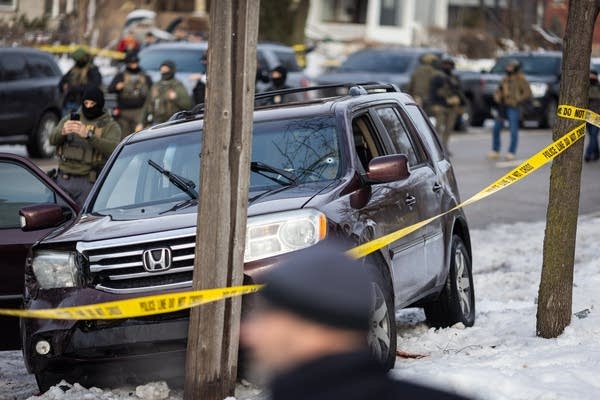
The widow of Renee Good is asking a judge to force the federal government to return the vehicle that Good was driving when an ICE agent fatally shot her.
In a Friday court filing, Becca Good argued the Honda Pilot belongs to her, and she needs it to pursue a potential lawsuit.
Renee and Becca Good were returning home on Jan. 7 from dropping their 6-year-old son at school. They stopped along Portland Avenue in south Minneapolis to observe and protest ICE activity.
Becca got out of their Honda Pilot and recorded video while taunting the masked men. Renee remained in the driver’s seat and confronted Agent Jonathan Ross as he held up a phone and recorded his own video that captured what would be Good’s final words.
“That’s fine dude, I’m not mad at you.”
Video that witnesses recorded shows Good steering the SUV away from Ross, but he opens fire, killing her.
The Department of Homeland Security soon called Good, 37, a “violent rioter.” At a news conference later that day, then-Homeland Security Secretary Kristi Noem continued to press the Trump administration’s contention that the agent fired in self defense.
“Our officer followed his training, did exactly what he’s been taught to do in that situation and took action to defend himself,” Noem said on Jan. 7.
The next week, then-Deputy and now Acting Attorney General Todd Blanche said there is no basis for a criminal civil rights investigation into Good’s killing.
The federal government is also refusing to cooperate with a state-level Bureau of Criminal Apprehension investigation or share any evidence.
In a filing in which Becca Good seeks the return of her vehicle, Minneapolis attorney Kevin Riach wrote the federal government has no business keeping the 2014 Honda Pilot, which Renee and Becca Good bought jointly in February 2024 with more than 135,000 miles on the odometer.
Riach wrote that 10 days after the shooting, an investigator working with family attorneys asked the FBI’s Minneapolis office about getting the vehicle back. They received no response.
Good’s attorneys wrote another letter on Feb. 3, this time to the FBI and also the Justice Department, Minnesota U.S Attorney’s Office, Homeland Security and ICE. Again, they received no response.
Attorneys’ phone calls and emails in mid-March were also met with silence.
Becca Good has not filed a wrongful death suit, but soon after her wife was killed, she retained Romanucci & Blandin, the same Chicago law firm that represented George Floyd’s family after his 2020 murder by Minneapolis police and secured a record $27 million settlement with the city.
"The valuable evidence that could be contained in Renee and Becca Good’s Honda Pilot needs to be released to those who are working to get to the bottom of what happened on January 7,” family attorney Antonio Romanucci said in a Monday statement to MPR News. “The federal government cannot at once declare that it will not investigate the shooting death of Renee Good by a federal agent and at the same time withhold key evidence from those seeking the truth.”
Riach, who’s working with Romanucci, said in the court petition federal authorities have had the Honda for more than three months but have declined the opportunity to examine it for evidence. He added that Becca Good and the BCA should have an opportunity to “ensure that there is a complete and accurate public accounting of Renee’s killing.”
Homeland Security referred a request for comment from MPR News to the FBI.
A spokesperson for the FBI Minneapolis field office said in an email the bureau is not commenting on Good’s request out of respect to the BCA’s investigation.
Good’s court filing comes a month after Hennepin County Attorney Mary Moriarty and Minnesota Attorney General Keith Ellison sued the federal government in an effort to pry loose evidence in the killings of Renee Good and Alex Pretti, and a third shooting in which an ICE agent shot and wounded Julio Sosa-Celis.
In a separate case, a federal judge in St. Paul has given the Justice Department until Friday to hand over evidence in the Good shooting. The decision earlier this month from Judge Jeffrey Bryan isn’t part of any civil suit.
It stems from the criminal case of Roberto Muñoz-Guatemala, an immigrant living in the country without authorization convicted of using his vehicle to drag and seriously injure Ross last summer.
The court isn’t expected to make the evidence public. But Bryan wrote in a court order that a magistrate judge will sift through the files to determine if anything Ross said or did on Jan. 7 could have a bearing on Muñoz-Guatemala’s defense at sentencing or form the basis for a new trial.