I have found this body of work clarifying, and not for sentimental reasons. Read together, these articles are a sustained empirical argument about where security actually comes from — and the answer they keep arriving at is not the one our institutions are organized around. Security, in the lived experience of people rebuilding after collapse, is not the capacity to repel a threat. It is the presence of functioning systems: work people can do, institutions they can trust, health they can rely on, ecological conditions that hold, a shared story that includes a future. Where those exist, communities are durable. Where they are absent, no amount of force makes a society safe.
This is the argument at the center of the book I have been writing for the past several years, and I want to make the economic version of it here, because for the impact-investing and social-enterprise readership of this magazine, the economic version is the one that should change behavior.
The mispricing
We have inherited a definition of security that is almost entirely reactive. Security, in the dominant frame, is the ability to deter, repel, or destroy a danger once it has materialized. This is the logic that organizes national budgets, insurance markets, corporate risk functions, and — though we rarely admit it — a great deal of philanthropic and impact capital as well. We fund the response to the crisis. We chronically underfund the conditions that would have made the crisis less likely.
The result is one of the largest and least-examined misallocations of capital in the modern economy. And unlike most claims about misallocation, this one is quantifiable.
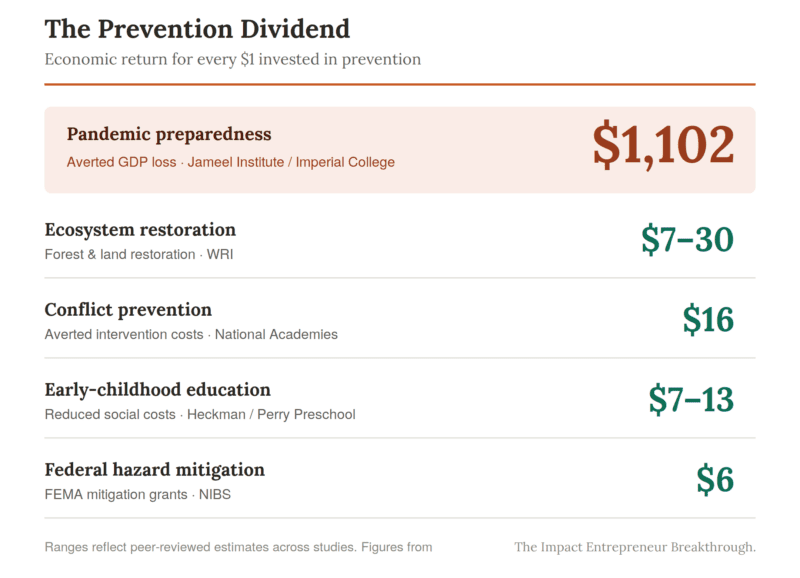
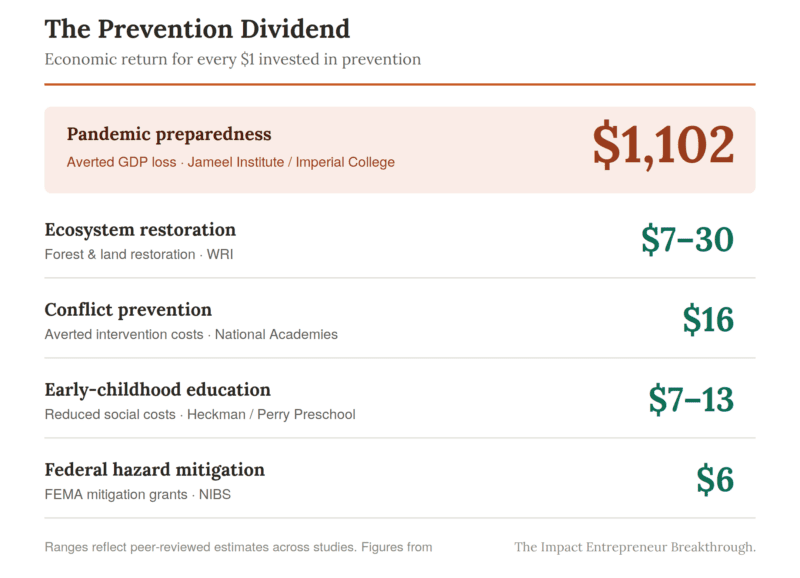
The Prevention Dividend: Across public health, ecology, education, disaster mitigation, and conflict prevention, the return on investing before crisis far exceeds the cost of responding after systems fail.
The returns on prevention are not marginal; they are extraordinary, and they are documented across domains. Federal hazard-mitigation investment returns roughly six dollars for every dollar spent — with riverine flood mitigation closer to seven, and building-code improvements around four. Ecosystem restoration generates between seven and thirty dollars in economic returns per dollar invested. Early-childhood education has been estimated to return seven to thirteen percent annually through reduced downstream social costs and improved life outcomes. Conflict prevention saves on the order of sixteen dollars for every dollar spent on intervention after the fact. And in the most striking single figure I encountered in the research, epidemiological-economic modeling out of the Jameel Institute at Imperial College London projected that pandemic preparedness generates roughly $1,102 in averted economic loss for every dollar invested.
I call this gap the Prevention Dividend™ — the systematically unclaimed return on investing in causes rather than symptoms. Set against it is a companion diagnostic I find useful for any organization, portfolio, or community: the Prevention Ratio™, the proportion of security-related spending directed toward root-cause prevention versus symptom reaction. For most institutions, public and private alike, that ratio is dismal, and almost no one is measuring it.
Security, in the lived experience of people rebuilding after collapse, is not the capacity to repel a threat. It is the presence of functioning systems.
The evidence is overwhelming. So the real question is not whether prevention pays. It is why prevention remains chronically starved of capital when the returns are this clear.
Why the market keeps getting this wrong
The answer is mostly political economy, and it should be familiar to anyone who has watched impact-washing or short-termism distort otherwise rational markets.
Prevention is invisible by construction. Its product is a non-event — the pandemic that doesn’t happen, the conflict that doesn’t reignite, the watershed that doesn’t flood, the neighborhood that doesn’t empty out. Non-events generate no headlines, win no political credit, and photograph terribly. Crises, by contrast, create urgency that unlocks emergency funding instantly. We have built a capital-allocation system that is exquisitely responsive to the visible and structurally blind to the avoided. The returns accrue diffusely and over long horizons; the costs are concentrated and immediate. It is, in other words, a textbook market failure — the same shape as the failure to price carbon, or to value care work, or to capitalize natural systems.
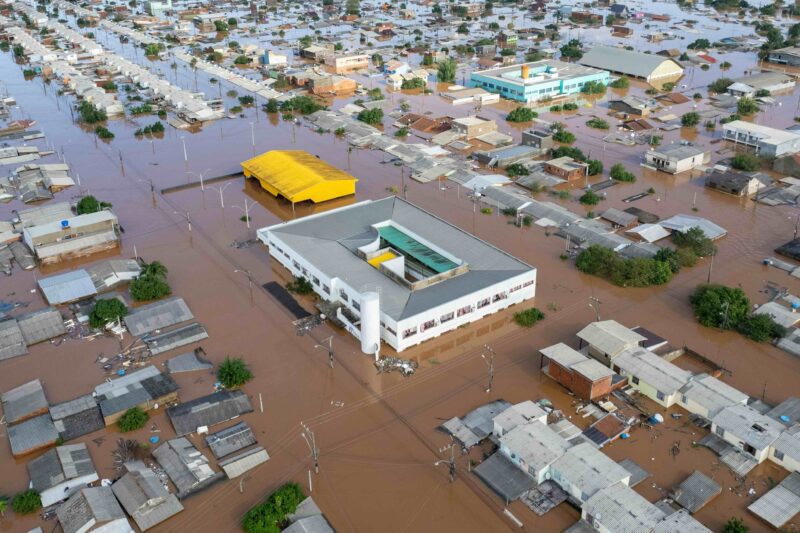
When prevention is underfunded, the costs show up all at once — in homes, schools, businesses, and public systems; Photo by Getty Images
This is precisely the territory the impact economy exists to correct. We already understand, better than most, that markets which fail to reflect true costs produce catastrophic misallocation. The security paradigm is simply the largest and least-examined instance of that failure. We have priced defense as the thing that responds to danger, and priced at roughly zero the things that prevent it.
What this asks of impact capital and enterprise
If you take the mispricing seriously, several things follow for the people who read this magazine.
The first is that prevention infrastructure is an asset class hiding in plain sight. Genuine security rests on five interdependent pillars — ecological stability, public health capacity, economic equity, democratic infrastructure, and community cohesion — and each is, in effect, an underpriced security investment with returns the conventional frame cannot see. Enterprises and funds that learn to recognize and underwrite those returns are not doing charity adjacent to their real work. They are pricing an asset the rest of the market has mispriced — which is, historically, where the most durable advantage in any market has come from.

Prevention infrastructure is often invisible until it fails — but its value lies in the crises it helps communities avoid; Photo by Getty Images
The second is that recovery and prevention are the same competency pointed in two directions. The community resilience that lets a society share risk after catastrophe is the same resilience that, capitalized earlier, lowers the odds of catastrophe. The recovery economies our correspondents are documenting are, in this sense, a live demonstration of what prevention infrastructure does — observed, unfortunately, after the fact. The enterprises that will matter most in the coming decades are the ones that can deliver these conditions before collapse, not only rebuild them after.
We have built a capital-allocation system that is exquisitely responsive to the visible and structurally blind to the avoided.
The third is a reconceptualization of defense itself. If security is fundamentally the provision of functioning systems rather than the threat of force, then it can be organized the way we organize other essential services — as continuous, accountable provision rather than episodic, reactive expenditure. I have come to call this Defense as a Service™: security reframed from a fortress to be manned into a service to be delivered, with the five pillars as its operating substance. It is the part of this argument with the most direct implications for enterprise design and for where defense-scale capital might be redirected, and it is the subject I am spending the most time on now.
The breakthrough is a decision
None of this is utopian. Every figure above is drawn from research, modeling, and real program evaluation, not aspiration. The prevention returns are already proven; what is missing is not evidence but allocation. We are, quite literally, choosing to pay sixteen dollars to avoid spending one — and we are doing it across nearly every domain that determines whether the coming century is survivable.
The breakthrough is to start funding it in advance.
The work of the impact economy, as I understand it, is to make the invisible return visible and then to capitalize it — to build the enterprises, structure the capital, and reform the markets so that prevention is no longer a non-event no one is paid for, but the most valuable infrastructure we know how to build. The young correspondents reporting from the recovery economies are showing us, after the fact, exactly what we failed to fund in advance. The breakthrough is to start funding it in advance.
Laurie Lane-Zucker is the founder and CEO of Impact Entrepreneur and coined the term “impact entrepreneur” in 2011. This essay draws on his forthcoming book, The Impact Entrepreneur Breakthrough: A Field Manual for the Regenerative Economy (Berrett-Koehler), available September 1, 2026. The recovery-economy series referenced here is part of Impact Entrepreneur’s content partnership with the Arts4Refugees Media Hub, whose correspondents are trained through IE’s Impact Journalism Institute — a first-of-its-kind program building a global community of impact-fluent journalists. Learn more at impactentrepreneur.com/breakthrough.