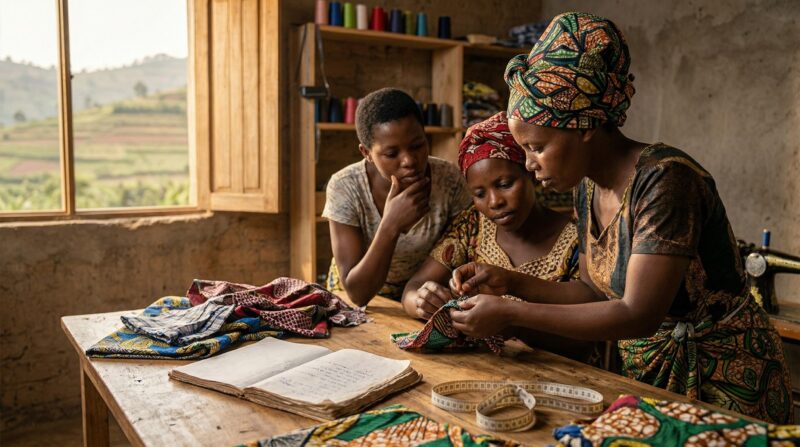
At first glance, it resembles many small-scale artisan enterprises operating across rural Africa. Yet its structure — and the conditions from which it emerged — reflect a more complex set of economic and social realities: the long aftermath of mass sexual violence, the gendered dimensions of recovery, and the role of cooperative enterprise in filling gaps left by formal systems. More than a cooperative, it is a risk-sharing economic model designed for conditions of uneven labor capacity, fragile markets, and limited institutional support. Its story raises a deeper question: what do post-conflict economies actually deliver, and what does that imply for designing ownership, livelihoods, markets, and support systems that enable durable communal recovery?
Post-conflict recovery as an uneven system
The 1994 genocide in Rwanda, which unfolded over roughly 100 days, resulted in the deaths of an estimated 800,000 to one million people. Sexual violence was used systematically, with estimates indicating that between 250,000 and 500,000 women and girls were subjected to rape. This violence was not incidental. It was used predominantly by Hutu extremist forces against Tutsi women and moderate Hutu as a weapon of social fragmentation, displacement, and long-term destabilization.
A cooperative like Abasangiye’s strength lies not only in what it produces, but in how shared work redistributes risk across the group.
In the decades since, Rwanda has often been cited as a model of post-conflict recovery. Macroeconomic growth has been sustained, infrastructure has expanded, and women now hold more than 60 percent of parliamentary seats in the lower house. But such indicators reflect national-level progress more than lived reality. In rural regions, where many genocide survivors still reside, economic opportunity remains constrained and access to formal employment, healthcare, and financial services remains uneven. The gap points to a broader pattern in post-conflict economies: state-led recovery can stabilize national systems without resolving localized vulnerabilities, particularly those shaped by gendered violence.
The cooperative as informal social infrastructure
The Abasangiye Cooperative emerged within that gap. Established in 2010 through a partnership between Indego Africa, Foundation Rwanda, and Survivors Fund (SURF), with funding from the Alan and Babette Sainsbury Charitable Trust, it began as a skills-training initiative for women affected by genocide-related sexual violence. Over time, it evolved into a hybrid enterprise combining income generation with social support. Members receive training in textile production, literacy, and basic financial management, alongside access to collective income. Program data points to a marked shift in earnings: the share of participants earning at least $1 per day increased from 7 percent in 2008 to 67 percent in 2011.
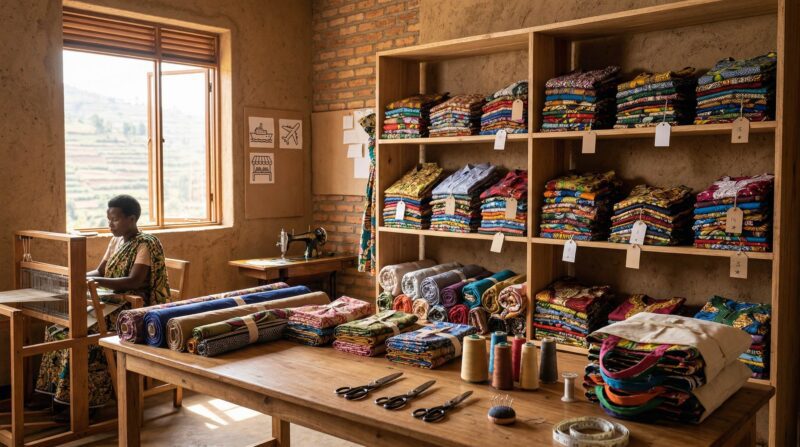
Market access can open doors, but without working capital and stable buyers, participation in value chains often remains precarious.
But the cooperative’s significance extends beyond income. Within Abasangiye, support is embedded in everyday economic activity rather than externalized to institutions. Care, trust, and mutual recognition circulate through shared labor and routine interaction, enabling the enterprise to compensate for gaps in social protection and formal recovery systems. In that sense, the cooperative functions not only as a productive unit, but also as a form of informal social infrastructure.
Redefining productivity
One of the cooperative’s most distinctive features is its equal-income distribution model, in which earnings are shared evenly among members regardless of individual output. This challenges a foundational assumption in enterprise design: that productivity, measured at the individual level, should determine income allocation.
As one cooperative member explained, “Some [members] are sick with HIV or have trauma and body weaknesses, while others are strong.” In a context where many women live with trauma-related health conditions, caregiving responsibilities, and social stigma, individual output is neither consistent nor a fair basis for income. The equal-distribution model functions as internal risk-pooling. Rather than shifting risk onto individuals through volatile or exclusionary earnings, it is shared across the group. That helps sustain participation despite uneven labor capacity and reduces the likelihood that members already constrained by structural conditions will be pushed further to the margins.
Many survivors continue to navigate stigma and social exclusion even where formal legal processes have taken place.
Rather than rejecting economic rationality, the model reframes it. In conditions of fragility, stability and inclusion are prerequisites for sustained economic activity. For the impact economy, that suggests a need to reconsider how enterprise performance is defined and measured in post-conflict and high-vulnerability environments. Where labor is shaped by trauma, chronic illness, and social stigma, productivity cannot be treated as an isolated competitive variable. Enterprise models that prioritize output maximization may inadvertently reproduce exclusion, while those that embed risk-sharing may generate more durable forms of participation, even with different efficiency tradeoffs. Abasangiye illustrates a broader principle: in recovering communities, resilience is not a byproduct of efficient systems, but an outcome of deliberate choices about distribution.
Market access without market security
Despite its strong internal organization, the cooperative remains structurally exposed to the weaknesses of the markets it depends on. Monthly earnings from handicraft production are irregular, typically ranging from 20,000 to 50,000 Rwandan francs, or roughly $15 to $40. These constraints are not incidental. They are embedded in how the cooperative is positioned within the value chain. Market access is largely intermediated through NGOs and ethical-trade partners that open routes to export markets while also shaping the terms of engagement. The cooperative operates less as a price-setting actor than as a fulfillment partner, with limited visibility into end-market pricing and little leverage in negotiation. Orders tend to be small, irregular, and project-based rather than contractually guaranteed, producing discontinuous production cycles that translate directly into income volatility.
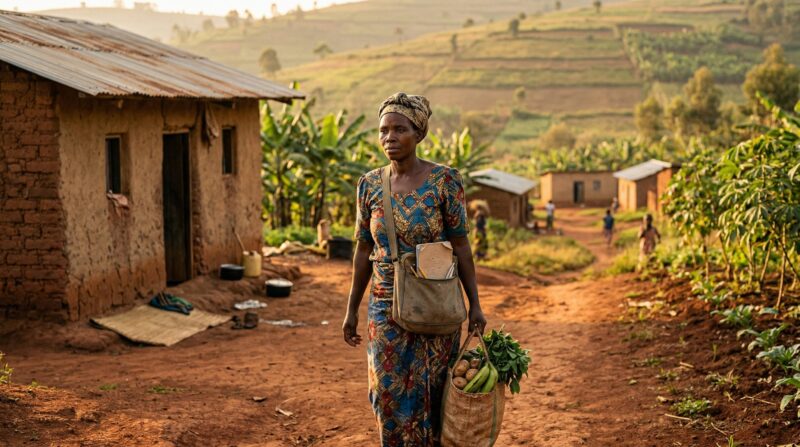
Income instability is felt most sharply at the household level, where even short interruptions in orders can ripple into food security and school costs.
The cooperative’s lack of working capital further constrains its room to maneuver. Without the ability to procure materials in advance, build inventory, or absorb payment delays, it remains reactive to incoming orders rather than able to plan production or pursue larger buyers. This reinforces dependence on low-volume, higher-touch ethical markets, where demand is often episodic and shaped by external retail cycles rather than local production needs. Limited local purchasing power narrows alternatives even further, effectively locking the cooperative into export-oriented channels without the stability usually associated with them.
One of the cooperative’s most distinctive features is its equal-income distribution model, in which earnings are shared evenly among members regardless of individual output.
The result is a form of access without security. Abasangiye is integrated into global value chains, but only at their most contingent edges, where demand is discretionary, orders are nonbinding, and risk is pushed downward. Market participation offers income opportunities, but not income reliability. At the household level, that instability becomes acute. Members describe anxiety around even brief interruptions in orders, with a production gap of two weeks raising fears that it could stretch into months and affect food security. Even with the shared-income model, some members remain unable to meet essential expenses consistently, including school fees and housing costs.
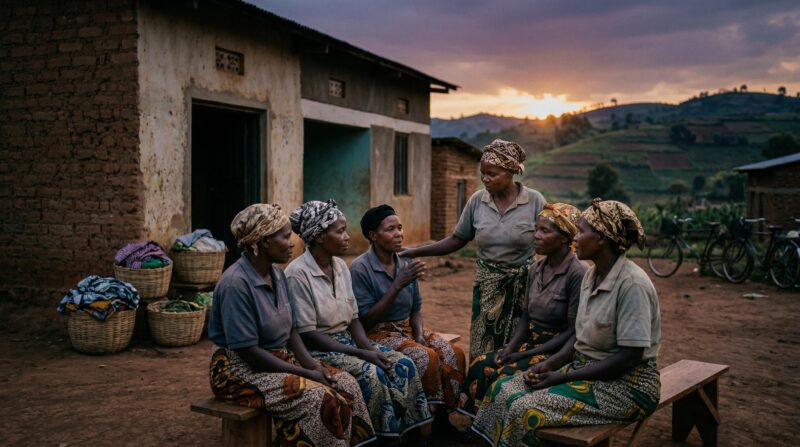
The unfinished work of recovery often happens not in courtrooms or capital cities, but in small communities building resilience together.
Cooperatives such as Abasangiye therefore function as partial stabilizers within incomplete systems. They enhance resilience at the group level, but remain dependent on external market structures they do not control. The implication for practitioners is clear: improving access to markets is not enough. What is also needed is market infrastructure — including long-term procurement partnerships, appropriate working capital, and more equitable value-chain integration — capable of turning participation into sustained economic security.
Justice systems and the limits of recognition
The cooperative also exists within the unresolved social dimensions of post-genocide justice. International prosecutions, including those conducted by the International Criminal Tribunal for Rwanda, initially faced major challenges in addressing sexual violence. Although the ICTR ultimately issued landmark judgments recognizing rape as a constitutive act of genocide, such cases represented only a small proportion of its overall docket and were often constrained by evidentiary and procedural limitations. Alongside international efforts, Rwanda introduced extensive domestic mechanisms, most notably the community-based Gacaca courts, which operated from 2002 to 2012. While these courts handled a vast number of genocide-related cases, sexual violence was frequently underreported and in many instances addressed outside public proceedings.
As a result, many survivors continue to navigate stigma and social exclusion even where formal legal processes have taken place. The gap points to a broader limitation of post-genocide justice: legal accountability does not automatically translate into social recognition, reintegration, or material security. For women rebuilding their lives through enterprises such as Abasangiye, that unresolved social terrain remains part of the economic landscape.
Where recovery actually happens
The Abasangiye Cooperative illustrates a recurring feature of post-conflict economies: recovery is distributed across systems that remain only partially functional. States provide macro-level stability. Markets generate income, but often with limited protection against volatility. Community-based enterprises absorb the residual risk. In this context, cooperatives operate as hybrid institutions — simultaneously productive units, risk-sharing mechanisms, and forms of informal social infrastructure. Their role is not only to generate income, but to stabilize participation where labor capacity, health, and market access are uneven.
For impact economy practitioners, this exposes a misalignment in how enterprise success is typically defined and supported. Income gains and market access are insufficient indicators if they do not translate into predictability or sustained participation. Enterprise models in these settings are not underperforming relative to ideal conditions; they are compensating for missing ones. Supporting them effectively therefore requires engaging with the systems they are embedded in, not just the enterprises themselves.
More fundamentally, Abasangiye shows that communal recovery is, in part, a problem of economic design. Where risk remains concentrated at the level of community enterprise, inclusion stays fragile. Durable recovery depends on redistributing that risk across financial, market, and institutional systems, so that resilience is not left to communities to sustain alone.