Maribel Marin, executive director of 211 LA, had been on alert since January 3. “We were already out in the field, talking to folks, getting them ready.” When the fire swept through, her team was ready, too.

That evening, through its partnership with 211 Ventura, Marin’s team connected with Airbnb.org. Within hours, they had agreed: 100 families would receive seven-day emergency stays. The county activated 211 LA that same night. By January 2026, a response launched within 24 hours of the Palisades and Eaton wildfires had helped provide free emergency housing for nearly 24,000 people, including more than 1,000 first responders.

The right people for the right job

211 LA opened its doors in 1981 and serves as a centralized broker of vetted information for non-life-threatening situations, as well as a critical triage layer during disasters, when misinformation is often widespread. Airbnb.org, the nonprofit founded by Airbnb, brings a different kind of capacity: access to a global host network, a mechanism for placing people quickly in free or discounted stays, and an operating model in which Airbnb covers overhead so public donations fund housing directly.

WIldfires around Los Angeles

Wildfire smoke over Los Angeles underscores the growing pressure on emergency housing systems as climate-related displacement becomes more frequent; Photo by Jessica Christian

The fit seems obvious once you see it. “They have the team that gets the resources,” Marin explains. “We have the agents who can do intake and make referrals and warm connections.” The logic has since extended beyond Los Angeles: Airbnb.org has built similar relationships with 211 organizations across the country.

For Christoph Gorder, executive director of Airbnb.org, the partnership reflects hard-won lessons about what technology-enabled humanitarian response can and cannot do. The son of Lutheran missionaries, Gorder describes his path as “growing up on the front lines” — running medical humanitarian operations that airlifted supplies into Darfur, then expanding digital infrastructure at charity: water, before joining Airbnb.org in late 2023. His understanding of where technology amplifies human capacity has shaped how he thinks about scale: Airbnb.org, he says, moved from a handful of disaster responses globally in 2023 to 78 in 2025, and is on track for 150 this year.

It’s like saying, ‘I have an ambulance’ when what you need is healthcare.

But Gorder is precise about limits. Reflecting on earlier iterations housing refugees during the Ukraine war, he notes: “The issue is that many of the world’s refugees are not near an Airbnb. And what they need is not two to four weeks — they need six months. They need a year. They need two years.” He pauses. “Our housing solution isn’t a great housing solution. It’s like saying, ‘I have an ambulance’ when what you need is healthcare.”
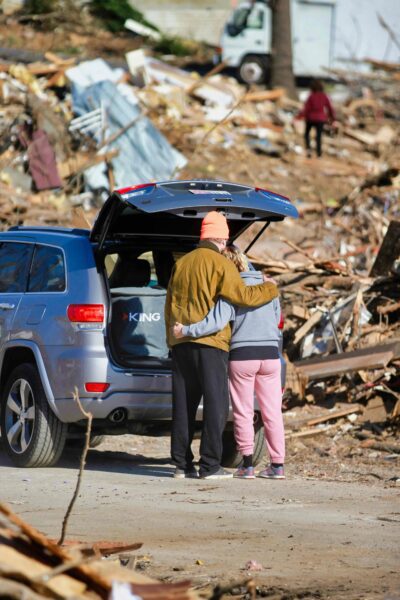
Couple in front of destroyed homes

For displaced households, the emergency stay is only the beginning of a much longer recovery process; Photo by Chandler Cruttenden

Finding the fit

That clarity has pushed Airbnb.org toward a more specific fit: localized, rapid-response short-term housing deployed at scale. One direction is focusing on smaller, localized disasters where housing needs are more likely to be temporary. Another is its Medical Stays program, which pairs families needing to travel for care with hosts offering free accommodation, facilitated through civil society partners. Launched in October 2025, the program now operates in nine countries. “With medical stays we can scale really quickly,” Gorder explains. “There’s very little physical risk. So we can just grab any organization who is ready to work with us and go.” In May 2026, Airbnb.org announced a 20 million peso — more than $1.1 million — commitment to expand the program to thousands of Mexican families traveling for specialized care.

In parallel, Airbnb.org is piloting a program designed to address a specific gap in the domestic violence response: the period between the acute crisis moment — which requires physical safety, case management, and mental health services — and access to permanent housing.

In all of these cases, success hinges on the complementarity of organizational capabilities, with trust at its center.

The human infrastructure

What makes the model work at the local level is less the technology itself than the human infrastructure around it. Kathryn is an Airbnb host and ambassador who listed her California property with Airbnb.org and housed a family displaced by the Eaton Fire. “I wrote to them: this is a place for you to find peace and comfort, to have quiet time to think of your next steps,” she says. When she and her son sat down with the family in person, she witnessed the impact firsthand. “They were effusively thanking us, over and over.”

The warm referral from a trusted source, the face-to-face conversations, the note about next steps — all point to what distinguishes this model from a hotel voucher or a shelter bed. At each node in the journey, there is a committed, vetted human being.

This is Airbnb.org’s distinctive advantage, and it is difficult to replicate. For supporters, Airbnb’s emphasis on shared local experience makes its philanthropic arm feel less like a corporate initiative and more like a natural extension of what its community already values. For critics, that same connection makes it impossible to separate the nonprofit’s humanitarian promise from the housing-market effects of the platform that helped create it.

And therein lies a tension that is difficult to ignore.

The platform economy’s uncomfortable bargain

Responses like the one in Los Angeles are often praised for their speed and practicality. They also trigger an understandable skepticism: is this humanitarian infrastructure, or a corporate-adjacent effort that distracts from Airbnb’s own role in housing pressures? In December 2025, the Spanish government fined Airbnb €64 million for advertising unlicensed tourist rental homes. Cities from Barcelona to New York have tightened rules on short-term rentals in response to concerns about housing supply, affordability, and neighborhood stability. Research on long-term impacts has also found that Airbnb listings can increase the supply of short-term rentals while decreasing the supply of long-term rental units.
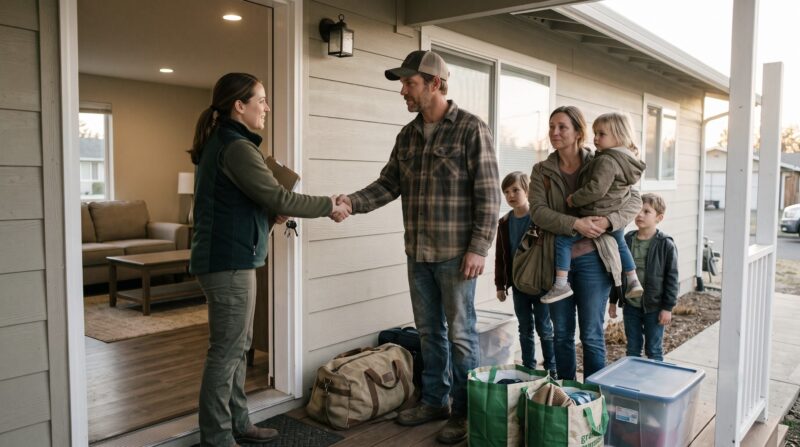
family arrives at temporary housing after displacement

A family arrives at temporary housing after displacement — the moment where emergency response, local trust, and platform capacity either come together or fail.

The criticism has merit. It also risks obscuring larger structural issues: the commodification of housing, the high cost of borrowing, and persistent underinvestment in affordable homes. Airbnb’s success has hinged on its disruptive business model, its robust platform, and an unprepared regulatory landscape. That success, like it or not, helps fuel its philanthropy. Do we need it to? Can we accept that a single actor might both weaken and strengthen a community’s fabric? And if we can, what forms of accountability should follow?

The gap no one wants to own

FEMA’s Transitional Sheltering Assistance program remains the U.S. federal government’s primary emergency housing mechanism after major disasters. Even when the agency is working, survivors can experience bureaucratic burden, fragmented information, and delays; FEMA has also become an easy target for misinformation. Beyond the U.S. context, governments’ increasing reliance on regional and third-sector actors for disaster management leaves a widening gap between the resources needed and the resources that are not only available, but visible. So who is stepping up?

Crisis response works better when people and institutions build the system together before the emergency call comes in.

By 2050, an estimated 1.2 billion people could be displaced globally by ecological threats, according to the Institute for Economics and Peace. War and political unrest are permanent fixtures, and these interrelated pressures fuel a rise in gender-based violence which, in the case of domestic abuse, elevates the risk of homelessness. Short-term shelter solutions share a common ceiling: they are designed for acute crisis, not the prolonged recovery that displacement actually requires. That timeline demands a different approach — one that leverages relationships, rebalances access to resources, and includes beneficiaries in its design.

One name for this is co-production: the work of service providers and users designing and delivering public goods together. The language can sound technical, but the principle is simple. Crisis response works better when people and institutions build the system together before the emergency call comes in.

For 211 LA, the answer begins with infrastructure established before the next disaster, not after it. “When a crisis occurs, people who want to help raise their hand,” Marin says, “and so it’s incumbent on those of us who have capacity and infrastructure to reach out and say, let’s come together.” Out of the Eaton Fire response, 211 LA, the Red Cross, Airbnb.org, the Salvation Army, and other partners are now building what they call the Crisis Care Plan Alliance — a standing coalition designed to function before the emergency call comes in.

It is, in miniature, what a policy response to displacement could be: distributed, pre-coordinated, and honest about the difference between an ambulance and a healthcare system. Both matter. But while the system is redesigned, someone has to drive the ambulance. The question is whether we care who that is.



Source link

Leave a Reply

Subscribe to Our Newsletter

Get our latest articles delivered straight to your inbox. No spam, we promise.

Recent Reviews


Two politicians speak at different events.

Minnesota’s U.S. Senate race got a preconvention jolt Wednesday when Democratic Rep. Angie Craig announced she would bypass the state DFL endorsement process entirely and go straight to a primary against Lt. Gov. Peggy Flanagan.

It comes just days before the two were to go head-to-head for the party endorsement at the DFL convention in Rochester. Flanagan was seen as the favorite and is now a virtual lock to get the seal of approval, which brings access to party-held voter data and other campaign resources.

As Craig filed for the primary ballot Wednesday, she said she would forgo the convention and said the endorsement process “just doesn’t reflect the full scope of the party that we are.”

“And the purple state that we have become. This is no ordinary moment. Donald Trump and Republicans are attacking Democracy itself, gutting the voting rights act, gerrymandering and threatening to interfere with elections,” Craig said. In prepared remarks, she added, “The only way we save democracy is through democracy, where every voice is heard, not just a few.”

Flanagan’s campaign was quick to declare victory.

“It’s clear that Peggy Flanagan is the consensus candidate,” said campaign spokesperson Lexi Byler.

The Flanagan team released details of its pre-convention push that expressed confidence she would easily secure the party endorsement. Now she could win the backing without real opposition.

In Minnesota, the endorsement is one step in the process. Candidates can file for the primary ballot without it. Some past Democrats of note, including Gov. Tim Walz and former Gov. Mark Dayton, both won their first races without the party endorsement. Dayton also prevailed over an endorsed candidate in his 2000 U.S. Senate race.

Flanagan’s campaign insists this year is different given the outrage over President Donald Trump’s actions and his immigration enforcement actions in Minnesota.

The primary could prove expensive and caustic. Craig has millions in her campaign fund but Flanagan has some prominent advocates on her side. TV ads on behalf of each have already started running.

The Republican nominee is also a question mark, with this weekend’s GOP convention potentially also setting the stage for an August primary.

The seat is open in November as U.S. Sen. Tina Smith prepares to retire.

DFL voters have been divided throughout the campaign over who to back.

Jim Drake sat to the side at a recent campaign event for Craig. Drake came to the event undecided in Minnesota’s Senate race and hoping for clarity.

“I tend to lean, you know, maybe a little more progressive, maybe more than Angie does,” Drake said. The Arden Hills voter says agenda isn't the only thing on his mind.

“It’s the electability and the track record that make me come back here,” he said. “Those are really important to me. Those are the first things I want done, is to get a Democrat elected in the fall.”

Drake said at the early May event that he wasn’t ready to commit his vote in the between Craig and Flanagan.

There are some similarities between the two. The stories of their childhoods, which they incorporate into their campaign stops, have parallels.

They were both raised by single mothers. Both spent some time as children on food assistance. Flanagan talks about having lived in Section 8 housing; Craig talks about living in a mobile home park.

“These are the programs that helped my mom care for me and to afford it all. And I'm here because of those investments, not in spite of them,” Flanagan said.

“So, this fight that we're in at this moment in time, it is personal,” Craig said, reflecting on her childhood.

A woman speaks from a podium
U.S. Rep. Angie Craig speaks to supporters at an event for her U.S. Senate campaign at Malcolm Yards in Minneapolis on May 8.
Peter Cox | MPR News

In many ways, there is plenty of crossover in issue positions at the center of their campaigns. Both highlight how they’ll focus on improving healthcare access, ending corruption, emphasizing affordability and protecting voting and civil rights.

But the differences are clear in both their approaches and philosophies.

Flanagan’s political journey can be traced back to the politics of the late Sen. Paul Wellstone. She worked for Wellstone Action, a group that sprang up after his death to train progressive political activists and candidates. She says Wellstone, an unapologetically progressive U.S. senator, greatly informed her approach.

Craig’s political career took root in the 2nd Congressional District, a swing district that had been in Republican hands for nearly two decades until she took office in 2019. To win there, she had to win over centrist and some Republican voters, which she’s done. She’s worked across the aisle and voted with Republicans from time to time, which is part of her pitch to voters.

Flanagan has hammered Craig’s backing of the Laken Riley Act, which Flanagan said set the stage for the Immigration and Customs Enforcement actions seen in Minnesota over the winter. Craig said in March that she regrets supporting that law.

Meanwhile, Craig has been going after Flanagan for the human service provider fraud that led to millions of dollars in payments to fraudulent providers. Craig said Flanagan and the Walz administration did not do enough to stop it from happening. Flanagan has said the administration has taken many steps to address the issue.

Craig stresses how Democrats need more than their hardcore base to succeed.

“The only way we win is by extending a hand, by meeting people where they are, by bringing more people into or back into the fold, and folks, I know how to do that,” Craig told an audience at Malcolm Yards in Minneapolis earlier this month.

Flanagan says voters are tired of timidly pushing for small changes.

“Everywhere I go, they're sick and tired of Democrats bending to Republicans fighting from a defensive crouch, nibbling around the edges, or governing by sternly worded letter,” Flanagan told a crowd at a recent rally. “We need senators with the heart of Minnesota and the backbone of Bernie Sanders.”

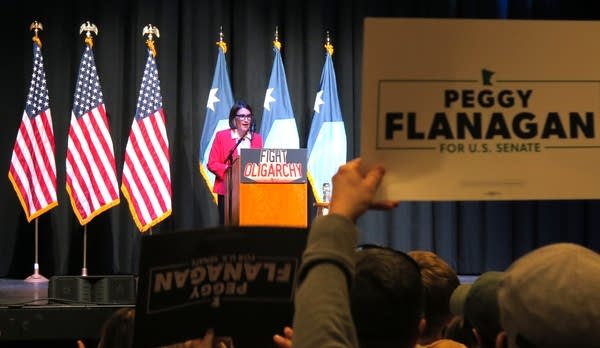
A woman speaks on stage
Lt. Gov. Peggy Flanagan campaigns for U.S. Senate at John Marshall High School in Rochester on May 2.
Peter Cox | MPR News

The Vermont senator and progressive kingmaker headlined a recent rally for Flanagan in Rochester. About 1,300 people showed up for what was called the “Fighting Oligarchy Tour.”

Sanders plugged his agenda over a 50-minute speech and left the stage with a final pitch.

“We're going to create a government that works for all of us, and one way to do that is making sure that Peggy Flanagan is the next U.S. senator from Minnesota,” he said.

Flanagan has racked up other endorsements from well-known liberals. That includes Sens. Elizabeth Warren and Tina Smith, whose seat is up for grabs in Minnesota.

One prominent Democrat withholding his endorsement for now is Gov. Tim Walz. Despite having his longtime second-in-command in the running, he’s remaining neutral. He won’t even be in Rochester, saying he has a scheduling conflict and thinks it’s time for him to step off the stage.

Pressed on MPR’s Politics Friday why he isn’t backing Flanagan after twice sharing a ticket with her, Walz said he has connections to both candidates.

“It’s also a dear friend in Angie Craig, who I encouraged to run for Congress and tried to support. I think we have two incredibly talented women,” he said. “I think it's important not to have the past, which is me, have a thumb on what the future is going to look like.”

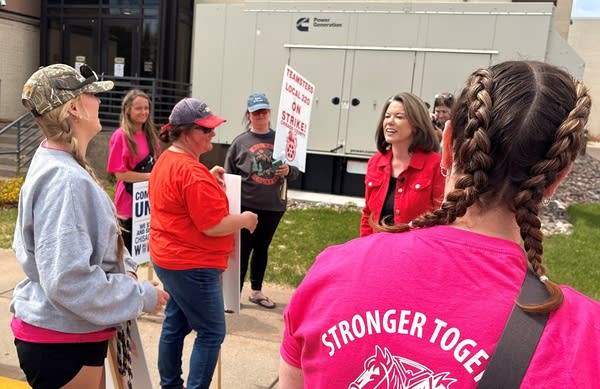
A woman greets a crowd
U.S. Rep. Angie Craig speaks to striking Chisago County employees on May 8.
Peter Cox | MPR News

In early May, Craig joined a union picket line of striking Chisago County workers in Center City, an exurban town where Republicans usually dominate. It's the kind of place she isn't shy about going.

“My commitment to you is that I will always protect the right to organize and collectively bargain in this country, and that I will always show up on the damn picket line with you,” she said.

Craig has racked up substantially more money. But her haul often draws criticism from Flanagan, who emphasizes that she won't take money from corporate-connected political funds.

“If billionaires and big corporations can buy this seat, it will tell politicians everywhere that playing it safe is what gets rewarded,” Flanagan said.

Craig underscores how expensive the race will get as national Republicans eye Minnesota as a pickup target. She says she knows what a tough race takes.

“I've had $50 million spent against me by Republicans over the last 10 years, while I've been fighting every single election cycle to hold my seat in the second district and help Democrats hold the House majority,” Craig said.

The lack of a competitive convention race for Senate will lower the temperature in Rochester.

There are other races to be decided. Multiple DFL candidates are vying for an open state auditor spot — another choice for delegates this weekend.

Sen. Amy Klobuchar waves after a ribbon cutting ceremony, holding a piece of ribbon.
U.S. Sen. Amy Klobuchar holds a piece of the ribbon from the ribbon cutting celebrating healthcare company Solventum's new research and development hub in Eagan on April 1.
Cait Kelley | MPR News

Meanwhile, Klobuchar is the clear favorite to wrap up the party's backing for governor, but could face some skepticism from the more progressive wings of the party.

There are several challengers also looking for the DFL nod, but none that have Klobuchar’s name recognition or history in the state.

Klobuchar has a significant fundraising advantage over all of the Republicans seeking their party’s nomination. A low-strain endorsement and primary contest would allow her to conserve money and get organized for the fall campaign while the GOP field needs narrowing.

She’s likely to pick a running mate either before or at the convention.

Incumbent Attorney General Keith Ellison faces one DFL challenger, Dave Madgett, who served as a judge advocate general in the Air Force and has been in private practice for nearly two decades.

Incumbent Secretary of State Steve Simon is so far running unopposed for the DFL endorsement as he tries for a fourth term.

The DFL convention in Rochester begins Friday and runs through Sunday. The GOP convention in Duluth also begins Friday.


Source link