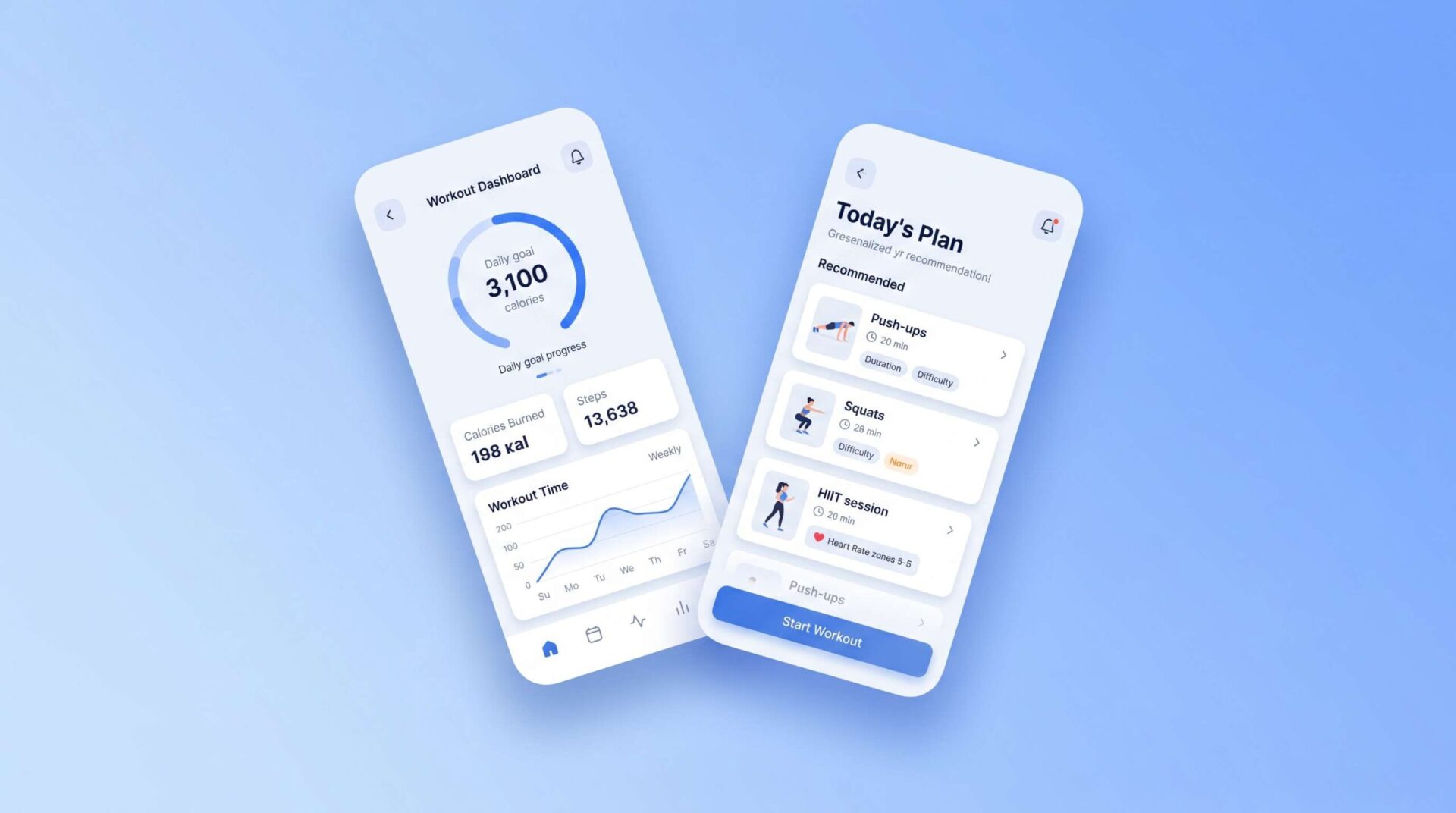

Most cost guides for fitness app development give you a number without giving you a reason. The estimates range from $10,000 to over half a million dollars, and neither extreme comes with a satisfying explanation. Understanding the real fitness app development cost requires breaking it across three dimensions, and that gap is exactly what this guide fills.
The fitness app market has fundamentally changed. In 2026, a competitive fitness product is not a step counter or a calorie log. It is a health-data platform that processes real-time biometric signals, delivers AI-personalized coaching, syncs with wearable ecosystems such as Apple HealthKit and Google Health Connect, and operates across multiple platforms simultaneously. According to Mordor Intelligence, the global online fitness market is valued at over $36 billion. That growth is raising the technical bar for every new product entering the space.
A production-ready fitness app today costs between $40,000 and $500,000. That range is not vague; it reflects genuinely different products with different architectures and different business models. Whether you want to create a fitness app for consumers, build a trainer marketplace, or deploy an enterprise wellness platform, this guide gives you everything you need: realistic costs, a 10-step development roadmap, a modern tech stack breakdown, compliance requirements, real-world benchmarks, and an ROI framework. By the end, you will have a clear picture of what your specific product actually costs and what it takes to build it right..

What Makes a Fitness App Fundamentally Different in 2026
The decision to create a fitness app in 2026 means building a health-data platform, not a lifestyle utility. Every layer of a modern fitness application carries more complexity than a standard mobile app: continuous data streams, device integrations, AI pipelines, and compliance obligations.
Three dimensions separate a modern fitness app from a basic one:
The Real-Time Data Layer
Modern fitness apps capture continuous biometric signals: heart rate variability, VO2 max estimates, sleep quality scores, blood oxygen levels. This is not step logging. It requires always-on background processing, efficient battery management, and a time-series database built to handle high-frequency writes without performance degradation. Every time you add a real-time data stream, your infrastructure complexity increases in a non-linear way.
The AI and Personalization Layer
Personalization is now a baseline expectation, not a premium feature. Users expect workout plans that adapt to their progress, nutrition recommendations that reflect their goals, and coaching feedback that feels specific to them. Delivering this at scale requires machine learning pipelines, not rule-based logic. The rise of the AI fitness app has also introduced computer vision for real-time form analysis, where the device camera counts reps and flags posture errors, and LLM-based conversational coaching that responds to natural language. Each of these capabilities adds infrastructure cost and maintenance overhead.
The Ecosystem Integration Layer
Your users arrive with existing devices: Apple Watch, Garmin, WHOOP, Fitbit, Oura Ring. They expect your app to read from those devices, not compete with them. For clinical wellness products, integration may extend into EMR systems and continuous glucose monitors. Each device ecosystem has its own SDK, its own data format, and its own update cadence. Your team needs to maintain all of them. For a detailed look at how this intersects with patient-facing products, our resource on AI in healthcare apps covers the compliance and integration landscape in depth.
5 Types of Fitness Apps: Choose Your Category Before You Budget
Your app category determines your backend architecture, your compliance obligations, and your realistic cost range. The five categories below represent meaningfully different products, not variations on the same platform. Understanding which one you are building is the first real decision of your project.
|
Category
|
Primary User
|
Key Backend Requirement
|
Complexity
|
|---|---|---|---|
|
Workout and Training Apps
|
Gym-goers, athletes
|
Video delivery, program logic
|
Medium
|
|
Nutrition and Calorie Trackers
|
Diet-conscious users
|
Food database, barcode scanning
|
Medium
|
|
Wearable-Integrated Apps
|
Health enthusiasts, patients
|
Multi-SDK sync, real-time processing
|
High
|
|
Trainer Marketplace Apps
|
Coaches and clients
|
Booking, payments, live sessions
|
High
|
|
Enterprise Wellness Platforms
|
HR teams, insurers
|
Multi-tenant, SSO, analytics
|
Very High
|
The most instructive lesson from the apps that dominate these categories today: Strava, MyFitnessPal, WHOOP, and Apple Fitness+ did not build everything at once. Each solved a single problem deeply before expanding. Define your category, dominate it at MVP stage, then expand. Trying to compete across categories from launch is one of the most common and expensive strategic errors in this space.
If you are building in the running or sports coaching category, GPS accuracy, real-time coaching cues, and leaderboard dynamics introduce distinct technical requirements that differ significantly from a nutrition or wearable app. Our guide on sports and fitness running app development covers those category-specific considerations in detail.
Fitness App Features: Core, Advanced, and AI-Powered
Before you create a fitness app, estimate a budget, or select a tech stack, you need a feature taxonomy. Not all features carry equal weight in terms of complexity, infrastructure cost, or user impact. Mapping your feature set across three tiers is the clearest way to scope any fitness application honestly.

Tier 1: Core Features (Required for Any Fitness App)
- User onboarding with structured goal-setting flow
- Activity logging: both manual input and automatic capture via device sensors
- Progress dashboard with visual analytics
- Push notifications and scheduled reminders
- Subscription management and in-app payment processing
- User profile, preferences, and settings management
Tier 2: Advanced Features (Mid-to-High Tier Products)
- Video content delivery streamed via CDN with adaptive bitrate
- Real-time GPS route tracking with elevation and pace data
- Wearable device sync via Apple HealthKit, Google Health Connect, and Garmin Connect IQ
- Live workout sessions built on WebRTC or equivalent technology
- Community features: challenges, leaderboards, social sharing
- Trainer booking, session scheduling, and payout management
- Admin dashboard with cohort-level analytics and engagement metrics
Tier 3: AI-Powered Features (Premium and Enterprise Products)
- ML-based personalized workout plan generation that adapts to user progress
- Computer vision for form analysis and rep counting using MediaPipe pose estimation
- Adaptive nutrition recommendations driven by logged intake and goal data
- Predictive injury prevention signals based on training load patterns
- LLM-based conversational coaching and natural language Q and A interface
- Biometric anomaly detection with contextual push alerts
Know which type of fitness app you are building? Book a Free Product Scoping Session
The 3-Dimensional Cost Framework: What Actually Drives the Price
The single biggest problem with fitness app cost guides is that they reduce a complex, multivariable question to one table sorted by complexity. Complexity level matters, but it is only one of three dimensions that together determine your actual budget. Understanding all three is what separates a realistic investment plan from a number that surprises you twelve months later.
Dimension 1: Cost by Complexity Level
|
Complexity
|
Cost Range
|
What Is Included
|
Infrastructure
|
|---|---|---|---|
|
Basic / MVP
|
$40,000 to $80,000
|
Manual tracking, login, basic UI, notifications
|
Single backend, basic DB, minimal APIs
|
|
Mid-Level
|
$80,000 to $180,000
|
Video content, payments, third-party integrations
|
CDN, API backend, payment gateway, background sync
|
|
Advanced
|
$180,000 to $350,000
|
Real-time tracking, wearable sync, analytics
|
Cloud-native, microservices, event queues, scalable storage
|
|
Enterprise / AI-First
|
$350,000 to $500,000+
|
AI coaching, computer vision, SSO, multi-tenant
|
Distributed architecture, ML pipelines, dedicated infra
|
Dimension 2: Cost by Development Stage
Build cost does not distribute evenly across stages. Skipping or underfunding any stage produces costs that show up later, usually at a multiplier.
|
Stage
|
Activities
|
Cost Share
|
Consequence of Skipping
|
|---|---|---|---|
|
Discovery and Architecture
|
User research, system design, tech decisions
|
10 to 15%
|
Wrong architecture requires costly rebuild at scale
|
|
UI/UX Design
|
Wireframes, prototypes, design system
|
12 to 18%
|
Poor UX causes churn spike within 30 days of launch
|
|
Frontend Development
|
iOS, Android, Web layers
|
25 to 30%
|
Platform gaps create lost user segments
|
|
Backend Development
|
APIs, databases, integrations
|
25 to 30%
|
Scaling failures appear under real-world load
|
|
QA and Testing
|
Functional, performance, security, UAT
|
10 to 15%
|
App store rejections and potential data breaches
|
|
Deployment and DevOps
|
CI/CD setup, cloud config, monitoring
|
8 to 12%
|
Downtime events and slow release cycles
|
Dimension 3: Cost by Business Model
This is the dimension most budgets ignore entirely, and it is the most consequential one. Your monetization model dictates your backend architecture. An enterprise multi-tenant wellness platform and a consumer subscription app may share a feature list on a product brief, but they are entirely different systems under the hood.
|
Business Model
|
Cost Range
|
Backend Requirement
|
Key Risk
|
|---|---|---|---|
|
Consumer Subscription
|
$40,000 to $120,000
|
Content delivery, access control, billing
|
Churn if content library is thin
|
|
Trainer Marketplace
|
$90,000 to $220,000
|
Two-sided system, booking, split payments
|
Trust and dispute resolution complexity
|
|
Enterprise Wellness
|
$150,000 to $400,000
|
Multi-tenant, SSO, HR integrations, dashboards
|
Long sales cycles and compliance requirements
|
|
Wearable-First App
|
$100,000 to $300,000
|
Multi-SDK sync, real-time processing
|
Device fragmentation and SDK update breakage
|
|
AI Coaching Platform
|
$200,000 to $500,000+
|
ML pipelines, LLM integration, data labeling
|
Model accuracy drift and retraining costs
|
Factors That Affect Fitness App Development Cost
Two apps with identical feature lists can have significantly different fitness app development costs depending on several variables. Understanding these factors gives you real leverage when planning your budget and evaluating vendor proposals.

1. Team Location and Engagement Model
Development rates vary substantially by geography. US-based teams typically bill between $120 and $200 per hour. Eastern European teams range from $50 to $90 per hour. Indian fitness app developers with strong technical credentials range from $25 to $60 per hour. The total cost difference for a $150,000 project at US rates versus a comparable offshore team can exceed $80,000. The critical qualifier: team quality matters more than location. A cheaper team that rebuilds key components twice costs more than a premium team that ships correctly the first time.
2. Platform Choice: Native vs. Cross-Platform
Building native iOS and Android apps separately roughly doubles frontend development cost versus a cross-platform Flutter build with comparable features. For most fitness apps, Flutter delivers 85 to 90 percent of native performance at 55 to 65 percent of native cost. The exception is sensor-heavy apps with real-time biometric processing or complex device hardware interactions, where native development justifies the premium.
3. Third-Party Integration Complexity
Each wearable SDK, payment gateway, video streaming service, or nutrition database you integrate adds development time, testing overhead, and ongoing maintenance cost. A single well-integrated wearable SDK typically adds two to four weeks of development time. A platform supporting five device ecosystems simultaneously can add eight to twelve weeks. Map your integrations explicitly before accepting a cost estimate.
4. AI and Machine Learning Depth
The difference between a basic app that calls an LLM API and a true AI fitness app with a custom-trained personalization model is not a minor line item. Custom ML development, data pipeline infrastructure, model serving, accuracy monitoring, and retraining schedules can add $80,000 to $200,000 to a project depending on the number of AI features and the volume of training data required.
5. Compliance Requirements
A fitness app with no health data handling has minimal compliance overhead. An app that processes PHI under HIPAA, handles EU users under GDPR, or operates in India under the DPDP Act requires specific technical controls, legal review, and audit infrastructure from day one. Budget $15,000 to $40,000 for compliance-by-design in a health-adjacent product, versus $40,000 to $100,000 to retrofit compliance onto an existing system that was not designed for it.
6. Content Production Requirements
Video-first fitness apps carry a content cost that is entirely separate from development cost. A library of 50 professionally produced workout videos with trainers, equipment, and post-production editing typically costs between $30,000 and $100,000. If your product thesis depends on content quality, this budget line belongs in your total investment calculation from day one.
Real-World Fitness App Cost Examples
Abstract cost ranges become more useful when anchored to real product decisions. The three examples below show what it actually costs to create a fitness app across the most common product archetypes, each with a realistic cost profile based on typical delivery parameters.
Example 1: Consumer Subscription Workout App (MVP Stage)
Profile: A startup building a subscription-based strength training app for iOS and Android. Core features include a workout library with video, an adaptive training plan generator, progress tracking, and a freemium-to-subscription conversion funnel. No wearable integrations at MVP stage. No AI features in the first version.
|
Component
|
Timeline
|
Estimated Cost
|
|---|---|---|
|
Discovery and architecture design
|
3 weeks
|
$8,000 to $12,000
|
|
UI/UX design and prototyping
|
4 weeks
|
$14,000 to $20,000
|
|
iOS and Android development (Flutter)
|
14 weeks
|
$45,000 to $65,000
|
|
Backend development and API layer
|
10 weeks
|
$28,000 to $40,000
|
|
QA, testing, and app store launch
|
4 weeks
|
$10,000 to $15,000
|
|
Total estimate
|
35 weeks
|
$105,000 to $152,000
|
Example 2: AI-Powered Trainer Marketplace
Profile: A growth-stage company building a two-sided marketplace connecting independent fitness coaches with clients. Features include trainer profiles, session booking, live video sessions, split payment processing, a basic AI recommendation engine for trainer matching, and an admin analytics dashboard.
|
Component
|
Timeline
|
Estimated Cost
|
|---|---|---|
|
Discovery, compliance review, and architecture
|
5 weeks
|
$15,000 to $22,000
|
|
UI/UX design for client and trainer flows
|
5 weeks
|
$20,000 to $30,000
|
|
Frontend development (iOS, Android, Web)
|
18 weeks
|
$70,000 to $95,000
|
|
Backend, booking logic, and payment infrastructure
|
16 weeks
|
$60,000 to $85,000
|
|
AI matching engine and recommendation layer
|
8 weeks
|
$30,000 to $50,000
|
|
QA, security audit, and launch
|
5 weeks
|
$18,000 to $25,000
|
|
Total estimate
|
57 weeks
|
$213,000 to $307,000
|
Example 3: Enterprise Corporate Wellness Platform
Profile: An established HR tech company building a white-label corporate wellness platform for enterprise clients. Requirements include multi-tenant architecture with per-organization data separation, SSO and SAML integration with HR systems, HIPAA-compliant data handling, admin analytics dashboards, and a mobile app for employees.
|
Component
|
Timeline
|
Estimated Cost
|
|---|---|---|
|
Discovery, legal architecture, and compliance design
|
6 weeks
|
$22,000 to $35,000
|
|
UI/UX design for admin and employee interfaces
|
6 weeks
|
$25,000 to $40,000
|
|
Multi-tenant backend and data isolation layer
|
20 weeks
|
$90,000 to $130,000
|
|
Mobile app and web portal development
|
18 weeks
|
$75,000 to $110,000
|
|
HR system integrations and SSO setup
|
8 weeks
|
$35,000 to $55,000
|
|
Security audits, penetration testing, compliance review
|
5 weeks
|
$25,000 to $40,000
|
|
QA and enterprise onboarding
|
5 weeks
|
$20,000 to $30,000
|
|
Total estimate
|
68 weeks
|
$292,000 to $440,000
|
Get a Realistic Cost Estimate for Your Fitness App. Share your product goals with our team and receive a tailored cost breakdown
Hidden Costs Most Fitness App Budgets Miss
The build cost is the starting point, not the total investment. Most fitness app budgets underestimate post-launch costs by a factor of 1.5 to 2.5. Here is what consistently gets missed:
Third-Party API and SDK Fees
Video delivery via Mux or AWS Elemental, push notifications via Firebase, payment processing via Stripe at 2.9 percent plus $0.30 per transaction, and wearable device SDKs all carry ongoing costs that scale directly with your user base. A subscription management layer like RevenueCat adds a meaningful per-transaction fee but saves weeks of development time. Budget for these from day one; they affect your unit economics from the first paying user.
Compliance and Security Audit Costs
HIPAA Business Associate Agreements, annual penetration testing, GDPR Data Protection Officer requirements for EU users, and India DPDP compliance obligations are not one-time checkboxes. They require ongoing legal review, technical controls, and audit trails with annual costs ranging from $5,000 to $30,000 depending on your user geography and data sensitivity. Understanding HIPAA compliance testing strategies before you design your data model will save significant time and cost compared to addressing compliance after the system is built.
Cloud Infrastructure at Scale
A fitness app with 10,000 monthly active users might run on $500 to $1,500 per month in cloud infrastructure. At 100,000 monthly active users with video streaming, real-time sync, and AI inference running, that figure rises to $8,000 to $25,000 per month. Infrastructure costs grow non-linearly as you scale. Build this into your unit economics model before you hit growth milestones.
Content Production Costs
If your app delivers workout video content, which most do, production costs are significant and entirely separate from development spend. A library of 50 professionally produced workout videos with qualified trainers, production equipment, and post-production editing typically costs between $30,000 and $100,000. Ongoing content production is a recurring operational cost, not a one-time line item.
OS Update and SDK Maintenance
Apple and Google release major operating system updates annually. Each update requires re-testing across device models, and some require code changes. SDK deprecations from wearable manufacturers cause integration failures that need rapid response. Security vulnerabilities require patching within days, not weeks. Budget 15 to 20 percent of your annual build cost for ongoing maintenance
10 Steps to Build a Fitness App the Right Way
Experienced fitness app developers follow a disciplined development process that separates products that ship on time from those that spiral into expensive rework. Each step below includes the key decision to make and what failure looks like if it is skipped.

Step 1: Discovery and Market Positioning
When you set out to create a fitness app, the first step is defining who you are building for, what gap your product fills, and what it does measurably better than the three strongest competitors currently in your category. This is not market research for its own sake. It is a strategic decision about where you compete. The primary output is a product positioning statement and a validated user problem, not a feature list. Key decision: niche platform versus broad horizontal product.
Step 2: Compliance and Legal Architecture
Determine your data residency requirements, health data classification, and required certifications before a single database table is designed. If you are building a clinical-adjacent product, define your documentation and audit trail requirements at this stage. For teams building AI-assisted health products, our guide on clinical AI documentation outlines what regulators expect from AI-generated health recommendations and how to structure your system accordingly.
Step 3: System Architecture Design
Choose between a monolith (fast to build, fragile at scale), microservices (expensive upfront, highly scalable), or serverless architecture (cost-efficient for variable and low-volume traffic). This decision shapes every future cost in your project. Make it with experienced fitness app developers and architects, not by default or convention. A wrong architecture decision at this stage typically costs three to six months of rework to correct.
Step 4: Tech Stack Selection
Select your frameworks, cloud provider, databases, and AI or ML services based on your architecture requirements and team capabilities. Section 9 covers the 2026 tech stack in detail with the reasoning behind each choice. The wrong stack at this stage costs the same three to six months as the wrong architecture.
Step 5: UI/UX Design and Prototyping
Build clickable prototypes before development begins. Test them with real members of your target audience, not internal stakeholders. Poor UX is the single largest cause of post-launch churn in fitness apps, a category where user motivation is already fragile. Skipping or rushing this stage is the most expensive shortcut available to a development team.
Step 6: MVP Development
Build the smallest version that validates your core product hypothesis. Not all core features. The one thing users cannot accomplish without your app. A focused AI health app MVP blueprint concentrates the first build on validating whether the AI features deliver perceived value before you invest in full ML pipeline infrastructure.
Step 7: Wearable and Third-Party Integrations
Integrate HealthKit, Google Health Connect, Garmin Connect IQ, Stripe, and any other third-party services required for your MVP feature set. Integration bugs rather than UI issues are the top complaint category in fitness app reviews. Each integration point requires dedicated QA allocation and should be tested across the full range of supported devices.
Step 8: Quality Assurance and Security Testing
Cover functional testing, device and operating system compatibility across at least eight to ten real device models, load testing under peak usage conditions, and security penetration testing. Include user acceptance testing with actual members of your target audience. Testing with internal team members alone consistently misses the usability issues that real users encounter immediately.
Step 9: App Store Submission and Launch
Health apps receive heightened scrutiny from Apple and Google review teams. Privacy nutrition labels, health data disclosure requirements, and restrictions on medical claims require careful review before submission. Apple review averages one to three days for standard apps but rejections for health apps are significantly more common. Build a two-week review and response buffer into your launch timeline.
Step 10: Post-Launch Iteration and Maintenance
Monitor retention curves, crash rates, and feature-level engagement analytics from day one of launch. The fitness apps that build category leadership in 2026 ship two to four meaningful updates per month during their first six months. Retention is not established at launch. It is built in the update cadence that follows.
Tech Stack for a Fitness App in 2026
The right tech stack is not the most technically sophisticated one. Skilled fitness app developers know it is the one that matches your product requirements, your team’s capabilities, and your growth trajectory. Selecting the right stack is one of the most important decisions when you make a fitness app that performs at scale. Here is how to think through each layer with the reasoning behind each recommendation.
Frontend: Native vs. Cross-Platform
|
Technology
|
Best For
|
Trade-off
|
|---|---|---|
|
Swift / SwiftUI (iOS)
|
HealthKit-heavy apps, complex native animations
|
iOS-only; highest platform performance and integration depth
|
|
Kotlin / Jetpack Compose (Android)
|
Google Fit integration, Android-native experiences
|
Android-only; best battery efficiency and sensor access
|
|
Flutter (Dart)
|
Cross-platform apps with 85 to 90% code reuse
|
Minor performance gap on sensor-intensive operations versus native
|
|
React Native
|
Teams with existing JavaScript expertise
|
Larger native bridge overhead than Flutter for hardware-heavy features
|
Pragmatic 2026 recommendation: Use Flutter for most fitness apps. It delivers the right balance of development speed, cross-platform reach, and cost efficiency. The exception is apps where real-time biometric processing or deep device hardware integration is the primary value proposition; in that case, native development justifies the premium.
Backend
|
Technology
|
Primary Use Case
|
|---|---|
|
Node.js with Express or Fastify
|
Real-time features, live workout sessions, event-driven architectures
|
|
Python with FastAPI or Django
|
AI and ML workloads, data pipelines, analytics-heavy backends
|
|
Go
|
High-throughput, low-latency microservices under heavy concurrent load
|
|
PostgreSQL
|
Core relational data: user profiles, training plans, session records
|
|
InfluxDB or TimescaleDB
|
Time-series biometric data with high-frequency write requirements
|
|
Redis
|
Caching, session management, real-time leaderboard operations
|
AI and ML Layer
The AI layer is consistently where teams building an AI fitness app underestimate both complexity and cost. AI features are not simply API calls to an external model. They require data pipeline architecture, model serving infrastructure, accuracy monitoring, and scheduled retraining. Here are the primary tools for each function:
- TensorFlow or PyTorch: custom model training for personalization engines and biometric anomaly detection
- MediaPipe: Google’s framework for real-time pose estimation and form analysis via the device camera
- OpenAI API or Anthropic Claude API: LLM-based conversational coaching, plan generation, and natural language Q and A
- AWS SageMaker or GCP Vertex AI: managed model hosting with automated retraining pipeline support
Infrastructure and DevOps
- Cloud provider: AWS for the most mature health app ecosystem, GCP for ML-intensive workloads, Azure for enterprise compliance requirements
- Containers: Docker with Kubernetes for scalable backend service orchestration
- CI/CD: GitHub Actions or GitLab CI for automated testing and deployment pipelines
- Monitoring: Datadog for infrastructure observability, Sentry for error tracking, Amplitude or Mixpanel for behavioral product analytics
Third-Party Services
- Payments: Stripe for web-based billing, RevenueCat for managing Apple and Google in-app subscriptions
- Video streaming: Mux or AWS Elemental MediaConvert for adaptive bitrate video delivery at scale
- Wearables: Apple HealthKit, Google Health Connect, Garmin Connect IQ, WHOOP API, Polar SDK
- Nutrition data: Nutritionix API or USDA FoodData Central for food and macro databases
Monetization Strategy for Fitness Apps
Experienced fitness app developers will tell you: your monetization model is not a post-launch decision. How you plan to make a fitness app profitable shapes your backend infrastructure, your content strategy, and your user acquisition economics from the first day of development. Here are the four primary models with the specific implications of each.
Freemium with Subscription Conversion
The dominant model for consumer fitness apps. Free users access a limited feature set while paid subscribers access the full product. The conversion rate from free to paid in fitness apps typically ranges from 3 to 8 percent, with best-in-class products achieving 12 to 15 percent. Pricing in 2026 ranges from $9.99 to $29.99 per month for consumer apps, with annual plans averaging 35 to 50 percent of users. Key infrastructure requirement: content access control with granular permission layers.
Trainer and Session Marketplace
A two-sided marketplace model where the platform earns a commission on trainer-to-client transactions, typically 15 to 25 percent. Revenue scales with Gross Merchandise Value rather than user count. The backend complexity is substantially higher than a subscription model: you need booking logic, live session infrastructure, split payment processing, dispute resolution workflows, and separate dashboards for each side of the market. This model has higher upfront cost but stronger long-term defensibility.
Enterprise Wellness SaaS
A B2B subscription model selling to HR teams, health insurers, and corporate clients at per-seat pricing ranging from $5 to $15 per employee per month. Contracts typically run 12 to 24 months with annual billing, which creates strong revenue predictability. The trade-off is a longer sales cycle (typically 3 to 6 months for mid-market enterprise) and substantial compliance and integration requirements that most consumer app teams underestimate.
In-App Purchases and Branded Content
A supplementary model suited for apps with large free user bases, including the AI fitness app category where premium AI coaching modules can command strong one-time purchase prices. Revenue comes from one-time purchases of premium workout programs, digital nutrition plans, or specialist coaching courses. Works best as a secondary revenue stream layered onto a freemium subscription model rather than as a standalone monetization strategy. Requires a content marketplace infrastructure and a creator or partner management workflow.
|
Model
|
Avg Revenue Per User/Month
|
Break-Even MAUs at $150K Build
|
Timeline to Break-Even
|
|---|---|---|---|
|
Freemium + Subscription
|
$4 to $8 blended with free users
|
2,500 to 5,000 paying users
|
18 to 30 months
|
|
Trainer Marketplace
|
Depends on transaction GMV
|
$60,000+ monthly GMV
|
24 to 36 months
|
|
Enterprise SaaS
|
$8 to $14 per seat
|
1,500 to 2,500 active seats
|
24 to 42 months
|
|
In-App Purchases
|
Variable by content mix
|
High volume required
|
Unpredictable without data
|
ROI Analysis and Profitability Timeline
A fitness app is an investment and investments need return projections. The metrics that determine whether you break even, and when, are not downloads or app store ratings. They are retention, lifetime value, and customer acquisition cost.
The Metrics That Actually Determine Success
- DAU/MAU ratio: target 20 percent or higher for a healthy fitness app, meaning at least one in five monthly users returns daily
- Day-30 retention: industry average sits between 25 and 35 percent; best-in-class fitness apps exceed 50 percent at day 30
- LTV to CAC ratio: must reach 3:1 or higher for sustainable growth; below 2:1 indicates a fundamental economics problem
- Monthly churn rate: above 8 percent signals a product problem, not a marketing problem
Profitability Timeline by Investment Level
|
Build Investment
|
Realistic Break-Even
|
Key Assumption
|
|---|---|---|
|
$50,000 to $80,000 MVP
|
18 to 24 months
|
Day-30 retention above 35% and a clear paid conversion funnel
|
|
$120,000 to $180,000 mid-level
|
24 to 36 months
|
Content quality sufficient to sustain monthly subscriber renewal
|
|
$250,000 to $400,000 advanced
|
30 to 48 months
|
Enterprise contracts or marketplace GMV reaching $50K+ per month
|
5 Strategies to Reduce Fitness App Development Cost Without Cutting Corners
Reducing cost is not the same as cutting quality. The following strategies help you create a fitness app efficiently, reducing unnecessary spend while protecting the parts of your product that determine user retention and business outcomes.
1. Start with a Focused MVP and Validate Before Scaling
The most reliable way to reduce total development cost is to build less in the first version, but build the right things. A focused MVP that validates your core retention hypothesis with real users gives you evidence-based direction for every subsequent investment. Teams that overbuild their first version spend 40 to 60 percent of their budget on features users never engage with.
2. Choose Flutter Over Native for Your First Version
Unless your product thesis depends on deep device sensor integration or near-native performance for real-time biometrics, Flutter is the most cost-efficient way to make a fitness app for both iOS and Android, delivering production quality at 55 to 65 percent of native development cost. You can always introduce native modules for specific features later if performance requirements justify it.
3. Phase Your AI Feature Rollout
Do not build ML pipeline infrastructure in version one unless the AI feature is the core product hypothesis you are testing. Start with rule-based personalization or API-based LLM calls to validate that users find the feature valuable. Invest in custom model development and proprietary data pipelines only after you have evidence of engagement.
4. Use Managed Services Over Custom Infrastructure
RevenueCat for subscription management, Mux for video delivery, Firebase for notifications, and Stripe for payments are not shortcuts. They are proven infrastructure components that would each take weeks to build correctly from scratch. Using managed services for non-differentiating infrastructure lets your development budget concentrate on the features that actually set your product apart.
5. Hire an Offshore Team With Proven Health-Tech Experience
A team of offshore fitness app developers with genuine health-tech portfolio experience building a $150,000 product correctly is a better investment than a domestic team charging $280,000 for the same scope. The qualifier is critical: look for fitness app developers who can show you architecture decisions, compliance implementations, and retention outcomes from past health products, not just screenshots of fitness app UIs.
How to Choose the Right Fitness App Developers
The right partner to help you create a fitness app is not the largest agency or the most affordable freelancer. It is the team that understands both the technical and business complexity specific to health and fitness products. Here is a rigorous evaluation framework.
What to Look For
- Health or fitness-specific portfolio: not general mobile apps. Ask for examples where they built biometric data handling, wearable integration, or subscription infrastructure for a health-adjacent product.
- Architecture capability: ask to see system design documentation from past projects. Can they explain their database schema for biometric time-series data? Their approach to HIPAA-compliant data storage at the field level?
- AI and ML in-house versus outsourced: if AI is on your roadmap, confirm the team has actual ML engineers on staff, not developers who can call an API.
- Compliance track record: have they built HIPAA-ready or GDPR-compliant apps before? Ask what specific technical controls they implemented and how they handle audit trail requirements.
- Post-launch support model: what is their SLA for critical production incidents? How do they handle OS update compatibility testing each year?
Red Flags to Avoid
- Quotes a fixed price before reviewing your architecture requirements or asking about compliance obligations
- Cannot explain the performance trade-offs between Flutter and native development for your specific feature set
- Portfolio shows only UI screenshots with no discussion of backend decisions, integration challenges, or retention outcomes
- Describes testing as ‘built into development’ with no dedicated QA process or team
If you are evaluating partners for a fitness or health product build, our fitness app development services page details the delivery framework, compliance capabilities, and technology competencies our team brings to health-adjacent projects.
Building Your Fitness App on an Outcome-Based Model
Traditional software development sells time and effort. You pay for developer hours and sprint deliveries regardless of whether the product moves your business metrics. In 2026, that model is increasingly misaligned with how serious fitness app businesses operate.
Outcome-based software development reframes the engagement entirely. Instead of contracting for inputs, you define the business results you need to achieve: a target Day-30 retention rate, a specific subscriber count, a revenue milestone, or a time-to-market goal. Your development partner takes shared accountability for reaching those outcomes, not just shipping code.
For fitness app founders and product teams, this shift changes three things in a practical way:
1. Every Development Decision Is Tied to a Business Metric
In a traditional engagement, scope creep costs you money regardless of whether the additional features drive measurable value. In an outcome-based model, every development decision is evaluated against its impact on the agreed metrics: retention, activation rate, revenue per user. Features that do not move those metrics get deprioritized. Features that do get accelerated. This discipline consistently produces leaner, faster, higher-converting products than feature-driven development.
2. Architecture Is Designed for Growth, Not Just for Launch
Outcome-based teams design for the result, not only the release. Your scalability choices, your data model, and your AI feature roadmap are all anchored to a defined business trajectory rather than an abstract technical ideal. For a detailed look at how this translates into real engineering practice for health and fitness products, our outcome-based engineering approach outlines the delivery framework, accountability structures, and success metrics we apply to fitness and healthcare-tech product builds.
3. You Can Validate Your Core Hypothesis in 4 Weeks
One of the most high-impact applications of outcome-based thinking is how it reshapes your MVP strategy. Most teams overbuild their first version. They include features the market has not yet validated, spend four to six months building a product that could have been tested in four weeks, and arrive at launch without real user signal to guide the next investment.
When you make a fitness app using an outcome-first approach, the MVP is built around a single testable hypothesis: does this core experience generate enough user engagement to justify a larger investment? With the right team and delivery process, a focused fitness app MVP covering onboarding, a core workout or tracking experience, and the instrumentation needed to measure retention can be production-ready in four weeks. Our startup MVP velocity program is built specifically for this: a four-week sprint to a live, instrumented product with real users, so that your next investment decision is based on data rather than assumptions.
Conclusion
Fitness app development in 2026 is not a commodity market. User expectations are high, the technical bar is genuinely demanding, and the cost of getting key decisions wrong, whether architecture, compliance, or product scope, is measured in months of delay and six-figure rework budgets. The teams that successfully create a fitness app and build lasting products in this environment do not succeed because they had a better idea than their competitors. They succeed because they made better decisions before they wrote their first line of code.
To bring the core principles of this guide into focus:
- Define your business model before your feature list. It determines your architecture, your compliance obligations, and your realistic cost.
- Budget realistically: $40,000 to $80,000 for a validated MVP, $80,000 to $180,000 for a competitive mid-level product, and $350,000 or more for an enterprise or AI-first platform.
- Plan for total cost of ownership, not just build cost. Post-launch costs in Year 1 typically add 20 to 30 percent on top of your initial development investment.
- Design compliance in from day one. Retrofitting HIPAA or GDPR onto an existing system costs significantly more than building it correctly at the architecture stage.
- Track Day-30 retention above every other metric. It is the clearest indicator of whether your product has genuine value for real users.
- Consider an outcome-based engagement model. It aligns your development partner’s incentives with your business outcomes rather than with hours delivered.
The fitness app market rewards products with clarity of purpose and quality of execution. Define who you are building for, understand why they will return for a second session, and build the infrastructure that supports that experience at scale. Every successful fitness application in 2026 is built on that combination.
Ready to Build a Fitness App That Delivers Real Results? Get a realistic estimate and a tailored development roadmap for your specific product.
FAQs
How much does fitness app development cost in 2026?
The cost ranges from $40,000 for a focused MVP to $500,000 or more for an enterprise-grade platform with AI coaching, wearable integrations, and compliance infrastructure. The three main cost drivers are complexity level, development stage allocation, and business model. A mid-level consumer subscription app typically costs $80,000 to $180,000 to build, with Year 1 post-launch costs adding another 20 to 30 percent on top of the initial investment.
How long does it take to develop a fitness app?
Qualified fitness app developers typically deliver a focused MVP in 12 to 16 weeks. A mid-level fitness application with video content and third-party integrations typically requires 20 to 30 weeks. A complex app with AI features, wearable sync, and enterprise infrastructure takes 40 to 52 weeks from discovery to launch. Rushing the architecture and design stages is the most consistent cause of expensive post-launch rework
Do I need HIPAA compliance for a fitness app?
Not automatically. HIPAA applies when your app handles Protected Health Information in partnership with a covered healthcare entity. However, if your app collects biometric data and shares it with third parties, you may face regulatory scrutiny under GDPR in the EU or the DPDP Act in India regardless of HIPAA applicability. Consult a health-tech legal specialist early. Building compliance correctly at the architecture stage costs a fraction of retrofitting it later.
What is the best tech stack to make a fitness app in 2026?
For most fitness apps in 2026, Flutter provides the best balance of cross-platform reach and development efficiency. For apps where real-time biometrics or complex native device integrations are the primary value proposition, Swift on iOS and Kotlin on Android provide the lowest latency and best hardware access. For the backend, Node.js handles real-time features well while Python is essential for AI and ML workloads. PostgreSQL for relational data, TimescaleDB for biometric time-series, and RevenueCat for mobile subscription management are proven and well-supported choices.
What AI features can I realistically add to a fitness app?
The most commercially proven AI features in an AI fitness app are ML-based personalized workout plan generation, LLM-powered conversational coaching, and computer vision for real-time form analysis. More advanced capabilities such as predictive injury prevention and biometric anomaly detection are in active production use but require larger datasets and more infrastructure investment. The practical guidance is to start with one AI feature in your MVP, validate that real users find it valuable, then expand. Building ML infrastructure for three AI features simultaneously is one of the most common ways fitness app budgets spiral beyond their original scope.
Can I really launch a fitness app MVP in 4 weeks?
Yes, with the right scoping discipline and a team experienced in rapid delivery. A four-week MVP is not a feature-complete product. It is the smallest instrumented version of your app that tests your core retention hypothesis with real users. This means one primary user journey, basic onboarding, the core experience that defines your product, and analytics to measure whether users return. Four weeks is the sprint to validated learning, not to market-ready polish.

Discover how Ailoitte AI keeps you ahead of risk

Sunil Kumar
Sunil Kumar is CEO of Ailoitte, an AI-native engineering company building intelligent applications for startups and enterprises. He created the AI Velocity Pods model, delivering production-ready AI products 5× faster than traditional teams. Sunil writes about agentic AI, GenAI strategy, and outcome-based engineering. Connect on
LinkedIn

Stephan is the sports journalist for the Maple Grove Report.