Supreme Court paves the way for largest-ever drop in Black representation in Congress


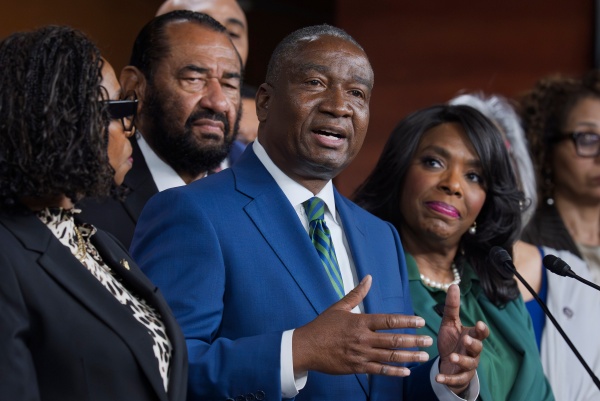
Democratic Rep. Cleo Fields is seen with members of the Congressional Black Caucus on Wednesday at the Capitol. Fields represents the Louisiana congressional district at the heart of the U.S. Supreme Court’s ruling on Wednesday to severely weaken the Voting Rights Act.

Democratic Rep. Cleo Fields is seen with members of the Congressional Black Caucus on Wednesday at the Capitol. Fields represents the Louisiana congressional district at the heart of the U.S. Supreme Court’s ruling on Wednesday to severely weaken the Voting Rights Act.
Democratic Rep. Cleo Fields is seen with members of the Congressional Black Caucus on Wednesday at the Capitol. Fields represents the Louisiana congressional district at the heart of the U.S. Supreme Court's ruling on Wednesday to severely weaken the Voting Rights Act.
J. Scott Applewhite/AP

A historic drop in representation by Black members of Congress may be on the way after the U.S. Supreme Court's landmark decision Wednesday to further weaken the Voting Rights Act.

Now that the high court's conservative majority has reinterpreted longstanding provisions against racial discrimination under Section 2 of the Voting Rights Act, Republican calls for new rounds of map drawing for the House of Representatives have already begun.

How much of that redistricting can be done in time for this fall's midterm election is unclear, although many states have held or are close to holding congressional primary races.

But in the long run, looking beyond this November, many redistricting experts are expecting Republican-controlled state legislatures in the South to eliminate at least some House districts with sizable racial minority populations currently represented by Black Democrats and that were likely protected under the Supreme Court's previous interpretation of Section 2 provisions.

From Louisiana and eastward to North Carolina, there are at least 15 House districts now at risk of elimination, according to an NPR analysis conducted earlier this year. (That list grows longer if taking into account newly redrawn districts in Missouri and Texas, which were not included in the analysis.)

Exactly how redistricting will play out with an eroded Voting Rights Act is hard to predict. Some Democratic-led states may jump into the fray and consider undoing certain majority-minority districts to spread out their voters and try to pick up additional seats.

And some GOP-led states may decide to keep some of those districts for partisan reasons, as they can keep large numbers of Democratic-leaning voters packed within those lines.

Losing even a handful of those districts, however, could set up the largest-ever decline in the number of Black representatives on Capitol Hill — breaking a record set around the end of the post-Civil War Reconstruction era by the Congress that began in 1877 with four fewer House districts represented by Black lawmakers than the previous session.

Black-represented districts were in the single digits or at zero for a century after the Civil War. But since the passing of the Voting Rights Act of 1965, that number has grown to 63 districts, making up around 14% of the House.

The potential drop in that figure drew a swift rebuke Wednesday from members of the Congressional Black Caucus.

"With this decision in Louisiana v. Callais, the Supreme Court has opened the door to a coordinated attack on Black voters across this country," Democratic Rep. Yvette Clarke of New York, chair of the caucus, said during a press conference hours after the court released its decision. "This is an outright power grab. It's about silencing Black voices, dismantling majority Black districts and rigging the maps so that politicians can choose their voters instead of the other way around."

As part of its reinterpretation of the Voting Rights Act, the court's conservative majority ruled that a Louisiana congressional district crafted to comply with Section 2 was an unconstitutional racial gerrymander, and that Section 2 should focus on intentional racial discrimination.

Rep. Terri Sewell, a Democrat from Alabama who has led what has been an uphill push to shore up and expand the Voting Rights Act, said she plans to revise her bill again to "reflect the court cases that have tried to gut" the landmark law.

"Listen, we cannot give up," Sewell said. "We're not going to give up."

In the meantime, however, Atiba Ellis, a law professor and associate dean at Case Western Reserve University, sees the ongoing partisan gerrymandering war between Republicans and Democrats only getting worse with a further weakened Voting Rights Act.

"This could distort politics in Washington substantially by preventing communities of color from genuinely being heard," Ellis says. "I think it highly ironic that under the guise of a colorblind Constitution communities of color in a diversifying America could lose the lion's share of their voice in government."

Edited by Benjamin Swasey

Copyright 2026, NPR


Source link

Leave a Reply

Subscribe to Our Newsletter

Get our latest articles delivered straight to your inbox. No spam, we promise.

Recent Reviews


A Republican lawmaker charged in an alcohol-related driving offense won’t have to appear in court again until after the Legislature adjourns for the year.

A June 10 arraignment hearing is set for Rep. Elliott Engen, a Lino Lakes Republican who faces three misdemeanor charges following an arrest early Friday. He was stopped for speeding and other infractions in White Bear Lake; officers detected alcohol and he later tested well above the legal limit for driving, according to a citation.

Engen has apologized for a lapse in judgment; he promised to learn from his actions and “do better.” Aside from being a second-term legislator, he is also a candidate for state auditor.

A second lawmaker, GOP Rep. Walter Hudson, was in Engen’s truck at the time of the stop and an open bottle of alcohol was found in a rear seat. Hudson, a second-term legislator from Albertville, was in possession of a permitted handgun, which could cause him legal problems if he is determined to have been intoxicated.

Police officers wrote in their report that Hudson disclosed he had the gun as the truck was being searched. The report said police took the firearm for safekeeping and said he could pick it up at a later time, which Hudson agreed to.

“I regret the poor decisions that were made during this incident, and commend the White Bear Police Department for their professional response,” Hudson said in a written statement. “I’m grateful that no harm was done to ourselves and others.”

Two lawmakers stand and look around
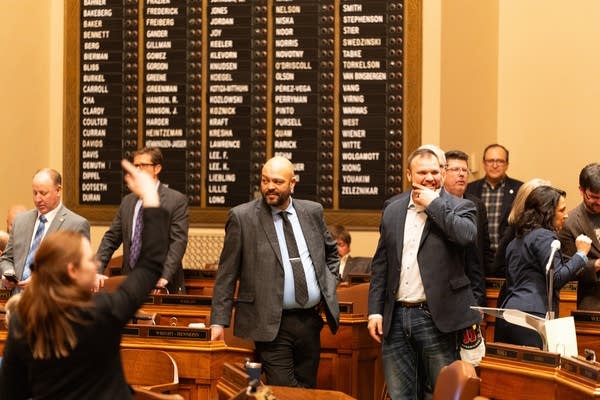
Rep. Walter Hudson, R-Albertville, (center) and Rep. Bidal Duran, R-Bemidji, (right) join other Republican lawmakers gather in the House chambers Jan. 27, 2025.
Tim Evans for MPR News file

A third, unidentified passenger was in the truck as well, according to police. Hudson and that person were transferred to the police department until they could arrange rides.

The Minnesota lawmakers had been at the Capitol late into the evening Thursday as the House debated procedural motions on gun, immigration and social media legislation. The motions failed on 67-67 votes.

There is no indication yet that either Hudson nor Engen had been drinking on Capitol grounds, which would be a violation of a House rule against consumption of alcohol or drugs in spaces under that chamber’s control.

According to a White Bear Lake Police report, Engen initially said he had not been drinking when asked by the police officer who pulled him over — “nothing at all,” he is quoted as saying. He performed a field sobriety test, which the report says showed signs of impairment.

Engen gave a preliminary breath sample there, the report says, which estimated a 0.142 blood alcohol level. After he was taken by squad car to the police department “Engen spontaneously stated, ‘Sir, I had a drink three hours ago,’” the report says.

He told the Minnesota Star Tribune in an interview Monday that he had also consumed alcohol in the afternoon on Thursday as well.

Engen is charged with two impaired driving offenses and speeding. White Bear Lake police also said he was driving a vehicle with expired registration and an inoperable headlight.

Engen has not returned calls from MPR News. A court docket lists a “notice of appearance” on Tuesday.

He is being represented in the criminal case by Chris Madel, an Excelsior attorney who waged a brief Republican campaign for governor.


Source link