According to the Council on Foundations’ report Coming Together, Not Apart, 89% of Americans surveyed support working across differences, and 93% believe people can and do come together to solve hard problems. At the same time, Democrats and Republicans imagine that almost twice as many of their political opponents hold views they consider “extreme” than actually do. More in Common calls this the “perception gap.”
That perception gap grows more damaging when people and organizations lack the tools to work with those who think differently. In that sense, bridge-building is not just a social good. It is enabling infrastructure for systems change and impact investing.
This is one of the ways the Council on Foundations aims to help philanthropy support connection and lead across differences. Coming Together, Not Apart offers tools and strategies for collaboration so foundations can build durable coalitions and implement solutions more effectively. The Building Together conference gave practitioners an opportunity to put those tools into practice, hear from others working across difference, and build relationships.
While the conference programming focused primarily on skill-building, grantmaking, and philanthropic tools, the deeper implication is broader. These strategies help build the relational infrastructure that systems change requires — the trust, culture, and shared purpose that make durable impact possible.
The psychology of working across difference
Understanding the science of belonging and conflict can help practitioners shape strategies that move people toward action rather than simply trying to persuade them to agree.
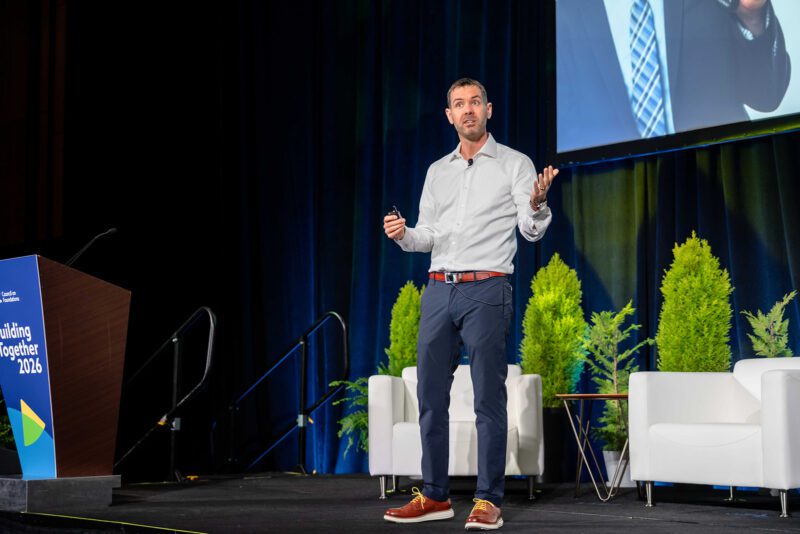
Professor Kurt Gray, the Weary Foundation Endowed Chair in Social Psychology at The Ohio State University, opened the conference with an introduction to the science of conflict. When faced with an opposing view, most people imagine that the person on the other side is against them. Gray calls this the “destruction narrative.”
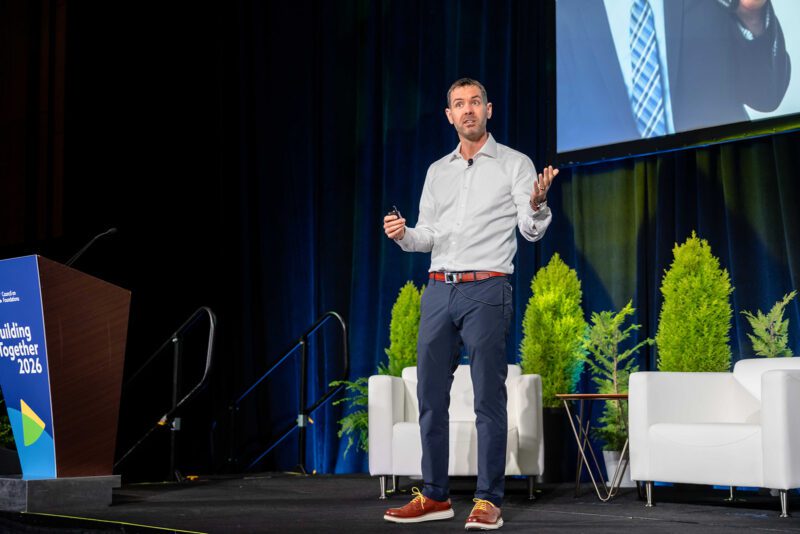
Professor Kurt Gray, the Weary Foundation Endowed Chair in Social Psychology at The Ohio State University
But according to Gray, that is usually not what is happening. Most people are instead driven by what he calls the “protection narrative” — the fundamental need to “protect ourselves, our society, and community.”
“And so a lot of our moral disagreements, our moral outrage, are disagreements about threats and harm,” Gray said.
Later in the week, Dr. Samantha Moore-Berg, assistant professor of social psychology at the University of Utah, made a related point. When people feel under attack or unsafe, certainty in their own opinions increases and empathy decreases. The result is that people become more combative, more entrenched, and less able to see where agreement or collaboration might be possible.
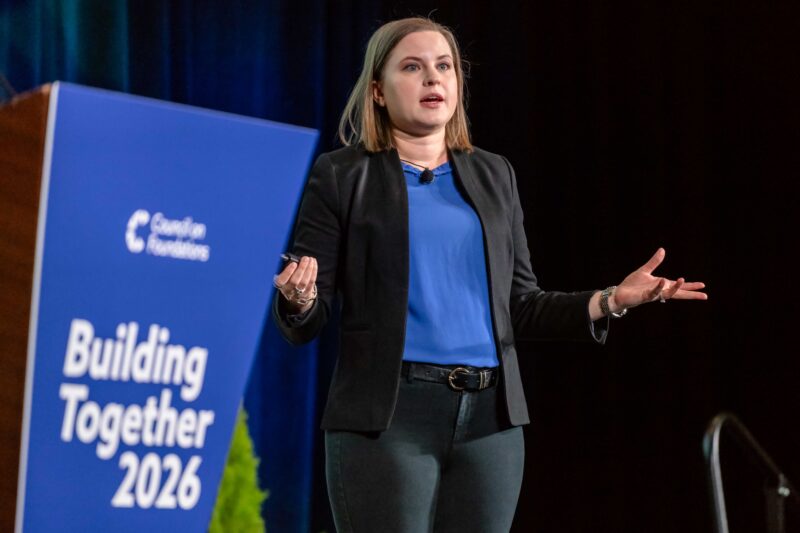
Dr. Samantha Moore-Berg, assistant professor of social psychology at the University of Utah
Open-minded, empathetic, and productive conversations across differences begin by understanding what people are afraid of, and then building a vision for the future that protects what they value.
Translating this insight from psychology into scalable, investable change is more complicated. Building together across differences is both relational and structural. Eric Liu, co-founder and CEO of Citizen University, argued that “culture precedes structure” — and that culture is often the key to structural change.
For organizations working toward systems change, that means bridge-building cannot be treated as soft or peripheral work. It is part of the operating system. To find solutions across difference, institutions need to invest in efforts that shift culture toward shared purpose rather than a zero-sum mindset. Both relational and structural bridges are needed to move from interpersonal trust to community action to systems-level change.
Climate action across the political divide
Climate policy is one sector where stakeholders may be able to come together around shared concerns, even when they differ on ideology, identity, or other issue areas.
A breakout session on “Climate Action in a Polarized US” offered a useful case study. The session featured a panel of primarily conservative organizations working toward environmental and conservation goals as part of a larger field self-identified as the “eco-right.” A representative from the Center for Climate and Energy Solutions, a nonpartisan environmental research nonprofit, also joined the group.
Bridge-building is not just a social good. It is enabling infrastructure for systems change and impact investing.
The eco-right is a movement among conservative Americans seeking to shift climate from a partisan talking point to a bipartisan imperative. Younger generations, in particular, are more likely to be concerned about climate change regardless of party affiliation.
The benefits of building a broader coalition around climate are significant. Panelists shared that they have helped build bipartisan support for initiatives such as permitting reform, which streamlines the federal review process for energy projects and infrastructure. By making the approval process for critical energy infrastructure more efficient and transparent, projects can get funded and built faster.
There is more common ground on climate than many assume. Democrats and Republicans may approach climate policy differently, but many share concerns about energy independence, the energy transition, food and agricultural security, everyday affordability, and the risk of the United States losing economic competitiveness.
Understanding those shared concerns is central to durable change. For climate investors and entrepreneurs, the lesson is not that values differences disappear. It is that coalitions can form when people see their own priorities reflected in the solution. Climate investment, innovation, and growth all depend on a level of political and cultural trust that technical arguments alone cannot create.
Building investable rural futures
The Aspen Institute offered another example of bridge-building as a precursor to investment during a session on “Asset-Based Rural Solutions.”
In 2022, the Aspen Institute Community Strategies Group developed the Thrive Rural Framework, a tool designed to help evaluate and track economic development in rural communities and Native nations. The framework now serves as the foundation for the Community Strategies Group’s work and is intended for rural practitioners across sectors, including funders, investors, and policymakers.
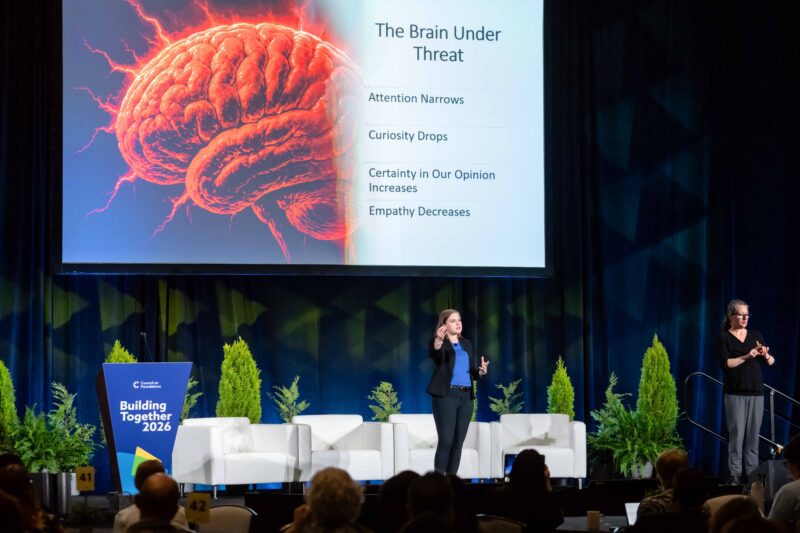
Samantha Moore-Berg discusses how the brain responds under threat during the Council on Foundations’ Building Together 2026 conference, underscoring why durable systems change depends on trust, curiosity, and the capacity to work across difference.
The Thrive Rural Framework considers the key elements that shape rural disadvantage — place, race, and class — and the role each plays at both the local and systemic level. Just as importantly, it creates a shared language for stakeholders with different perspectives to come to the table around common values and goals.
The Community Strategies Group offers a clear example of how funding bridge-building tools and strategies can prepare communities for investment. Small-business investment, community-determined investment outcomes, and blended capital are among the framework’s key tenets.
One meaningful outcome for investors is WealthWorks, a tool that helps match regional needs and community assets to market demand. By building infrastructure for connecting across difference, the Aspen Institute has already helped catalyze investments in rural entrepreneurship, energy, agriculture, and culture.
For organizations working toward systems change, bridge-building cannot be treated as soft or peripheral work. It is part of the operating system.
This is where bridge-building becomes especially relevant to the impact economy. Rural development is often treated as a capital-access problem or a policy problem. It is both. But it is also a trust problem, a narrative problem, and a coordination problem. Place-based investing can only work when the people, institutions, and capital providers involved have some shared understanding of what a thriving local economy is for.
Bringing capital into the bridge-building agenda
Philanthropic grants toward “building together” play an important role in long-term change. But there remains an opportunity for practitioners to better leverage investing as a strategy for systems change.
The conference focused on tools that individuals and institutions can use to foster belonging through interpersonal relationships, networks, and grantmaking. These are essential. Durable coalitions do not appear by accident. They require practice, facilitation, listening, and trust.
Yet investment strategies that use philanthropic capital — including social enterprises, affordable housing, climate technology, community finance, and place-based investing — were notably less visible in the conference conversation. Several foundations and practitioners in attendance do engage in impact investing or mission-aligned investing, but the programming focused largely on grantmaking and technical assistance.
Trust creates the conditions for collaboration; culture shapes what people believe is possible; and capital helps translate shared purpose into durable structures.
That gap matters because the world’s most entrenched problems are not solved by relationships alone, just as they are not solved by capital alone. Systems change requires both. Trust creates the conditions for collaboration; culture shapes what people believe is possible; and capital helps translate shared purpose into durable structures, enterprises, infrastructure, and policy.
For philanthropy, the next step is not to abandon bridge-building for investment, or investment for bridge-building. It is to integrate them more intentionally.
As organizations consider more holistic responses to polarization, climate change, rural disinvestment, and other systemic challenges, building together will require all the tools at an institution’s disposal: relational, structural, and financial.
The missing infrastructure of systems change is not only roads, broadband, housing, or energy systems. It is also trust, culture, and the capacity to act across difference. Without that infrastructure, capital struggles to move well. With it, impact investing has a better chance of becoming what it claims to be: a tool for durable, shared transformation.