Timberwolves handed largest postseason defeat, 133-95


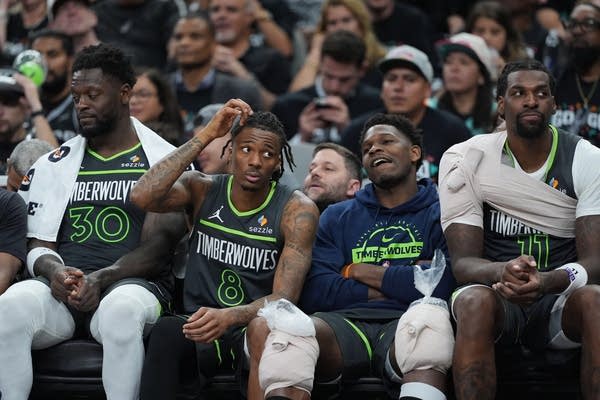
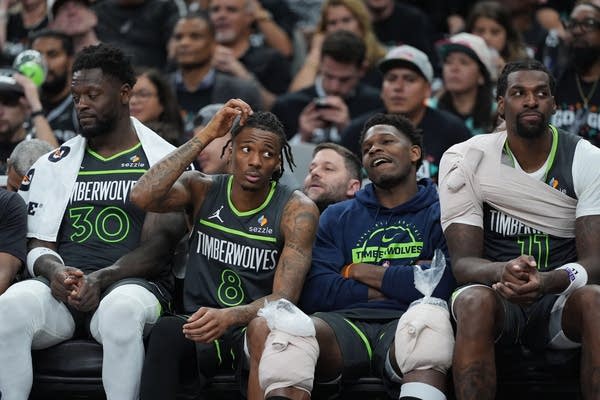
Julius Randle,Bones Hyland,Anthony Edwards,Naz Reid

Victor Wembanyama had 19 points and 15 rebounds, and the San Antonio Spurs handed Minnesota its worst postseason loss in franchise history, beating the Timberwolves 133-95 on Wednesday night to even their Western Conference semifinal series at one game apiece.

“I just told them we got punked,” Minnesota coach Chris Finch said.

Stephon Castle had 21 points and De'Aaron Fox added 16 points for San Antonio, which shot 50 percent from the field and 41 percent on 3-pointers. It was the highest-scoring playoff game for the Spurs since a series-clinching 145-105 win over Denver on May 4, 1983.

Anthony Edwards, Julius Randle, Jaden McDaniels and Terrence Shannon Jr. each scored 12 points for Minnesota.

Edwards came off the bench again as Minnesota continued to restrict his minutes in his second game back from a hyperextended left knee.

Games 3 and 4 are Friday and Sunday in Minneapolis.

With Wembanyama playing more aggressively on offense from the outset, the Spurs put the series-opening loss behind them quickly.

Minnesota's previous largest postseason defeat was by 30 points to the Los Angeles Lakers on April 29, 2003.

Only the margin of victory was in doubt Monday as both teams sent their starters to the bench with 10 minutes remaining and the Spurs leading 104-66.

“I told the guys after the first game it’s the natural tendency for the team that steals the first game, the away team, to get blown out in Game 2," Edwards said. “We can’t come out cool and we came out cool and what happened — we got blown out.”

After combining to score 21 points on 10-for-31 shooting in Game 1, Wembanyama and Fox combined to go 12 of 25 from the field Wednesday.

The All-Star duo scored the Spurs' first 11 points as they raced to a 29-point lead in the first half.

“Just trying to set the tone,” Wembanyama said.

Fox finished 2 for 2 on 3-pointers after missing on four attempts in Game 1.

“We’re at our best when (Fox is) in attack mode,” San Antonio coach Mitch Johnnson said. “He has probably the strongest ripple effect on our team in terms of when he’s in attack mode pushing the pace, because you have Steph (Castle) and Dylan (Harper) that follow suit with that. And then our shooters get shot in transition. Victor plays in space and so on and so forth.”

The Spurs missed their first three shots, but Wembanyama followed the third attempt by flying through the lane and throwing down a right-handed dunk to open the scoring.

Minnesota was held to 35 points in the first half. The Timberwolves shot 29.8 percent from the field before halftime and were 2 for 15 on 3-pointers as they fell behind by 25 points.

“I loved how everyone had everybody’s back (defensively),” Wembanyama said. “Tonight looked like a system that worked.”

Source link

Leave a Reply

Subscribe to Our Newsletter

Get our latest articles delivered straight to your inbox. No spam, we promise.

Recent Reviews


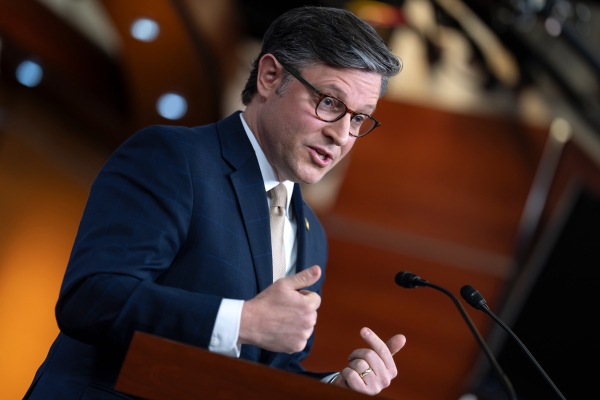
Speaker of the House Mike Johnson, R-La., takes questions at a news conference at the U.S. Capitol on April 21, 2026.

Speaker of the House Mike Johnson, R-La., takes questions at a news conference at the U.S. Capitol on April 21, 2026.
Speaker of the House Mike Johnson, R-La., takes questions at a news conference at the U.S. Capitol on April 21.
J. Scott Applewhite | AP

The House of Representatives voted Thursday to reopen most of the Department of Homeland Security, ending the longest agency shutdown in U.S. history.

The House passed a bill funding DHS, minus dollars for Immigration and Customs Enforcement and Customs and Border Protection. The measure passed by voice vote on what was the 76th day of the shutdown.

Democrats refused to back funding for many of the agency's immigration functions in an unsuccessful effort to secure reforms including body-worn cameras and broad restrictions on face coverings after federal law enforcement killed two American citizens in Minnesota earlier this year.

The Senate, led by Republican Majority Leader John Thune, R-S.D., unanimously advanced this funding legislation in March. At the time, Speaker Mike Johnson, R-La., referred to the proposal as "a joke" and refused to bring it up for a vote. Many members of the House Republican conference refused to fund the agency in a piecemeal fashion and did not want to negotiate over reforms to immigration enforcement operations.

On April 1, Johnson reversed course. He announced the funding bill would be voted on "in the coming days." More than four weeks later, he finally made good on that commitment.

In an effort to appease his hardline members, Johnson waited to bring the Senate's proposal to a vote until that chamber's Republicans started the arcane procedural process, known as reconciliation, to fund all of DHS — including Immigration and Customs Enforcement (ICE) and Customs and Border Protection (CBP) — for the remainder of Trump's term without any backing from Democrats.

The funding bill comes as Secretary of Homeland Security Markwayne Mullin warned the agency was close to running out of funds to pay staff.

"We have reached all the emergency funds we can reach into," Mullin told Fox News on Friday. "I am completely out of the slush fund, I have no place to move at the end of the month."

Mullin said the agency was relying on appropriated funds from last year's One Big Beautiful Bill, which allocated more than $150 billion to DHS on top of its regular annual appropriations funding.

President Donald Trump signed a memo this month authorizing DHS to use some of the money from that legislation to fund the department's operations — potentially infringing on the powers granted to Congress by the Constitution to direct how taxpayer money is spent.

Copyright 2026, NPR


Source link