

U of M says economic growth can help environment


A green tractor pulls a trailer in a field of crops.

Economic growth in poorer countries may be the best way to protect biodiversity, according to a new study led by University of Minnesota researchers recently published in the Proceedings of the National Academy of Sciences.

Cropland expansion is a major environmental issue, causing habitat loss and climate change. That’s part of the reason why debates about the environment and economic growth often pit the two against each other, said lead author Steve Polasky, environmental economist at the University of Minnesota.

“The standard line is if you make people richer, they’re just going to want to eat more, and they’re going to want to eat more meat, and that's going to be bad for nature,” Polasky said. “But there's a couple of other factors going on.”

The study examines global trends to project how much land will be used for crops in low-income countries under different potential futures. Researchers found that if these countries have accelerated economic development, global cropland demand may shrink

That’s because rising incomes are associated with reduced population growth and higher agricultural yields, meaning more food from less land. Researchers highlight that these trends have already been observed in other countries, such as the United States and China.

A green tractor in front of grain bins
A tractor sits in front of grain bins at a farm in Lowry, Minn., on April 14. A new study from University of Minnesota researchers finds countries use less cropland as they become wealthier, preserving biodiversity
Tadeo Ruiz Sandoval | MPR News

“As people become wealthier, we see this: people don't have as many children,” Polasky said. “And then there’s the supply-side: farmers, when they have more resources, and when they are in societies that have more resources, they do better, they increase their yields.”

Those two factors more than offset the change in tastes associated with higher incomes. Polasky said the result told the “hopeful story” that easing global poverty and helping the environment can happen at the same time without relying on diet changes.

“I've been to many workshops where they say we just need to change diets, and that's like one of the hardest things to do,” he said.

Potential paths to economic growth

Polasky and his team highlighted several policies that could help boost developing economies while reducing cropland demand, such as directing more money toward agricultural research in developing countries.

“Why have we seen such large yield increases in Iowa and Minnesota and the rest of the U.S.?” he said. “Part of that is that, historically, we've put a fair amount of money into research and development and into extension, so getting the advances and the better seeds out of university laboratories and into seed companies and to farmers.”

Freer trade could help developing economies, too, Polasky said. If crops are mostly produced in countries with the highest yields and exported to lower-yield countries, that could reduce global cropland requirements and biodiversity loss. But like trying to change diets, that might also be a hard sell in the United States given the Trump Administration's protectionist policies.

“This move towards higher tariffs, more tariff barriers, non-tariff barriers is a move that moves against that and reduces the ability of U.S. farmers to effectively feed the world and take pressure off of land expansion elsewhere,” Polasky said.



Source link

Leave a Reply

Subscribe to Our Newsletter

Get our latest articles delivered straight to your inbox. No spam, we promise.

Recent Reviews


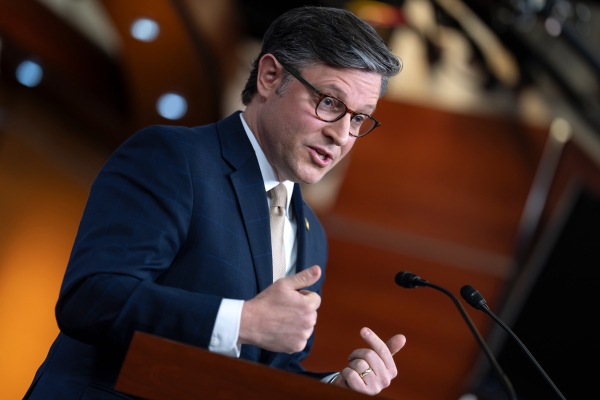
Speaker of the House Mike Johnson, R-La., takes questions at a news conference at the U.S. Capitol on April 21, 2026.

Speaker of the House Mike Johnson, R-La., takes questions at a news conference at the U.S. Capitol on April 21, 2026.
Speaker of the House Mike Johnson, R-La., takes questions at a news conference at the U.S. Capitol on April 21.
J. Scott Applewhite | AP

The House of Representatives voted Thursday to reopen most of the Department of Homeland Security, ending the longest agency shutdown in U.S. history.

The House passed a bill funding DHS, minus dollars for Immigration and Customs Enforcement and Customs and Border Protection. The measure passed by voice vote on what was the 76th day of the shutdown.

Democrats refused to back funding for many of the agency's immigration functions in an unsuccessful effort to secure reforms including body-worn cameras and broad restrictions on face coverings after federal law enforcement killed two American citizens in Minnesota earlier this year.

The Senate, led by Republican Majority Leader John Thune, R-S.D., unanimously advanced this funding legislation in March. At the time, Speaker Mike Johnson, R-La., referred to the proposal as "a joke" and refused to bring it up for a vote. Many members of the House Republican conference refused to fund the agency in a piecemeal fashion and did not want to negotiate over reforms to immigration enforcement operations.

On April 1, Johnson reversed course. He announced the funding bill would be voted on "in the coming days." More than four weeks later, he finally made good on that commitment.

In an effort to appease his hardline members, Johnson waited to bring the Senate's proposal to a vote until that chamber's Republicans started the arcane procedural process, known as reconciliation, to fund all of DHS — including Immigration and Customs Enforcement (ICE) and Customs and Border Protection (CBP) — for the remainder of Trump's term without any backing from Democrats.

The funding bill comes as Secretary of Homeland Security Markwayne Mullin warned the agency was close to running out of funds to pay staff.

"We have reached all the emergency funds we can reach into," Mullin told Fox News on Friday. "I am completely out of the slush fund, I have no place to move at the end of the month."

Mullin said the agency was relying on appropriated funds from last year's One Big Beautiful Bill, which allocated more than $150 billion to DHS on top of its regular annual appropriations funding.

President Donald Trump signed a memo this month authorizing DHS to use some of the money from that legislation to fund the department's operations — potentially infringing on the powers granted to Congress by the Constitution to direct how taxpayer money is spent.

Copyright 2026, NPR


Source link