
Definition
AI transformation is the strategic deployment of artificial intelligence across a company’s core processes, products, and operating model to replace manual workflows with intelligent systems that continuously learn, adapt, and improve measurable business outcomes.
AI transformation is not the same as installing a few AI tools. It is the structural rewiring of how a business operates, with intelligence embedded across operations, customer experience, product development, and decision-making. When done well, it does not just make existing processes faster. It makes them autonomous, predictive, and self-improving.
According to McKinsey’s State of AI 2024 report, 65% of organizations now use generative AI regularly across at least one business function, nearly double the rate from early 2023. Yet embedding AI into core operations at enterprise scale, beyond isolated tools and pilot projects, remains far less common than headline adoption figures suggest. The gap between AI adoption and measurable enterprise value is consistent, and it is almost always a strategy and execution problem rather than a technology problem.
This guide covers what AI transformation means in practice, how it differs from digital transformation, the core technologies powering it, a proven eight-stage implementation framework developed from 300+ AI product builds, real industry applications, Ailoitte case studies, and the criteria for choosing the right AI transformation company.
AI Transformation vs Digital Transformation
These two terms are frequently conflated but describe fundamentally different organizational journeys. Understanding the distinction matters because the strategies, timelines, investments, and success metrics are entirely different.

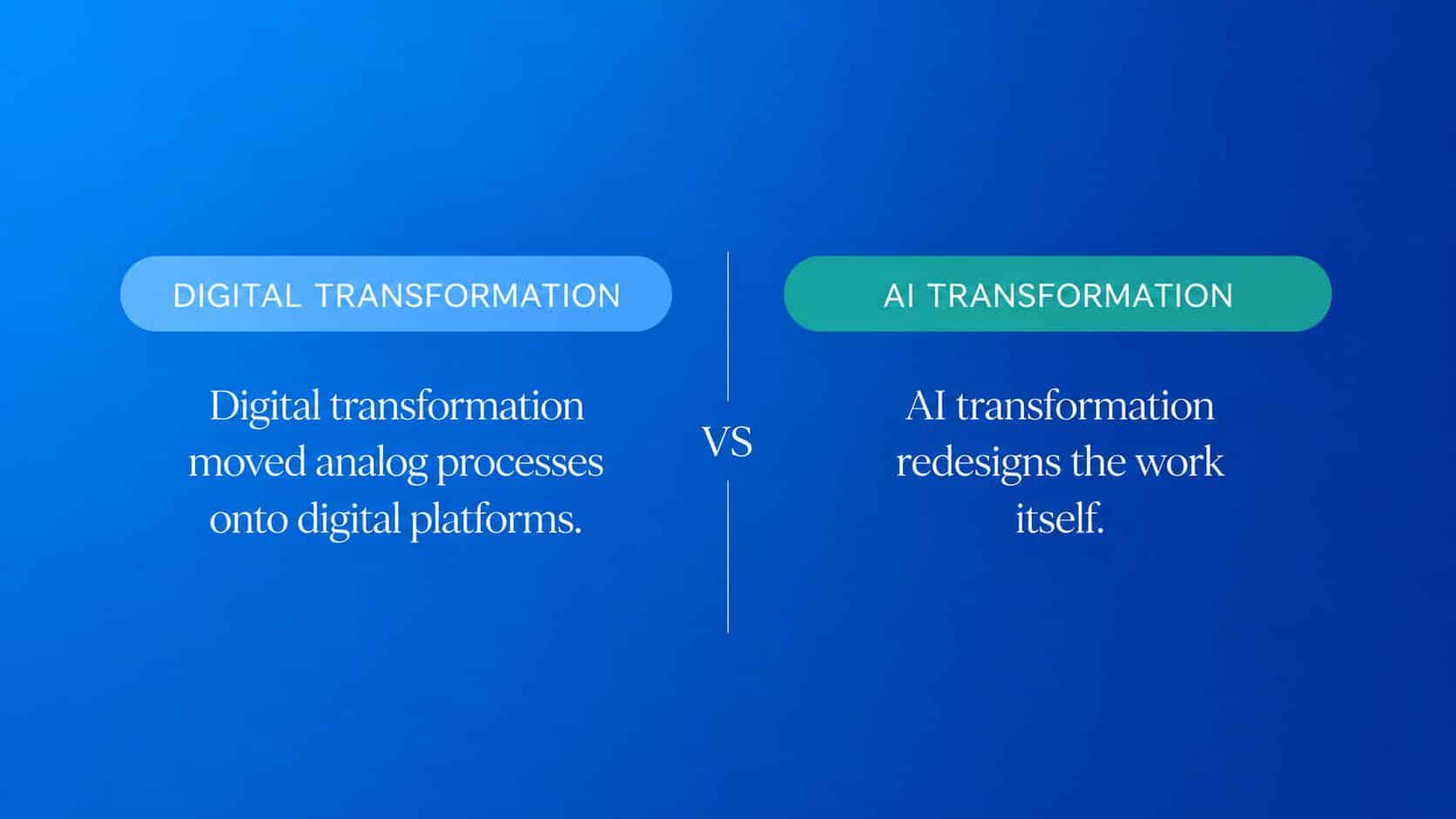
Digital transformation moved analog processes onto digital platforms. Paper forms became web forms. Filing cabinets became cloud storage. In-store checkout became e-commerce. The underlying work remained essentially the same. The medium changed.
AI transformation redesigns the work itself. Instead of digitizing a manual invoice review process, an AI transformation initiative eliminates the manual review entirely by deploying a model that reads, classifies, validates, and routes invoices autonomously. Instead of presenting dashboards for humans to interpret, AI surfaces specific anomalies and recommended actions before any analyst would notice the pattern.
| Dimension | Digital Transformation | AI Transformation |
|---|---|---|
| Core activity | Move processes to digital platforms | Make processes autonomous and self-improving |
| Driver | Efficiency through digitization | Value creation through intelligence |
| What changes | The medium (paper to screen) | The operating model (human to AI) |
| Outcome | Faster human-run processes | Autonomous, continuously optimizing systems |
| Scope | Technology adoption | Operating model redesign |
| Time to value | 12-24 months | 6-12 months with structured framework |
Core Technologies Powering AI Transformation
AI transformation is not a single technology. It is the deliberate integration of several AI disciplines, each serving a distinct function in the transformation stack.
Machine Learning and Predictive Analytics
Machine learning algorithms identify patterns in historical data to forecast outcomes, classify inputs, and detect anomalies in real time. In enterprise contexts, ML powers demand forecasting, customer churn prediction, fraud detection, and automated quality control. The business value is not the prediction itself but the operational action it triggers without manual review.
Generative AI
Generative AI creates original content, including text, code, images, and structured data, from patterns learned during training. Enterprise applications include automated contract drafting, code generation, personalized customer communications, and synthetic training data creation. A 2022 GitHub research study found that developers using AI coding assistance completed tasks up to 55% faster on average, with gains varying by task complexity. Similar productivity patterns are reported across other knowledge-intensive functions.
Agentic AI and Autonomous Workflows
Agentic AI represents the current frontier of AI transformation. AI agents do not just produce outputs. They plan, take sequences of actions, use external tools, call APIs, and complete multi-step tasks with minimal human intervention. Organizations deploying agents for knowledge-intensive work, including customer onboarding, procurement, compliance review, and software development, are seeing the largest productivity gains of any AI application category in 2025.
Intelligent Automation
Traditional robotic process automation follows rigid rules and fails on exceptions. AI-enhanced automation adds perceptive capability, reading unstructured documents, handling edge cases autonomously, and learning from corrections over time. This layer handles high-volume, repetitive cognitive workflows that drain team capacity and are too variable for rule-based systems.
LLMOps and Data Infrastructure
The operational backbone of any AI transformation program is invisible but non-negotiable. LLMOps, the discipline of managing large language models in production, governs model deployment, performance monitoring, version control, retraining pipelines, and drift detection at scale. Without it, AI projects succeed in pilot and fail in production. Robust data infrastructure is equally critical: AI systems are only as reliable as the data they consume.
Is your infrastructure AI-ready? Ailoitte offers a free AI Readiness Assessment that maps your current data maturity, technology stack, and organizational readiness to a production-ready AI architecture.
The Ailoitte AI Transformation Framework: 8 Stages to Production
Ailoitte has designed, built, and deployed 300+ AI-native products across 21 countries. The eight-stage framework below distills that delivery experience into a repeatable model built around one principle: every stage must produce a measurable business output, not just a technical deliverable.
Stage 1: Define business outcomes before selecting technology
AI transformation fails most consistently when it starts with technology selection instead of outcome definition. Stage 1 identifies the specific metrics the transformation must move: cost per transaction, time-to-resolution, revenue per customer, or defect rate. Every subsequent stage is evaluated against these anchors.
Stage 2: Conduct an AI readiness audit
A readiness audit examines three dimensions: data maturity (volume, quality, and accessibility of operational data), technology infrastructure (cloud readiness, API availability, model hosting options), and organizational readiness (available talent, governance structures, and change management capacity). This audit surfaces the constraints that would otherwise become expensive late-stage surprises.
Stage 3: Build the AI roadmap by impact and complexity
The roadmap sequences AI initiatives by two variables: potential business impact and implementation complexity. Quick wins, typically automation of high-volume rules-heavy manual tasks, build internal confidence and generate the measurable ROI that funds deeper transformation across the organization.
Stage 4: Establish data governance before model development
AI data governance is not a compliance formality. It is the structural foundation that determines whether AI systems produce reliable outputs or unreliable ones. Stage 4 establishes data ownership, access controls, quality standards, and compliance guardrails. For regulated industries, this stage also addresses model explainability requirements, bias monitoring procedures, and audit trail structures that regulators and enterprise clients increasingly mandate.
Stage 5: Select the right AI stack for your operating context
Stack selection covers model choice (open-source vs. proprietary vs. fine-tuned), deployment architecture (cloud, on-premise, or hybrid), and the integration layer that connects AI outputs to existing systems. The right stack is one your team can operate, monitor, and iterate on in production, not simply the most capable model available at the time of selection.
Stage 6: Run structured pilot projects with defined success criteria
Pilots should be scoped to a single workflow, a quantifiable outcome, and a 6-10 week timeline. The goal is validated learning, not a perfect system. A pilot demonstrating a 20-30% improvement on a target metric creates the internal stakeholder confidence needed for broader deployment authorization.
Stage 7: Scale with governance controls in parallel
Scaling AI is not simply deploying more models. It requires model monitoring frameworks, drift detection, escalation paths for edge cases, and human-in-the-loop checkpoints wherever error consequences are high. Ailoitte’s AI Velocity Pods deliver production-ready AI systems at 5x the speed of traditional development teams by building governance infrastructure in parallel with product development rather than after it, eliminating the compliance lag that typically delays enterprise AI deployment by months.
Stage 8: Measure, iterate, and compound value over time
AI transformation is a living system, not a one-time build. Models drift when data distributions shift. Business conditions change. Stage 8 establishes the KPIs, monitoring dashboards, and structured review cadences that keep AI systems aligned with business goals continuously after launch, not just at the moment of deployment.
See what the Ailoitte AI Transformation Framework looks like applied to your business.
AI Transformation Across Industries
AI transformation is active across every major industry vertical. The following applications represent domains where measurable outcomes are documented and deployment velocity is accelerating through 2025 and 2026.

Healthcare
AI in healthcare is automating one of medicine’s most documented productivity drains: administrative burden. A landmark study published in the Annals of Internal Medicine (Sinsky et al., 2016) found that physicians spend 49% of their working time on administrative tasks and EHR documentation compared to just 27% on direct patient care. AI is systematically reclaiming that time, while also accelerating diagnosis through medical imaging analysis and enabling population health management at a scale previously impossible for human teams. Predictive readmission models flag at-risk patients before discharge, reducing both cost and adverse outcomes simultaneously. AI-assisted ambient documentation systems deployed across health networks have demonstrated consistent, clinically significant reductions in per-encounter documentation time in published implementation studies, with time freed returning directly to patient care.
Finance and Fintech
AI in fintech has expanded from fraud detection to encompass real-time credit risk assessment, automated regulatory compliance reporting, AI-driven underwriting, and personalized wealth management at scale. AI models now review regulatory documents in hours rather than weeks, a capability that is becoming competitively necessary as compliance requirements intensify under frameworks including the EU AI Act.
Retail and E-commerce
Retail AI transformation delivers individualized product recommendations, demand forecasting that reduces both overstock and stockout events simultaneously, and dynamic pricing that responds to competitive signals in real time. The measurable outcomes are higher revenue per visitor and lower logistics cost, driven by the same underlying data and modeling infrastructure.
Manufacturing
Predictive maintenance AI monitors equipment sensor streams continuously, identifying failure signatures before breakdown occurs. Quality control vision systems detect defects at production line speed with accuracy that manual visual inspection cannot sustain consistently across shifts. These two applications address manufacturing’s two largest cost drivers directly: unplanned downtime and scrap rate.
Ailoitte AI Transformation in Practice
The following projects represent Ailoitte’s direct AI transformation delivery work. Each demonstrates a different domain of AI transformation applied to real commercial requirements.
Prime Compliance: AI-Native Compliance Automation Platform
Prime Compliance engaged Ailoitte to architect and build an AI-native compliance management platform designed to automate regulatory document monitoring, obligation extraction, and structured compliance reporting. The platform processes regulatory filings and legal documents, surfaces actionable compliance obligations with priority classification, and generates audit-ready records, replacing a workflow that previously required intensive manual analyst hours at each regulatory cycle. Read the Prime Compliance case study.
Kalaido.AI: Generative AI Platform for Creative Production
Ailoitte built Kalaido.AI as a generative AI platform enabling creative and marketing teams to generate, iterate on, and deploy visual content through AI-native workflows. The product demonstrates Ailoitte’s capability to deliver end-to-end generative AI applications from model integration through production-grade product experience in a commercially deployed, at-scale environment. Read the Kalaido.AI case study.
Card Paisa: Fintech Platform with AI-Powered Financial Intelligence
Ailoitte engineered the Card Paisa fintech platform with AI-powered financial intelligence embedded at its core, enabling intelligent transaction analysis and automated financial workflow management for its user base. The project illustrates Ailoitte’s capacity to deliver AI transformation outcomes in regulated financial services environments where reliability and auditability are non-negotiable requirements. Read the Card Paisa case study.
Documented Benefits of AI Transformation
The business case for AI transformation is grounded in documented outcomes from production deployments, not projected potential.
Measurable productivity gains in affected functions
McKinsey’s research on AI-driven transformation documents its clearest productivity signals in knowledge-intensive functions. The firm’s 2023 analysis of generative AI’s economic potential found that use cases in software engineering, R&D, marketing, and customer operations account for the largest share of AI-driven productivity value, precisely because these functions involve the highest volumes of drafting, summarizing, classifying, and synthesizing tasks that AI handles at scale.
Faster and better-calibrated decisions
AI systems process data at a scale and speed no human team can match. Real-time models give leaders current operating insights rather than last-period reports, enabling decisions that are both faster and better calibrated to actual conditions. Anomaly detection surfaces problems before they reach threshold levels that trigger manual review.
Personalized customer experience at enterprise scale
AI-powered recommendation engines, personalization layers, and intelligent service agents allow organizations to deliver tailored experiences to millions of users simultaneously. This is operationally impossible for human-only teams and translates directly into measurable improvements in conversion rates, retention, and customer lifetime value.
Cost structure improvement without proportional headcount reduction
AI transformation’s productivity gains typically manifest as capacity freed for higher-value work rather than immediate headcount reduction. Teams previously spending the majority of their time on manual data extraction and report preparation redirect that capacity toward strategy, client relationships, and product development.
Durable competitive advantage through compounding data moats
McKinsey estimates generative AI alone could deliver $2.6 to $4.4 trillion in additional annual economic value across industries (McKinsey Global Institute, 2023). Organizations that build AI capability now establish data and operational moats that are genuinely difficult for late-moving competitors to replicate, particularly in industries where proprietary historical data improves model quality over time.
Non-linear scalability
AI systems scale with demand at negligible marginal cost. A document processing model handling 1,000 inputs today handles 100,000 inputs tomorrow with no additional labor requirement. This cost structure changes the economics of growth in any data-intensive operation.
Common Challenges in AI Transformation and How to Overcome Them

Data quality and accessibility
The most consistent AI transformation obstacle is not the AI technology itself. It is the underlying data. Models trained on incomplete, inconsistent, or siloed data produce unreliable outputs that erode stakeholder trust quickly and permanently. The solution is a structured data preparation phase including auditing, cleaning, deduplication, and governance setup before model development begins. In the Ailoitte framework, this data foundation work spans Stages 3 and 4.
Organizational resistance to change
Teams resist AI transformation when they experience it as a replacement threat rather than a capability amplifier. The most effective counter strategy is early and genuine involvement: identify internal champions in each affected department, demonstrate AI handling the tasks people most dislike, and frame productivity gains as capacity for higher-value work rather than as a headcount reduction mechanism.
Governance and regulatory compliance gaps
Deploying AI in regulated industries without proper governance structures creates both regulatory liability and reputational risk. The EU AI Act entered into force in August 2024, with its most consequential tier, the high-risk AI system requirements covering healthcare, financial services, employment, and other regulated domains, taking effect in August 2026. These provisions introduce mandatory risk classification, human oversight requirements, and documentation obligations. Note: the prohibition on unacceptable-risk AI practices took effect earlier, in February 2025. Organizations without governance infrastructure in place face both compliance cost and competitive delay.
The pilot-to-production gap
Many organizations successfully complete AI pilots and then fail to scale them. The failure point is almost always operational rather than technical: no MLOps infrastructure to monitor models in live production, no defined retraining process when data distributions shift, and no clear ownership of AI systems after the initial launch sprint ends. Closing this gap requires investing in the operational layer before it becomes the deployment bottleneck.
Ready to move from pilot to production? Book a free 45-minute AI Transformation Consultation with Ailoitte’s engineering team.
How to Choose the Right AI Transformation Company
Choosing an AI transformation company is among the most consequential decisions in any technology strategy. The wrong partner delivers compelling proofs-of-concept that never reach production. The right one builds systems that compound in business value over time.
These are the criteria that separate AI transformation companies with genuine execution capability from those selling strategy decks without delivery track records:
- Production delivery track record. Ask specifically for examples of AI systems deployed to live production environments with real users and real data, not demonstration environments or internal prototypes. Request outcome metrics from those deployments, not slide presentations about them.
- Full-stack technical capability. AI transformation requires machine learning, MLOps, product engineering, UX design, and change management working in parallel. A company strong in research but weak in production engineering creates handoff failures that delay time to value by months and erode stakeholder confidence.
- Industry-specific domain experience. Generic AI expertise does not transfer cleanly into regulated domains. Prior experience delivering AI systems in healthcare, financial services, or manufacturing significantly reduces the risk of regulatory, operational, or data security errors during live deployment.
- Outcome-based engagement model. Avoid vendors whose pricing is structured entirely around hours rather than outcomes. Ailoitte’s AI Velocity Pods are structured as fixed-price, outcome-defined engagements, which means the vendor’s incentive is aligned with the client’s result rather than with the duration of the engagement.
- Transparent AI governance practices. AI transformation companies should explain clearly and specifically how deployed models are monitored, how performance drift is detected, how errors are caught and corrected, and how systems are updated as business conditions change. Vague governance at the pitch stage consistently predicts vague governance in production.
The Future of AI Transformation in 2026 and Beyond
Agentic AI entering enterprise production
The shift from AI tools to agentic AI systems is the defining development of 2025 and 2026. Agents that autonomously plan, execute multi-step tasks, use external tools, and iterate on outputs are moving from research projects to production deployments. Early enterprise adopters are running agents for customer onboarding workflows, regulatory submission preparation, and software development pipelines. Organizations that invest in agentic infrastructure today will hold a compounding operational advantage over those that wait for the technology to mature further.
Multimodal AI expanding business function coverage
The next generation of enterprise AI models processes text, images, audio, and structured data simultaneously within a single model context. This enables applications that were previously impossible at scale: automated invoice processing that reads the document image and cross-validates against ERP line items in the same pipeline, real-time call compliance analysis, and AI quality inspection combining visual feeds with sensor telemetry. Business functions with high volumes of mixed-format data stand to benefit most from this architectural shift.
AI governance transitioning from compliance to competitive differentiator
The EU AI Act, the NIST AI Risk Management Framework, and emerging national AI regulation globally require documented, monitored, and auditable AI systems for high-risk domain applications. Organizations that build governance infrastructure proactively face lower compliance costs, shorter enterprise sales cycles, and fewer deployment disruptions when regulations tighten. Among enterprise B2B buyers, demonstrable AI governance is increasingly a purchasing criterion, not just a regulatory checkbox.
Conclusion
AI transformation is not a project with a finish line. It is a capability that accumulates value continuously as models improve, data volumes grow, and more business processes become candidates for automation and intelligent augmentation.
The organizations capturing the most value in 2025 are not those that adopted AI earliest. They are those with a clear outcome-led strategy, a solid data foundation, and an AI transformation company capable of delivering at production quality across the full technology stack, from model selection through MLOps governance and organizational change.
Ailoitte has built 300+ AI-native products across 21 countries, delivering measurable outcomes for startups and enterprises through a fixed-price, outcome-defined delivery model. If you are mapping your first AI initiative or scaling an existing program, the path to production starts with a clear strategy and the right engineering partner. Start your AI transformation with Ailoitte.
FAQs
What is AI transformation?
AI transformation is the systematic integration of artificial intelligence into a company’s core operations, products, and decision-making processes at scale. Unlike point-solution AI adoption, which adds tools to existing workflows, AI transformation redesigns how work is performed at a structural level, making processes autonomous, predictive, and continuously self-improving through machine learning, generative AI, and agentic systems working together.
How to use AI in digital transformation?
Here are some ways to use AI in digital transformation: predictive analytics, personalized customer experiences, process automation, natural language processing (NLP), computer vision, fraud detection, and more.
How do IoT development services contribute to AI transformation?
The IoT devices collect real-time data, and these data are fed into AI systems in analytics, through the optimization of processes, bring about higher efficiency and thus intelligent environments.
How can AI help businesses enhance decision-making?
AI can help businesses enhance decision-making in multiple ways, such as data analysis and predictive analytics, automation of routine tasks, real-time insights and notifications, scenario planning, creating personalized customer experiences, etc.
How can businesses evaluate the success of their AI implementation?
To measure the success of AI transformation, businesses can track various metrics, including performance indicators, business impact, ROI, cost-benefit analysis, and customer feedback.
Which sectors benefit the most from AI Transformation?
Sectors like healthcare, retail, manufacturing, finance, and startups have seen significant benefits, as the main advantages of AI innovations lie in improving efficiency, and enhancing customer satisfaction.
How can businesses stay up-to-date with emerging AI trends to keep adapting their strategies?
Businesses can stay updated on emerging AI trends by attending industry events, following relevant online resources, reading research papers, and partnering with tech vendors and startups.
What role does Ailoitte play in AI transformation programs?
Ailoitte is an AI-native product engineering company that designs, builds, and deploys AI transformation solutions for startups and enterprises across 21 countries. AI Velocity Pods deliver production-ready AI systems at 5x the speed of traditional development teams through fixed-price, outcome-defined engagements. Ailoitte’s delivery scope spans the full AI transformation stack: data infrastructure, model development, MLOps, product engineering, and governance implementation. Learn more about Ailoitte’s AI transformation capabilities.

Discover how Ailoitte AI keeps you ahead of risk

Sunil Kumar
Sunil Kumar is CEO of Ailoitte, an AI-native engineering company building intelligent applications for startups and enterprises. He created the AI Velocity Pods model, delivering production-ready AI products 5× faster than traditional teams. Sunil writes about agentic AI, GenAI strategy, and outcome-based engineering. Connect on
LinkedIn

Stephan is the sports journalist for the Maple Grove Report.