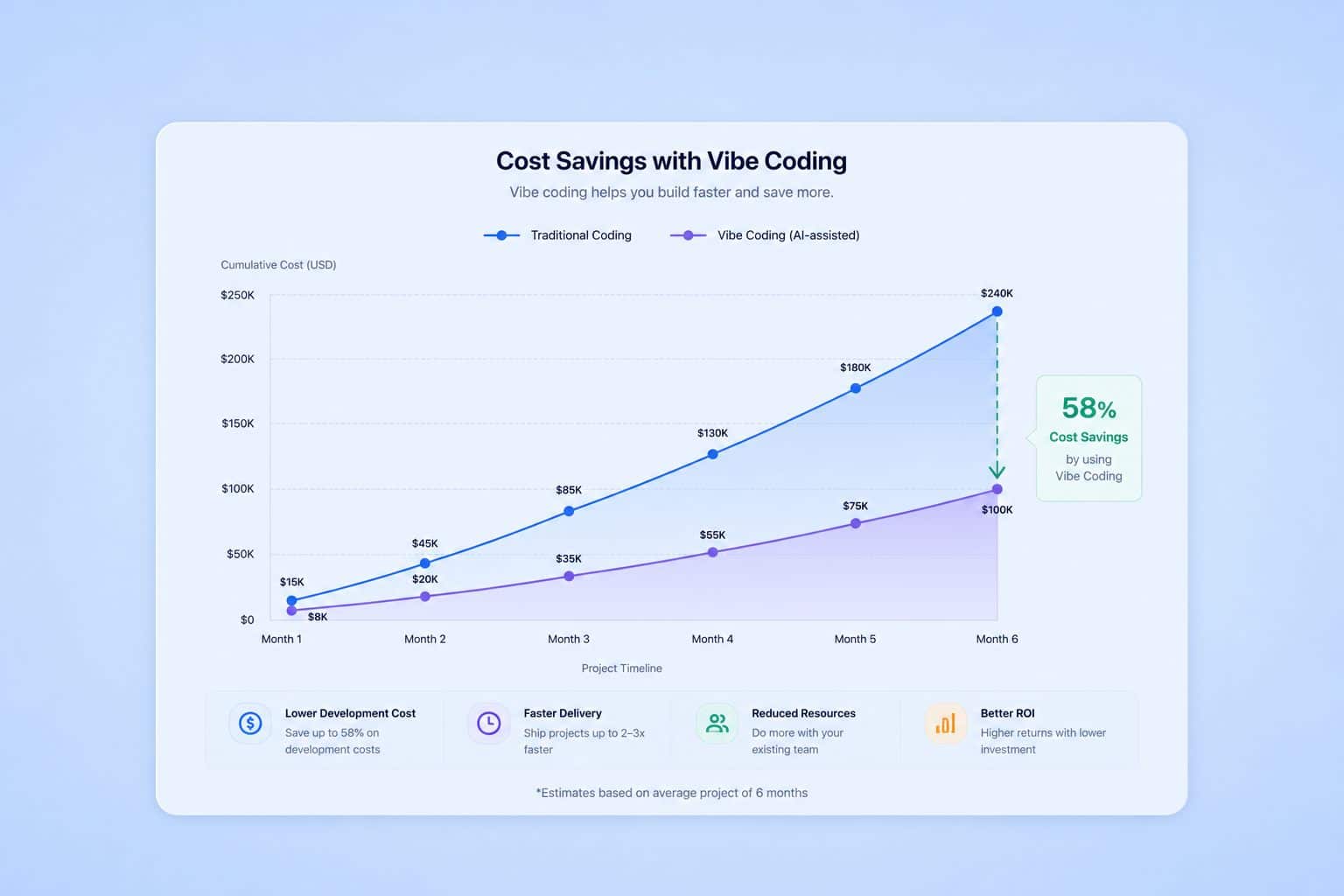

Vibe coding for enterprise delivers real savings: development velocity increases 3-5x, prototype costs drop 60-80% compared to traditional builds, and enterprise teams are replacing SaaS subscriptions at scale with custom AI-built tools. The budget surprise is not the tool cost. It is the governance gap, a compounding bill that arrives in months 6-18 through security remediation, technical debt, and compliance overhead that no AI code generator accounts for automatically.
This guide gives engineering leaders and budget owners a complete total cost of ownership (TCO) framework for vibe coding for enterprise decision-making. Not a hype piece, not a fear piece. Ailoitte builds production software for enterprises in healthcare, fintech, and SaaS. We use AI-assisted development on every engagement. Below is the honest accounting.
What Vibe Coding for Enterprise Actually Involves
Vibe coding for enterprise is not the same as the consumer vibe coding trend. Vibe coding, in its original definition, is an AI-first development approach where software is described in natural language and an AI model generates the code. The term was coined by former Tesla AI director and OpenAI co-founder Andrej Karpathy in February 2025 and was named Collins Dictionary’s Word of the Year 2025 . In enterprise contexts, the term covers three distinct categories, each carrying a different cost and risk profile.
| Category | Tools | For Enterprise? | Primary Budget Risk |
|---|---|---|---|
| Consumer vibe coding | Lovable, Bolt.new, Replit Agent | Prototype only | No governance, no audit trail, no compliance |
| AI-assisted development | Cursor, Windsurf, GitHub Copilot | Yes, with governance | Security debt if governance layer is absent |
| Agentic development | Claude Code, AWS Kiro | Early adoption stage | Requires the most rigorous human oversight |
By 2026, 92% of US developers use AI coding tools daily (GitHub Developer Survey, 2026) and Gartner forecasts that 60% of new software code will be AI-generated by year-end (Gartner, AI Developer Tools Forecast, 2025). The AI code generation market reached $4.7 billion in 2026 with a 38% CAGR projected through 2030 (MarketsandMarkets, 2025).
The critical distinction for vibe coding for enterprise buyers: 63% of users on consumer vibe coding platforms are non-technical (Replit internal data, cited in multiple 2026 analyses). These tools were not designed for production systems, compliance requirements, or enterprise-scale security. The same prompt-to-code workflow that ships a weekend side project in two hours will produce a compliance liability when applied to a payment processor or a healthcare records system.
The Budget Promise: What Vibe Coding for Enterprise Can Genuinely Save
Vibe coding for enterprise delivers measurable savings in specific phases of the software lifecycle. Senior developers using AI coding tools consistently report 3-5x productivity gains on implementation tasks. For enterprise teams, this translates to three concrete budget benefits:

1. Prototype and validation cost compression
Traditional MVP development costs $50,000-$150,000 over 8-16 weeks. An AI-assisted prototype of the same scope can be built for $1,000-$5,000 in 1-2 weeks. This compression eliminates speculative development spend before product-market fit is confirmed. For a Series A company evaluating three product directions, the savings on prototype iteration alone can reach $200,000-$400,000 per year.
2. SaaS subscription displacement
A 2026 Retool analysis found that 35% of enterprise teams have already replaced at least one SaaS product with a custom-built internal tool using AI coding platforms (Retool State of Internal Tools, 2026 [URL to be verified by Ailoitte team]). Blinkist publicly reported replacing approximately $60,000 per year in SaaS spend by building lightweight internal tools in days. For large organisations with mature SaaS stacks, this is a real and recurring savings category.
3. Developer capacity multiplication
Data from multiple 2026 studies places developer productivity gains from AI tooling at 30-55% on implementation-heavy tasks. For a five-person team, this is the equivalent of 1.5-2.7 additional developers at no added headcount cost. On a $500,000 annual engineering payroll, that is $150,000-$350,000 in equivalent output gained.
In our project delivery work, AI-assisted development gains concentrate in implementation phases: code scaffolding, boilerplate generation, test case creation, and documentation. On a recent healthcare data integration engagement, we reduced implementation sprint hours by approximately 40% using governed AI-assisted development. That gain did not extend to architecture design, compliance mapping, or integration testing, which require the same engineering depth regardless of how the code layer was generated. The ceiling on savings is real: AI tools produce 20-35% efficiency gains on routine development tasks. They do not materially change the cost profile of complex integration or regulated system development.
The Hidden Invoice: Six Vibe Coding for Enterprise Budget Costs Nobody Quotes
The total cost of unmanaged vibe coding for enterprise comprises six distinct categories that almost never appear in initial ROI projections. Understanding them before procurement is the budget decision. Each category has a real dollar figure attached.
1. Security remediation costs
Approximately 45% of AI-generated code samples contain security vulnerabilities mapped to the OWASP Top 10 (multiple security analyses, 2025-2026). AI-generated code carries 2.74 times more vulnerabilities than human-written code (CodeRabbit, 2025 [URL to be verified by Ailoitte team]). Among Fortune 50 enterprises, security findings increased from approximately 1,000 to over 10,000 per month in the six months following scaled AI coding adoption (Apiiro, cited in SecurityWeek, 2025 [URL to be verified by Ailoitte team]).
The IBM Cost of a Data Breach 2025 Report places the average enterprise data breach at $4.88 million. Even without reaching that threshold, the security remediation work alone, specifically auditing AI-generated code, rotating exposed credentials, and patching authentication flows, can cost more than the application cost to build.
Ailoitte holds OWASP Top 10 compliance and ISO 27001 certification specifically because AI-assisted development at scale requires a formal security scanning layer that consumer tools do not provide. On every AI-assisted delivery, we run SAST and DAST tooling on each pull request before code reaches a staging environment. Skipping this gate is not a speed advantage. It is deferred cost.
2. Technical debt acceleration
Vibe coding technical debt accumulates approximately three times faster than traditional technical debt, according to an ICSE 2026 meta-analysis synthesizing 101 sources on AI-assisted development in practice (ICSE 2026, cited in Hatchworks, 2026 [URL to be verified by Ailoitte team]). Industry analysts project that 75% of companies will see their technical debt reach moderate-to-high severity in 2026, with rapid AI adoption cited as the primary contributing factor.
Standard software maintenance budgeting uses 15-20% of annual build cost. For AI-heavy codebases without review discipline, that floor rises to 25-35% due to the comprehension debt tax described in point 5 below. For a $300,000 production application, that is a difference of $15,000-$45,000 per year in maintenance overhead.
3. The usage-based pricing spiral
Most vibe coding platforms operate on subscription tiers ($10-$90 per seat per month) plus usage-based credits that scale with iteration. The root cause of budget overruns is structural: fewer than 15% of typical enterprise backlogs have effective acceptance criteria (industry observation). Vague requirements meet AI code generation without a structured validation layer. The result is faster rework, not faster delivery. Usage bills scale directly with iteration, and unstructured iteration is the default workflow for teams without sprint discipline.
At 50 engineers: GitHub Copilot Enterprise at $39 per user per month costs $23,400 per year. Cursor Enterprise at $90 per user per month costs $54,000 per year. Neither figure includes compute infrastructure or usage credit overages.
4. Compliance and governance overhead
Consumer vibe coding tools deploy directly to production with no staging environment, no security scan, and no audit trail. HIPAA, PCI-DSS, and SOC 2 each add 20-40% to a base development estimate in regulated environments. SOC 2 Type II certification costs $30,000-$100,000 or more, and AI-generated code must pass every control regardless of how it was produced.
5. The comprehension debt tax
Code that no one on the team fully understands is the most expensive kind to maintain. 48% of developers admit they do not always review AI-generated code before committing it (Veracode, 2026 [URL to be verified by Ailoitte team]). When the original developer leaves, comprehension debt compounds: every subsequent sprint is slower because the codebase contains sections with no documented reasoning and no test coverage.
In merger and acquisition technical due diligence contexts, AI-generated codebases without governance documentation are increasingly flagged as valuation discount factors in 2026.
6. The prototype trap and rebuild cost
AI-generated prototypes that move directly to production without a professional rebuild carry exponentially higher maintenance costs over their lifecycle. The foundational decisions made during a two-day vibe session, covering data models, API contracts, and authentication architecture, constrain the system for years. A professional MVP rebuild after a failed vibe-coded prototype costs $50,000-$150,000 minimum, excluding data migration and user re-onboarding.
A Real TCO Framework: How to Budget Vibe Coding for Enterprise
Enterprise AI-assisted development budgets should account for five cost buckets, not one. The visible subscription cost is typically 5-15% of total lifecycle cost. Here is the complete framework:
| Cost Bucket | Typical Range | Notes |
|---|---|---|
| Tooling subscriptions | $10-$90 per seat per month | Scale to team size. Enterprise tiers add SSO, audit logs, priority support. |
| Security and QA overhead | 15-25% of build cost annually | SAST/DAST tooling, security audits, penetration testing, patch cycles. |
| Technical debt reserve | 25-35% of build cost annually | Standard 15-20% floor rises for AI-heavy codebases without review discipline. |
| Compliance and governance | 20-40% added to base cost (regulated industries) | SOC 2, HIPAA, PCI-DSS compliance mapping, documentation, audit trail tooling. |
| Rework and comprehension | 15-25% of sprint capacity | Reviewing, refactoring, and documenting AI-generated code in production systems. |
The three-scenario budget comparison
| Budget Factor | Scenario A: Unmanaged | Scenario B: Governed In-House | Scenario C: AI Velocity Pods |
|---|---|---|---|
| Month 1 tooling cost | Lowest | Medium | Fixed-price, all-in |
| Year 1 total cost | Highest (remediation compounds) | Medium-high | Predictable |
| Security risk | High (45% vuln rate) | Medium (governance dependent) | Low (OWASP, ISO 27001 built in) |
| Compliance coverage | None | Requires dedicated resource | SOC 2, HIPAA, PCI included |
| Budget certainty | Low (usage-based unpredictable) | Medium | High (fixed-price outcomes) |
The time horizon is decisive. Months 1-3 savings from consumer vibe coding are real. Months 6-12 remediation costs begin appearing. Year 2 and beyond, technical debt compound interest and architecture constraints from early shortcuts dominate the budget conversation.
The Decision Matrix: When to Vibe Code and When to Hire
The question is not whether to use AI in software development. That decision is settled. The question is where in your delivery lifecycle AI generation is appropriate without a governance layer, and where it requires professional oversight.

| Use AI builder tools independently when… | Engage a professional AI-first engineering partner when… |
|---|---|
| Validating a product idea before committing development budget | Real user data, payments, or healthcare records are involved |
| Building single-team internal tools with no external user data | A compliance audit (SOC 2, HIPAA, ISO 27001, PCI-DSS) is required |
| Creating disposable prototypes explicitly planned for professional rebuild | The application needs to scale beyond a single team or department |
| A senior engineer will review every line before it touches production | Enterprise system integrations are involved (SAP, Salesforce, legacy APIs) |
| No payment processing, PHI, or PII is involved | Fixed-price budget certainty is required, not usage-based credit spend |
The validated sequencing strategy
Phase 1: Validate with a vibe-coded prototype. Budget $500-$2,000 and 1-2 weeks. Build the disposable version. Prove demand with real users.
Phase 2: If traction is confirmed, engage a professional AI-first engineering team for the production build. Every architectural decision gets made correctly the first time, informed by what the prototype taught you.
“Validate with vibe coding, build with professionals” has emerged as the dominant playbook among engineering-literate founders and enterprise product leaders in 2026. The prototype costs $1,000-$2,000. The production build informed by real user feedback costs significantly less than building the wrong thing at full scale.
Regulated Industries: The Budget Math Is Completely Different
For organisations in healthcare, financial services, and enterprise SaaS, vibe coding economics differ fundamentally from general software development because the cost of a compliance failure is not proportional to the cost of the code.
Healthcare and HIPAA
AI-generated code that processes protected health information (PHI) without HIPAA-compliant access controls is a regulatory event, not a bug. Consumer vibe coding tools deploy to production without the audit trails, encryption standard documentation, or breach notification procedures that are mandatory under HIPAA’s technical safeguard requirements.
Ailoitte’s work with enterprise-scale healthcare platforms, including environments similar to our AssureCare engagement involving over 53 million members, requires that every PHI data access layer be human-reviewed against HIPAA technical safeguards before deployment, regardless of how the underlying code was generated. AI tools are used extensively in the scaffolding and business logic layers. The PHI handling layer is not vibe coded.
Financial services and PCI-DSS
XSS vulnerabilities, injection failures, and broken authentication logic are the specific vulnerability classes where AI coding tools consistently underperform relative to human-written code (GIANTY technical analysis, 2026 [URL to be verified by Ailoitte team]). These are also precisely the vulnerability classes that trigger PCI-DSS findings.
PCI-DSS Level 1 compliance adds $50,000-$150,000 to a development project and requires documented evidence of security controls on every component. An AI-generated payment flow that passes functional testing but fails static analysis is a compliance liability that cannot be patched after a card brand audit.
Enterprise SaaS and B2B
Enterprise procurement now routinely includes SOC 2 Type II as a vendor requirement. A SOC 2 Type II report documents controls operating over a 6-12 month observation period. It is a process, not a certificate, and it applies to AI-generated code with the same rigour as any other code. Organisations planning to sell into enterprise accounts must account for this compliance layer in their engineering budget regardless of how their code was produced.
For teams that need AI-literate engineering capacity to supplement internal resources without a full project engagement, Ailoitte’s staff augmentation offering provides access to engineers trained in governed AI-assisted development and familiar with enterprise compliance requirements.
What Governed Vibe Coding for Enterprise Actually Looks Like
Governed vibe coding for enterprise captures the speed advantage while eliminating the hidden costs described above. The governance layer is the competitive advantage, not the prompt.
Green Zone and Red Zone code classification
Green Zone: AI-generated scaffolding, boilerplate, test skeletons, and documentation. No mandatory human review beyond a standard pull request process.
Red Zone: Authentication logic, payment flows, PHI access layers, API security controls. Mandatory human expert review before merge, regardless of how fast the AI generated it.
Automated security scanning on every commit
SAST (static application security testing) and DAST (dynamic application security testing) tooling runs on every pull request, catching OWASP Top 10 vulnerabilities before they reach staging. This is non-negotiable for any AI-heavy codebase in production. Without it, the security findings data cited above applies to your codebase by default.
Architecture sign-off before generation begins
Data models, API contracts, and integration design are reviewed and approved by a senior architect before AI code generation begins, not after. The speed of generation makes post-hoc architectural correction expensive. A correctly designed data schema takes two hours to produce and four months to refactor at scale.
Compliance mapping per sprint, not per audit
SOC 2, HIPAA, and PCI control documentation updated per sprint ensures AI-generated code is traceable back to a documented control at all times. AI-generated code that cannot be traced to a documented control is a compliance gap regardless of whether it functions correctly. This discipline is what separates a certifiable codebase from a certifiable audit problem.
Ailoitte’s AI Velocity Pods deliver production-ready applications on a fixed-price, outcome-based model. The governance framework above is embedded in the delivery process, not added as a separate cost line. Key delivery benchmarks: 38-day average ship time to production, 3x sprint velocity versus traditional T&M engagements, OWASP Top 10 compliance on every delivery, ISO 27001 and SOC 2 Type II certification covering the delivery process, and 300+ products shipped across 21+ countries. The billing model is fixed-price and outcome-based. It does not scale with AI iteration ambiguity the way usage-based credit billing does. For enterprise procurement teams building budget forecasts, that certainty is a direct risk mitigation against Bucket 3 of the TCO framework above.
What Changed in 2026: The Vibe Coding for Enterprise Landscape Shift
The vibe coding for enterprise landscape in 2026 differs materially from 2025 in four ways relevant to budget planning.
Governance tooling has matured
Enterprise-grade AI coding platforms with built-in security scanning, audit trails, and compliance documentation now exist as a distinct product category separate from consumer tools. AWS Kiro, launched in 2026, introduced spec-driven development that generates requirements documentation alongside code, a meaningful governance advance over prompt-only tools. This separation of categories makes enterprise procurement decisions cleaner.
Security data is no longer anecdotal
The ICSE 2026 meta-analysis of 101 sources, Veracode’s March 2026 security pass rate update reporting approximately 55% of AI code passing security checks (flat despite benchmark improvements), and the GitGuardian State of Secrets Sprawl 2026 report documenting 28.65 million new hardcoded secrets in public GitHub commits during 2025 (a 34% year-over-year increase) provide enterprise-grade evidence on AI code security (GitGuardian, 2026 [URL to be verified by Ailoitte team]). Budget conversations can now be grounded in published research rather than speculation.
Enterprise adoption has crossed a threshold
78% of enterprise teams plan to build more internal tools using AI coding platforms in 2026 (Retool, 2026 [URL to be verified by Ailoitte team]). The operational question has shifted from “should we adopt AI coding” to “how do we govern it at scale.” Organisations that answer the governance question now will have a structural advantage over those that answer it after a security incident.
The market has separated signal from noise
Consumer vibe coding tools optimised for non-technical users (Bolt.new, Lovable) and professional AI-first engineering tools (Cursor, Claude Code, Windsurf) have diverged into clearly distinct categories with different capability and risk profiles. Enterprise procurement teams can now make informed category decisions rather than treating all AI coding tools as equivalent. This distinction directly affects the budget model: consumer tool pricing is low; enterprise governance infrastructure and professional oversight are the real cost variables.
Is Ailoitte’s AI Velocity Pods a Vibe Coding Service?
No. AI Velocity Pods is not vibe coding in the way the term is commonly used, but it does use the same AI tools that power vibe coding to deliver 3x sprint velocity. The distinction matters because it determines whether you get the speed benefit only, or whether you get the speed benefit without the hidden costs this article documents.
Vibe coding, as originally defined by Andrej Karpathy, means accepting AI-generated code without deep review, letting the model drive, and relying on follow-up prompts to fix problems. It is a workflow optimised for speed at the expense of governance. Most of the security risks, technical debt acceleration, and compliance exposure documented above come from this unmanaged pattern.
AI Velocity Pods uses the same underlying AI development tools, including Claude Code, Cursor, and other AI-first platforms, but deploys them inside a professional engineering framework. Every sprint runs through a defined governance stack:
- Architecture before generation: Senior architects define data models, API contracts, and integration design before AI code generation begins. The AI accelerates implementation, not system design.
- Red Zone / Green Zone classification: Boilerplate, scaffolding, and documentation are Green Zone (AI-generated, standard PR review). Authentication, payment flows, and PHI access layers are Red Zone (mandatory human expert sign-off, no exceptions).
- Security scanning on every commit: SAST and DAST tooling catches OWASP Top 10 vulnerabilities before code reaches staging. Not periodic. Every pull request.
- Compliance documentation per sprint: SOC 2, HIPAA, and PCI controls are documented sprint by sprint, not retrospectively at audit time. AI-generated code without a control mapping is a compliance gap regardless of how it functions.
- Fixed-price, outcome-based billing: AI Velocity Pods bills on delivered outcomes, not on AI credit consumption or engineering hours. This eliminates the usage-based pricing spiral described in Section 4.
The result: the 38-day ship time and 3x sprint velocity figures come from the AI tooling. The ISO 27001 certification, SOC 2 Type II coverage, and HIPAA-ready delivery come from the governance framework. Enterprises evaluating vibe coding for enterprise use that want both the speed and the safety are the exact audience AI Velocity Pods was designed to serve.
For engineering teams that want to build governed AI-assisted development capability in-house rather than through a managed engagement, Ailoitte’s AI transformation services cover toolchain selection, governance framework design, and team training for organisations standing up their own AI-first engineering practice.
Ready to Build at AI Speed Without the Hidden Costs?
FAQs
How much does vibe coding for enterprise actually cost?
The visible tooling cost for vibe coding for enterprise runs $10-$90 per seat per month depending on platform. The full TCO for an enterprise AI-assisted development program, including security overhead (15-25% of build cost annually), technical debt reserves (25-35% of build cost annually), compliance mapping, and rework capacity, typically adds 40-70% to the base tooling and build cost in Year 1. For a $500,000 development program, budget an additional $200,000-$350,000 in governance and remediation costs unless a professional AI-first engineering partner is engaged under a fixed-price model.
Is Ailoitte’s AI Velocity Pods a vibe coding service?
Not in the consumer sense. AI Velocity Pods uses the same AI development tools that power vibe coding, including Claude Code and Cursor, but deploys them within a professional engineering framework that includes architecture governance, automated security scanning on every commit, compliance documentation per sprint, and fixed-price delivery. The speed advantage of vibe coding is preserved. The governance risks documented in this article are eliminated by design. For enterprises evaluating vibe coding for enterprise at scale, AI Velocity Pods represents the governed alternative to unmanaged consumer tools. Learn more about AI Velocity Pods.
Is vibe coding safe for HIPAA-compliant applications?
Consumer vibe coding tools are not HIPAA-safe in their current form: they lack audit trails, do not document encryption standards, and produce no breach notification procedures. Governed AI-assisted development, where PHI access layers are human-reviewed against HIPAA technical safeguard requirements and documentation is maintained per sprint, can be used safely in HIPAA environments. This requires an engineering team with active HIPAA compliance experience, not just an AI tool. See Ailoitte’s healthcare technology services for context on what HIPAA-compliant AI development actually requires.
Can vibe coding replace our development team?
No. AI coding tools accelerate the execution layer of development by 3-5x on implementation tasks. They do not replace software architects, security engineers, compliance specialists, or product engineers who make the decisions determining whether a system is maintainable, secure, and fit for purpose. The teams using AI most effectively in 2026 have not reduced headcount. They have shifted where senior engineers spend their time, away from boilerplate and toward architecture and quality.
What is the difference between vibe coding and AI-assisted development?
Vibe coding, as originally defined by Andrej Karpathy, involves accepting AI-generated code without deep review and relying on subsequent prompts to address problems. AI-assisted development uses AI tools within a structured review and governance framework where human engineers retain architectural authority. For enterprise production systems, the distinction is the governance layer, not the tools used.
When does vibe coding create technical debt?
Vibe coding creates technical debt when AI-generated code reaches production without: (1) automated security scanning on every commit, (2) documented architectural decisions, (3) test coverage on business-critical paths, and (4) comprehension review by a human engineer. The ICSE 2026 meta-analysis found technical debt accumulates approximately 3x faster in AI-heavy codebases without these governance controls. See Ailoitte’s AI transformation services for how we approach technical debt prevention in AI-assisted delivery.
How do I compare vibe coding costs against hiring a professional development team?
Compare on a three-year total cost basis, not on Month 1 spend. Professional AI-first development teams with fixed-price engagements typically cost more in Month 1 than self-service AI tools. Over 36 months, unmanaged AI coding teams typically incur $900,000-$1,200,000 in accumulated remediation, security, and technical debt costs for a 15-engineer team (ICSE and Hatchworks, 2026). Professional fixed-price delivery with governance built in typically has a lower three-year TCO for any production system handling real user data

Discover how Ailoitte AI keeps you ahead of risk

Sunil Kumar
Sunil Kumar is CEO of Ailoitte, an AI-native engineering company building intelligent applications for startups and enterprises. He created the AI Velocity Pods model, delivering production-ready AI products 5× faster than traditional teams. Sunil writes about agentic AI, GenAI strategy, and outcome-based engineering. Connect on
LinkedIn

Stephan is the sports journalist for the Maple Grove Report.