
But for a growing number of people who have dedicated their careers to this work, that vocabulary is beginning to feel less like a destination and more like a waiting room. The language arrived. The structures, in many cases, did not.
This is part of the backdrop behind greenwashing and the ESG backlash: purpose has too often been grafted onto existing institutional architecture rather than used to redesign it. When values language is not accompanied by structural change, it can become a liability. It signals aspiration while often leaving the machinery of extraction intact.
Which raises a harder question: What do spiritual principles actually demand of the structures of capitalism — not just its vocabulary?

A longer time horizon is not simply a nicer intention; it is a different way of designing economic responsibility across generations.
That question requires being precise about what “spiritual principles” means in this context. I mean the shared ethical commitments that emerge across traditions — from Indigenous wisdom to Bahá’í writings to Catholic social teaching to secular philosophy — when they engage seriously with economic life. These commitments have a common shape: the oneness and interdependence of humanity; stewardship toward future generations and the natural world; the inherent dignity of labor; and the conviction that justice requires structural fairness in how resources, opportunity, and power are distributed.
Understood this way, these are not just sentiments. They are design criteria. And when held up against the current architecture of capitalism, they reveal something important: the friction is not incidental. It is structural.

The dignity of labor becomes real when workers are treated not as inputs to be managed, but as participants in ownership, governance, and value creation.
To move from values to architecture, it helps to name the specific structural layers where that friction occurs — legal frameworks, market norms, governance design, financial expectations, and cultural assumptions. Each operates differently and requires a different kind of intervention.
Shareholder primacy and the quarterly earnings cycle
This is the most-cited culprit in the conscious capitalism literature, but it is worth being precise about why it persists. The problem is not simply that executives choose short-term profits over long-term value. It is that the bias is structurally embedded in how analysts evaluate companies, how boards are incentivized, and how capital markets reward behavior.
Time horizons as a cultural assumption
Most spiritual traditions operate with a sense of time that extends across generations. The Indigenous principle of seven-generation stewardship is not a metaphor — it is a design principle. It asks decision-makers to account for consequences that will arrive long after they are gone. Extending investment horizons from five years to ten is useful, but it is not the same as building structures that carry obligations to people and ecosystems that do not yet exist.
Measurement architecture
Robert F. Kennedy famously observed that Gross National Product measures everything except what makes life worthwhile. That is a structural argument, not just a rhetorical flourish. What we measure shapes what we optimize for — and what we optimize for shapes what we build.
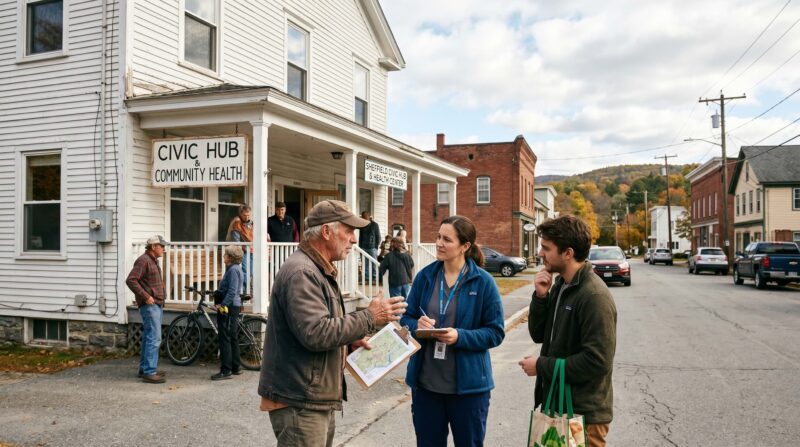
Community accountability requires more than good intentions; it depends on forms of investment willing to stay, listen, and build alongside local people over time.
Bhutan’s Gross National Happiness index represents a genuine attempt to redesign the measurement architecture of governance. Institutions such as the Global Impact Investing Network and the Impact Management Platform are also building frameworks that account for social and environmental outcomes alongside financial return. These are governance tools. They change what gets optimized.
The examples that follow are not theoretical. Each represents a real structural intervention, with a design principle that can be replicated and scaled.
Ownership architecture
When Yvon Chouinard transferred Patagonia to the Purpose Trust and the Holdfast Collective in 2022, he redesigned the company’s ownership architecture so that its mission could survive his departure. The structure separates voting control from economic interest: a small trust holds the voting shares and enforces the mission, while the nonprofit holds the economic shares and receives the profits for environmental causes.
Intergenerational stewardship means more than preserving wealth across generations. It means asking what obligations accompany that wealth.
This is not a values statement. It is a legal mechanism that makes mission override far more difficult for a future owner to reverse. The design principle is clear: separate voting control from economic interest so purpose cannot be overridden when priorities change.
Contractual alignment
When I worked with One Planet Group, we used what we called a “betterment-of-the-world agreement,” which companies signed as we invested in them. Salesforce’s 1-1-1 model reflects a parallel logic, embedding a structural commitment to social impact — 1% of equity, product, and employee time — from the company’s founding rather than as an afterthought once profitability was established.
The design principle here is equally straightforward: make values alignment contractually binding and operationally embedded, not merely aspirational.
Community accountability
One of the partners I have worked with over the years through Impact Experience is the Williamson Health and Wellness Center in rural West Virginia, in a region long shaped by economic dislocation and poor health outcomes. Through sustained investment in community leadership and local health infrastructure, the initiative has contributed to meaningful improvements in community health.

Community accountability begins when capital stays long enough to listen, repair, and build alongside the people a place depends on.
What matters here is not simply the programmatic success. It is the structural logic behind it: long-horizon commitment that does not disappear when returns slow, combined with accountability to the community being served. The design principle is sustained investment tied to local stewardship, rather than extractive capital that leaves when conditions become difficult.
Labor and governance
The Bahá’í writings describe profit-sharing not as philanthropy but as an expression of justice — a structural reflection of the dignity of labor and the shared stake workers have in the enterprises they build. Mondragón Corporation, with more than 70,000 employee-owners, is an example of this at scale. Governance structures that distribute both decision-making power and economic return reflect the spiritual principles of justice more faithfully than structures that concentrate both at the top.
This is part of the backdrop behind greenwashing and the ESG backlash: purpose has too often been grafted onto existing institutional architecture rather than used to redesign it.
Inclusive investment models point in a related direction. Ulu Ventures, for example, has shown that broadening who gets backed in venture capital is not a concession to social pressure, but part of rethinking how value, opportunity, and innovation are recognized in the first place.
Intergenerational stewardship
Intergenerational stewardship means more than preserving wealth across generations. It means asking what obligations accompany that wealth. Calvert Investments’ shareholder resolution that prompted Dell to implement a take-back and recycling program is an instructive example: active stewardship by a single institutional investor changed the behavior of a major corporation and, ultimately, helped shift expectations across an industry.
The design principle is simple but powerful: ownership carries obligations, not just rights, and those obligations extend across time.
The structural changes described above — purpose trusts, covenant-based investment agreements, community-accountable enterprises, worker ownership models, alternative measurement systems, active shareholder engagement — are not waiting to be invented. They exist. They are operating now, at different scales, in different sectors, and in different parts of the world.
The task is not invention. It is adoption, replication, and the deliberate movement of these structures from the margins to the center of how capital is allocated and how enterprises are governed.
What spiritual principles demand of capitalism is not better language about purpose. It is a different architecture — one in which legal frameworks, governance design, financial expectations, market norms, and cultural assumptions are deliberately aligned with the ethical commitments those principles represent: oneness, stewardship, dignity, and justice.
That is structural work. And the conscious business movement — investors, entrepreneurs, policymakers, and the communities they serve — is increasingly ready to do it.
—
Jenna Nicholas’s best selling book is the Enlightened Bottom Line: Exploring the Intersection of Spirituality, Business, and Investing. Learn more at jenna-nicholas.com.