It’s been one year since the killing of former House Speaker Melissa Hortman, her husband Mark and their golden retriever, Gilbert.
Gilbert started out as a service dog in training through Helping Paws, the Eden Prairie nonprofit that trains assistance dogs for people with physical disabilities, veterans and first responders living with PTSD. But Gilbert was ultimately deemed a little too friendly for the job, and the Hortmans adopted him as their own.
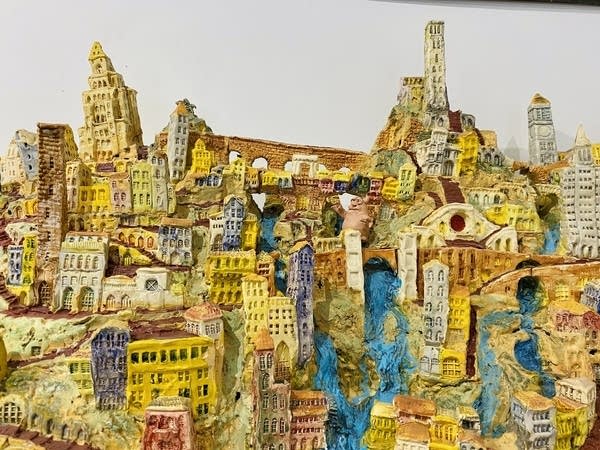
A portrait of Mark and Melissa Hortman's dog, Gilbert, is hung on the wall of the Helping Paws facility in Eden Prairie, on June 5.
Alanna Elder | MPR News
Alyssa Golob, executive director of Helping Paws, said that even though Gilbert did not become a professional service dog, he was an unofficial service dog to the Hortman family as they navigated demanding professional lives of public service.
“It wasn't his journey to be a service dog, and we respect that. In my head now, I kind of feel like that Gilbert was where he was supposed to be with Melissa and Mark. He helped them through the stress of their lives.“ Golob said.
In the months following their deaths, thousands of people donated to Helping Paws in their memory. That support helped create the Hortman Heroes Fund, which will train future service dogs.
During the most recent legislative session, lawmakers also funded an entire litter of puppies to go on to become service dogs in the Hortman’s honor. They are called the "Guided by Gilbert” litter. The nine puppies each have names that start with the letter G.
The puppies left for their volunteer trainer placements on May 31, and will train for more than two years to become professional service dogs for veterans and first responders with PTSD.
Puppy siblings Griffin and Gertie play at the Helping Paws training facility on June 5. They are part of the "Guided by Gilbert" litter that will train to serve veterans and first responders with PTSD.
Alanna Elder | MPR News
Golob calls the outpouring of support the “Melissa, Mark and Gilbert effect,” and said that their story is now a part of the soul of Helping Paws.
“Donations came our way, and that's wonderful, but it was really about people wanting to walk in Melissa and Mark's footsteps,” Golob said. “Now we have a wait list of people who want to take on a puppy.”
Training a service dog is hard work. In order to graduate, puppies must learn more than 70 commands from sitting all the way up to turning on lights and opening doors. But when they are still young like the “Guided by Gilbert” litter, they are mostly working on socializing with each other and people.
“Every time I watch the puppies play, it kind of gets me teared up a little bit,” Golob said. “These puppies, two years from now, are going to change somebody's life. You have no idea who they are going to, but somebody's life is going to be changed because of this cute, silly puppy.”
Griffin the golden retriever plays in a ball pit at the Helping Paws training facility on June 5. He is part of the "Guided by Gilbert" litter that will train to serve veterans and first responders with PTSD.
Alanna Elder | MPR News
For now, though, they are still just puppies — tumbling over one another, exploring the world and growing into the dogs that Helping Paws hopes will one day transform someone's life.
“When the guided by Gilbert litter went home, there was a lot of love and pride in the room,” Golob said. “They have a lot to live up to, those puppies, and we were certain that we're going to watch them grow, and they're going to change lives. Melissa, Mark and Gilbert will continue to be proud of us.”
Use the audio player above to listen to the full conversation.
Subscribe to the Minnesota Now podcast on Apple Podcasts, Spotify or wherever you get your podcasts.
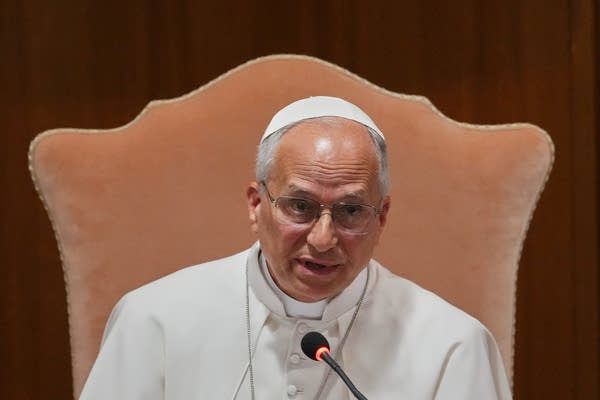
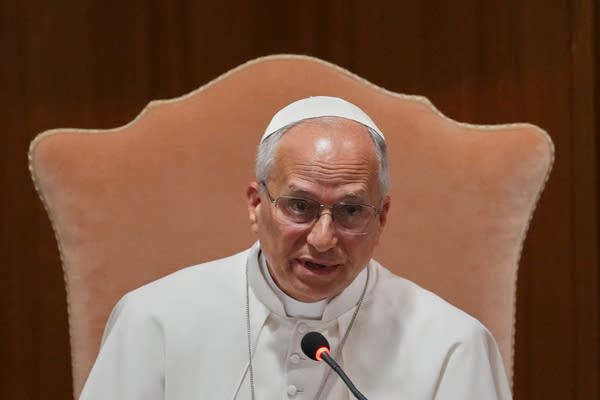
Pope Leo XIV made a historic apology on Monday for the role the Holy See played in legitimizing slavery and for having failed to condemn it for centuries, calling the Vatican’s record a “wound in Christian memory.”
Past popes have apologized for Christians’ involvement in the trans-Atlantic slave trade. But no pope had ever publicly acknowledged, much less apologized for, the role that past popes played in giving European sovereigns explicit authority to subjugate and enslave “infidels.”
History’s first U.S.-born pope, whose family history includes both enslaved people and slave owners, delivered the apology in his first encyclical, “Magnifica Humanitas,” (Magnificent Humanity), which was released Monday.
The sweeping manifesto is about safeguarding humanity in an era of increasing reliance on artificial intelligence. Leo raised the trans-Atlantic slave trade in relation to what he called the new forms of slavery and colonialism that the digital revolution is fueling, such as the unregulated labor practices in procuring rare minerals needed for AI chips.
Anthea Butler, senior fellow at the Koch History Center, Oxford University, said Leo needed to acknowledge and atone for the Catholic Church's complicity in historic slavery if he wanted to credibly “speak to the current issues of technological enslavement.”
“For descendants of enslaved persons, this is once again a much needed apology from the pope,” said Butler, who is Black.
Black American Catholics, activists and scholars have long called for the Holy See to atone for its role in the colonial-era trade in human beings, beyond more generic apologies for the involvement of individual Christians.
“It is impossible not to feel deep sorrow when contemplating the immense suffering and humiliation endured by so many in stark contrast to their immeasurable dignity as persons infinitely loved by the Lord,” Leo wrote. “For this, in the name of the church, I sincerely ask for pardon.”
Centuries of legitimizing slavery for European colonizers
The Vatican has insisted that it always upheld the dignity of all human beings as children of God. But a series of 15th-century directives from the Vatican authorized Portuguese sovereigns to conquer Africa and the Americas and enslave non-Christians.
In 1452, for example, Pope Nicholas V issued the papal bull Dum Diversas, which gave the Portuguese king and his successors the right “to invade, conquer, fight and subjugate” and take all possessions — including land — of “Saracens, and pagans, and other infidels, and enemies of the name of Christ” anywhere.
The bull also gave the Portuguese permission “to reduce their persons to perpetual slavery.”
That bull and another issued three years later, Romanus Pontifex, formed the basis of the Doctrine of Discovery, the theory that legitimized the colonial-era seizure of land in Africa and the Americas.
Nicholas V’s permissions to the Portuguese were confirmed or renewed by Pope Callixtus III in 1456, Pope Sixtus IV in 1481 and Pope Leo X in 1514, according to the Rev. Christopher J. Kellerman, a Jesuit priest and author of “All Oppression Shall Cease: A History of Slavery, Abolitionism, and the Catholic Church.”
Spanish kings received the rights for the Americas.
In 2023, the Vatican formally repudiated the Doctrine of Discovery, but it never formally rescinded, abrogated or rejected the bulls themselves. The Vatican insists that a later bull, Sublimis Deus in 1537, reaffirmed that Indigenous peoples shouldn’t be deprived of their liberty or the possession of their property, and weren't to be enslaved.
Holy See late to condemn slavery, Leo says
In his encyclical, Leo recalled that his namesake, Pope Leo XIII, was the first pope to explicitly condemn slavery in 1888, long after many countries had abolished it. Before that, in antiquity and the Middle Ages, even church institutions had slaves.
In acknowledging the Holy See’s role and the 15th-century papal bulls, Leo wrote in his encyclical: “Already in the early modern period, the Apostolic See of Rome, responding to the requests of sovereigns, intervened several times in order to regulate and legitimize forms of subjugation, and, in certain cases, including the enslavement of ‘infidels.’”
Leo said that it wasn't possible to judge the morality of the decisions with today’s standards.
“Yet neither can we deny or diminish the delay with which both society and the church came to denounce the scourge of slavery,” he said.
The pope said that the church has long affirmed the dignity of every human being as the basis of its doctrine, “even if it took eighteen centuries for its full incompatibility with slavery to be explicitly recognized.”
“This constitutes a wound in Christian memory, one from which we cannot consider ourselves detached,” he said.
Leo said that the church must firmly condemn all forms of trafficking related to the digital technological revolution “if we want to avoid the need to ask for pardon again in the future for having failed to respect the treasure of human dignity that is required by our faith.”
Leo’s own family history and past apologies
Kellerman, the scholar, welcomed Leo’s apology but said more needs to be done to further acknowledge and atone for how the Catholic Church legitimized and expanded slavery.
“Pope Leo has strengthened the moral credibility of the church with this admission and apology today,” he told The Associated Press. “Hopefully a future document will explain in more detail the church’s involvement with slaveholding. As a scholar I have some quibbles with the wording, but this is a truly remarkable moment.”
During a 1985 visit to Cameroon, St. John Paul II asked forgiveness of Africans for the slave trade on behalf of Christians who participated in it. In a 1992 visit to Goree Island, Senegal, which was the largest slave-trading center in West Africa, he denounced the injustice of slavery and called it a “tragedy of a civilization that called itself Christian.”
According to genealogical research published by Henry Louis Gates Jr., 17 of Leo’s American ancestors were Black, listed in census records as mulatto, Black, Creole or a free person of color. His family tree includes slaveholders and enslaved people, Gates wrote in The New York Times.
During a visit to Angola last month, Leo prayed at a Catholic shrine at the site of an important hub of the African slave trade during Portugal’s colonial rule. While at the Sanctuary of Mama Muxima, Leo recalled the “sorrow and great suffering” Angolans endured for centuries, but he didn’t refer specifically to slavery.
To provide the best experiences, we use technologies like cookies to store and/or access device information. Consenting to these technologies will allow us to process data such as browsing behavior or unique IDs on this site. Not consenting or withdrawing consent, may adversely affect certain features and functions.
Functional
Always active
The technical storage or access is strictly necessary for the legitimate purpose of enabling the use of a specific service explicitly requested by the subscriber or user, or for the sole purpose of carrying out the transmission of a communication over an electronic communications network.
Preferences
The technical storage or access is necessary for the legitimate purpose of storing preferences that are not requested by the subscriber or user.
Statistics
The technical storage or access that is used exclusively for statistical purposes.The technical storage or access that is used exclusively for anonymous statistical purposes. Without a subpoena, voluntary compliance on the part of your Internet Service Provider, or additional records from a third party, information stored or retrieved for this purpose alone cannot usually be used to identify you.
Marketing
The technical storage or access is required to create user profiles to send advertising, or to track the user on a website or across several websites for similar marketing purposes.