Yet historic districts are frequently undervalued. They are treated either as conservation problems or tourism destinations, rather than as undercapitalized platforms for inclusive growth, housing, climate-smart reuse, and long-term community resilience. In many places, their potential as building blocks for local development, economic inclusion, and wealth creation remains largely untapped.
The Cultural Heritage Finance Alliance (CHiFA) was founded in 2019 in New York City to advocate for the preservation and prosperity of heritage sites by highlighting their value in sustainable development. In 2025, CHiFA pioneered the Urban Heritage Regeneration Accelerator, a nine-month program designed to help cities develop practical vehicles for attracting investment into historic buildings and neighborhoods.
The inaugural Accelerator concluded in March 2026 with presentations from four historic cities in developing and emerging economies, all inscribed on UNESCO’s World Heritage List. The program was conducted in partnership with the Organization of World Heritage Cities (OWHC), an association of municipal governments that share both the World Heritage designation and a set of common challenges that threaten livability in these places.
The challenge of World Heritage designation
World Heritage designation recognizes places for their outstanding universal value — their associations with creativity, technological development, land use, natural adaptation, and contributions to humanity. Governments invest heavily to gain designation. More than 300 of the 1,248 presently named World Heritage sites are city centers. For these cities, designation often brings tourism growth, branding, and global name recognition.
But recognition does not automatically produce inclusive prosperity. In some historic cities, success leads to museumification. Resident-oriented commerce, cultural activity, and everyday community life give way to infrastructure designed primarily for visitors and non-residents. The place becomes famous, but less livable.
Historic districts are not relics of the past. They are undercapitalized platforms for the future.
In other cities, especially where public budgets are limited, the challenge is almost the reverse. A lack of investment in cultural tourism infrastructure, housing, services, and local enterprise can lead communities to see the historic center as lacking economic value. Younger residents leave. Skills disappear. Properties deteriorate. The very environment that gives the place its character begins to decline.
These two patterns — overtourism and underinvestment — may look different, but they often produce the same result: depopulation. Whether historic centers become unlivable because they are overwhelmed by visitors, or because they lack jobs, services, and opportunity, they lose the residents who sustain them.
The public sector is a key orchestrator of heritage development and a major investor in heritage-rich areas. Yet public investment often focuses on prestigious landmarks rather than the broader urban fabric. Without meaningful collaboration with residents, property owners, entrepreneurs, and civic organizations, preservation can become overly regulatory, discouraging the development of a dynamic heritage marketplace and accelerating decline.
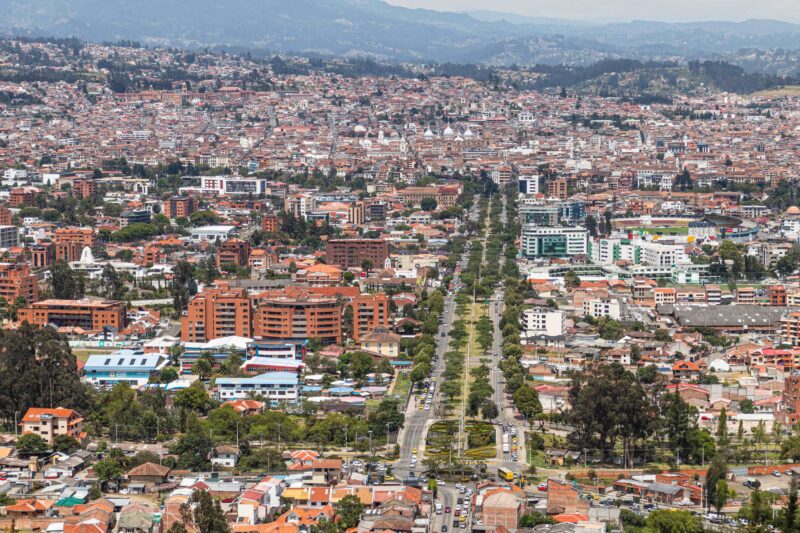
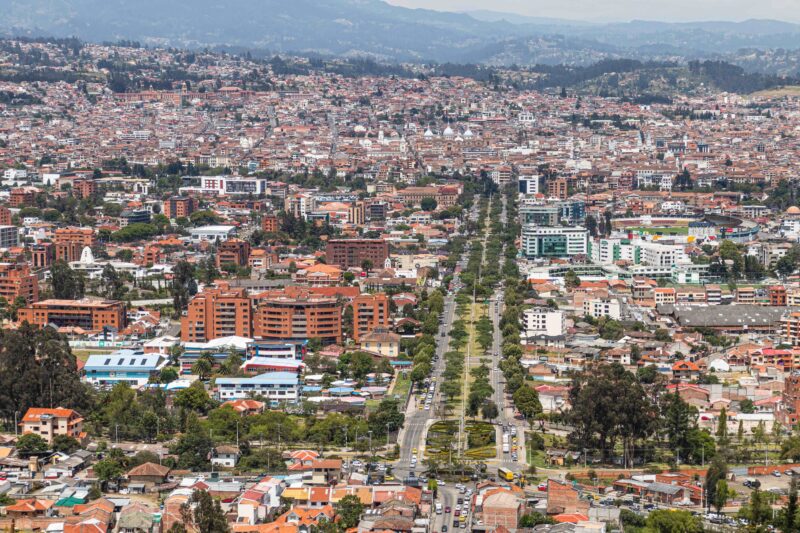
Cuenca, Ecuador; In many historic cities, the challenge is not simply preservation, but how to align growth, housing, tourism, and local opportunity so that heritage remains part of everyday civic life.
The Accelerator response
These issues were the centerpiece of CHiFA’s Urban Heritage Regeneration Accelerator. The goal was to help participant cities plan integrated, heritage-led regeneration strategies that involve communities and engage blended finance.
The Accelerator focused on four priorities identified by OWHC’s 100-plus member cities: equitable housing, ecology and green space, mobility, and economic development. It sought to open new sources of capital beyond public funding and local philanthropy, helping cities understand how public investment can catalyze complementary debt and equity, and how blended capital can support larger-scale urban initiatives rather than isolated restoration projects.
Recognition does not automatically produce inclusive prosperity.
With support from advanced students and faculty supervisors from NYU’s Schack Institute of Real Estate and NYU School of Law, each participating city developed a blended capital financing strategy and an integrated management model through the creation of a multi-sector Heritage Enterprise Organization.
The intention was not simply to preserve buildings, but to strengthen the local conditions that allow historic neighborhoods to remain lived-in, economically productive, culturally vital, and investable over time.
The four cities
Four cities on three continents became the first cohort of Accelerator participants: Baeza, Spain; Cuenca, Ecuador; Lamu, Kenya; and Tunis, Tunisia. Two participants were represented by municipal government officials; the others by locally based non-governmental organizations working in close cooperation with their municipalities.
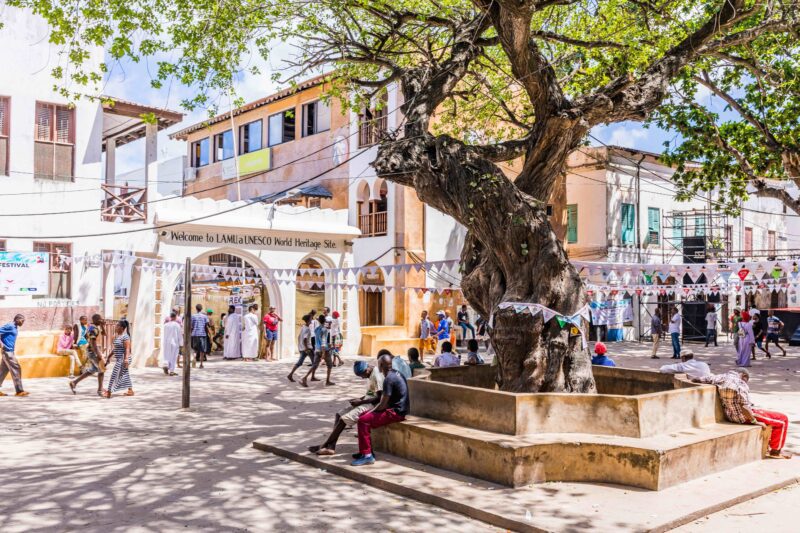
Lamu, Kenya; Heritage-led regeneration succeeds when historic places remain lived-in, locally meaningful, and economically productive — not merely preserved for visitors.
Baeza, a center for olive oil production in Andalucía, sought to stem outward migration by creating new opportunities for residents of all ages. Its proposal focused on converting a historic convent, vacant since 2015, into a seventy-unit senior living residence.
Cuenca sought to subsidize housing for middle- and low-income residents in its historic center in the face of a speculative real estate market driven in part by an influx of retirement-aged expatriates from North America. Its proposal developed an Affordable Housing Acquisition and Development Fund that would channel revenues from tourism and real estate activity toward subsidized housing.
Tunis sought to restore vitality in its historic Medina, anchored by the restoration of Hammam Tammerine — a 1639 Ottoman bathhouse, the last of its kind in the Medina — as a multi-use cultural and wellness destination.
Lamu pursued the revitalization of its historic urban core as a cultural magnet and model for the Swahili coast, where tourism flows largely bypass the Old Town’s extraordinary built heritage. Its proposal centered on the restoration of a traditional Swahili house as a replicable cultural center model.
Together, these projects illustrate a central premise of the Accelerator: urban heritage regeneration succeeds when cultural preservation is connected to housing, livelihoods, local enterprise, and community benefit.
A framework for success
Prior to launching the Accelerator, CHiFA conducted research on six successful urban regeneration programs around the world. Published as Case Studies in Heritage Regeneration in 2021, that research found that, despite wide variations in strategy and context, successful initiatives shared five common conditions.
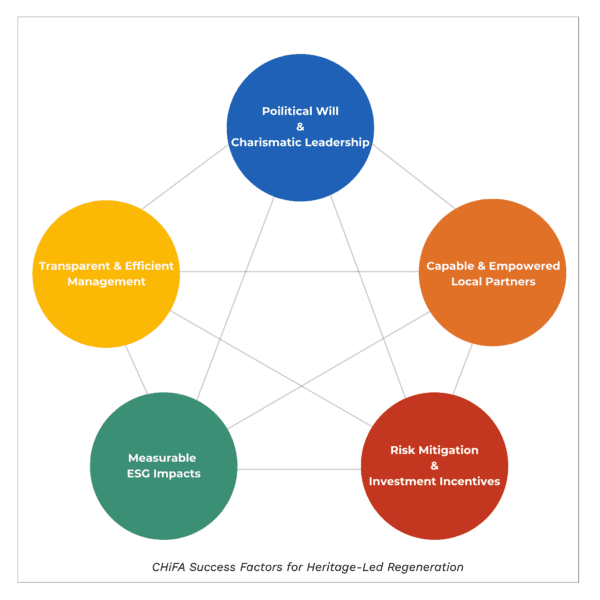
CHiFA’s framework emphasizes that successful heritage regeneration depends not only on capital, but on leadership, local partners, risk mitigation, measurable outcomes, and transparent management.
These are now recognized as the CHiFA Success Factors: political will combined with charismatic local leadership; capable and empowered local partners; risk reduction and investment incentives; measurable social, economic, and environmental outcomes; and transparent, efficient management structures.
Reinforcing all five is a culture of cooperation. The framework has since been adopted by OWHC as a standard for its member cities and provided the measure against which the Accelerator cohort aspired and by which its success will be evaluated. All four cities will convene at the OWHC biennial Congress in Marrakesh in October 2026 to share their perspectives, plans, and progress.
Catalytic capital and impact
The collective financial goal for the four Accelerator projects is $20.5 million. CHiFA is raising $1.5 million in catalytic capital — loans and grants that will help the cities build the structures upon which larger investments depend.
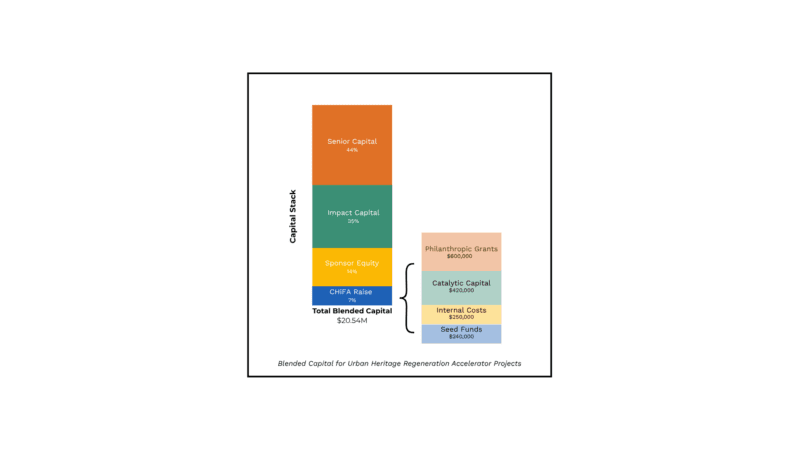
The Accelerator’s proposed capital stack illustrates how catalytic and philanthropic capital can help unlock larger pools of senior and impact capital for heritage-led regeneration.
Senior and impact capital will be raised from local and intergovernmental grants and loans by the Accelerator teams, with continued facilitation from CHiFA in the months following the Accelerator’s completion. Impact capital, targeted at $7 million, is projected to deliver measurable advances in affordable housing, job creation, neighborhood regeneration, cultural tourism, artisan and youth empowerment, and local economic activation.
The program’s outcomes are anchored by UN Sustainable Development Goal 11 on sustainable cities and communities, with relevance across additional goals including poverty reduction, decent work, reduced inequalities, responsible consumption and production, and climate action.
The question is whether heritage investment becomes inclusive regeneration — or another form of extraction.
Heritage-led regeneration also requires clear guardrails. Investment in historic districts can produce displacement, cultural commodification, gentrification, or tourism dependency if community benefit is not built into the structure from the beginning. Local leadership, transparent governance, resident engagement, and measurable social outcomes are therefore not peripheral to the model. They determine whether heritage investment becomes a tool for inclusive regeneration or another form of extraction.
The broader lesson is that heritage city management must move beyond technical preservation and public resources alone. It requires an integrated command of finance, impact assessment, and cross-sector governance. Historic cities are not relics of the past. With the right structures, they can become civic infrastructure for the future — places where culture, capital, and community are brought into more durable alignment.
—
Disclosure: The author serves as pro bono President of the Cultural Heritage Finance Alliance, whose Urban Heritage Regeneration Accelerator is discussed in this article.