
Trump drops IRS lawsuit, paving the way for a settlement


The Internal Revenue Service building is seen in February 2025 in Washington, D.C.

The Internal Revenue Service building is seen in February 2025 in Washington, D.C.
Tasos Katopodis/Getty Images

President Donald Trump is moving to dismiss a $10 billion lawsuit he filed against the IRS over the leak of his tax returns, according to a court filing.

Hours after the announcement, the Department of Justice announced an "anti-weaponization fund" as part of the settlement with Trump. In a statement, the department said the $1.776 billion find will allow the DOJ to settle and pay cases.

Ethics watchdogs and Democrats in Congress are trying to intervene.

Trump and the Trump Organization sued the Internal Revenue Service and the Treasury Department in January demanding $10 billion over the leak of his tax returns years ago.

Legal experts described the case as weak, since the leak has been attributed to a federal contractor, not a full-time employee of the U.S. government. That man is currently serving prison time. They also questioned whether the statute of limitations might have expired; the leaks of tax information happened between 2018 and 2020.

But the Justice Department recently told a judge it had entered negotiations to resolve the dispute. That could mean the government Trump leads would be in line to pay him personally.

U.S. District Judge Kathleen Williams of Miami is presiding over the case. The judge recently raised her own doubts, citing Trump's own rhetoric that in some ways, he was negotiating with himself as both plaintiff and president.

 "Although President Trump avers that he is bringing this lawsuit in his personal capacity, he is the sitting president and his named adversaries are entities whose decisions are subject to his direction," Judge Williams wrote last month. "Indeed, President Trump's own remarks about this matter acknowledge the unique dynamic of this litigation. Accordingly, it is unclear to this Court whether the Parties are sufficiently adverse to each other so as to satisfy Article III's case or controversy requirement."

There's a process in place at the Justice Department for people who say they've been harmed by the federal government.

In the normal course of business, those claims get evaluated by career lawyers. They rarely involve high-profile criminal investigations like Trump's.

"Some of them are run-of-the-mill, right?" said Rupa Bhattacharyya, a former Justice Department lawyer who evaluated these kinds of allegations. "Postal vehicles get into traffic accidents, Veterans Affairs doctors have malpractice claims brought against them, people slip and fall in federal buildings."

Even in the most serious cases, like ones that involved injuries to people cleaning up after the terrorist attack on Sept. 11, 2001, Bhattacharyya said the payouts almost never amounted to more than $10 million.

Edward Whelan, a prominent conservative lawyer, told NPR it would make sense to pause the litigation until Trump leaves the White House.

"There is a glaring conflict of interest with Trump being on both sides of the claim," said Whelan, a former lawyer at the Justice Department who once clerked for the late Justice Antonin Scalia. "It is outrageous that he and those answering to him would be deciding how the government responds to these extravagant claims."

Copyright 2026, NPR


Source link

Leave a Reply

Subscribe to Our Newsletter

Get our latest articles delivered straight to your inbox. No spam, we promise.

Recent Reviews


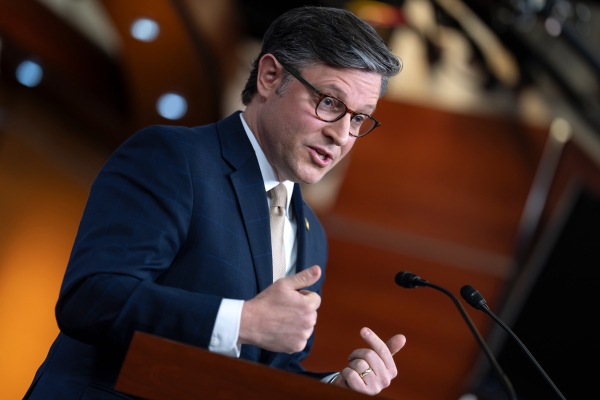
Speaker of the House Mike Johnson, R-La., takes questions at a news conference at the U.S. Capitol on April 21, 2026.

Speaker of the House Mike Johnson, R-La., takes questions at a news conference at the U.S. Capitol on April 21, 2026.
Speaker of the House Mike Johnson, R-La., takes questions at a news conference at the U.S. Capitol on April 21.
J. Scott Applewhite | AP

The House of Representatives voted Thursday to reopen most of the Department of Homeland Security, ending the longest agency shutdown in U.S. history.

The House passed a bill funding DHS, minus dollars for Immigration and Customs Enforcement and Customs and Border Protection. The measure passed by voice vote on what was the 76th day of the shutdown.

Democrats refused to back funding for many of the agency's immigration functions in an unsuccessful effort to secure reforms including body-worn cameras and broad restrictions on face coverings after federal law enforcement killed two American citizens in Minnesota earlier this year.

The Senate, led by Republican Majority Leader John Thune, R-S.D., unanimously advanced this funding legislation in March. At the time, Speaker Mike Johnson, R-La., referred to the proposal as "a joke" and refused to bring it up for a vote. Many members of the House Republican conference refused to fund the agency in a piecemeal fashion and did not want to negotiate over reforms to immigration enforcement operations.

On April 1, Johnson reversed course. He announced the funding bill would be voted on "in the coming days." More than four weeks later, he finally made good on that commitment.

In an effort to appease his hardline members, Johnson waited to bring the Senate's proposal to a vote until that chamber's Republicans started the arcane procedural process, known as reconciliation, to fund all of DHS — including Immigration and Customs Enforcement (ICE) and Customs and Border Protection (CBP) — for the remainder of Trump's term without any backing from Democrats.

The funding bill comes as Secretary of Homeland Security Markwayne Mullin warned the agency was close to running out of funds to pay staff.

"We have reached all the emergency funds we can reach into," Mullin told Fox News on Friday. "I am completely out of the slush fund, I have no place to move at the end of the month."

Mullin said the agency was relying on appropriated funds from last year's One Big Beautiful Bill, which allocated more than $150 billion to DHS on top of its regular annual appropriations funding.

President Donald Trump signed a memo this month authorizing DHS to use some of the money from that legislation to fund the department's operations — potentially infringing on the powers granted to Congress by the Constitution to direct how taxpayer money is spent.

Copyright 2026, NPR


Source link