

Lila Dominguez was helping the wrestling team in the basement of Roosevelt High School on Jan. 7 when the building went into lockdown.
Then word went out: Federal agents were on the school’s front lawn.
Bystander videos show that agents shoved staffers and students, and deployed pepper spray and pepper balls. Four people were arrested, including one teacher. Then-Border Patrol commander Greg Bovino was at the center of the uproar.
Dominguez, a junior at Roosevelt and an editor-in-chief of the school newspaper, remembers feeling shaken as she walked to her car that day.
The first thing she did when she got home was hug her father. Then she opened her computer and started to type.
“I didn’t want to continue to take in the stuff from social media,” Dominguez said. “I wanted to take what I had and put it down on paper, type it out.”

Dominguez wrote about watching her teachers put themselves in harm’s way to protect their students, that morning’s killing of Renee Good just three miles away and the anger students felt over what the federal government was doing to their city.
The article went viral. She was contacted by news organizations from as far away as England. But she really saw the impact when her older relatives read the story.
“It’s like, ‘Yeah, your granddaughter is going through this. So this is like her pure experience, and it’s something different than Fox News,’” Dominguez said. “It opened their eyes a bit.”
Everyone in Minneapolis experienced this winter’s federal surge differently. Some stayed hidden in their homes. Others patrolled outside daycares. And these students at Roosevelt High School — who watched their schoolmates and teachers get accosted by federal agents — wrote about it.
It had just been a few months since Dominguez and some friends had relaunched the high school’s newspaper, The Roosevelt Standard. The paper had been dormant for at least a decade.
The students were shocked at the violence they saw outside their own school. Another editor on the paper, Thora Anderson, remembers seeing her vice principal’s face streaked with terror as he ran through a panicked group of students.
She’d been aware of ICE’s actions in Minnesota, but it hadn’t directly touched her life.
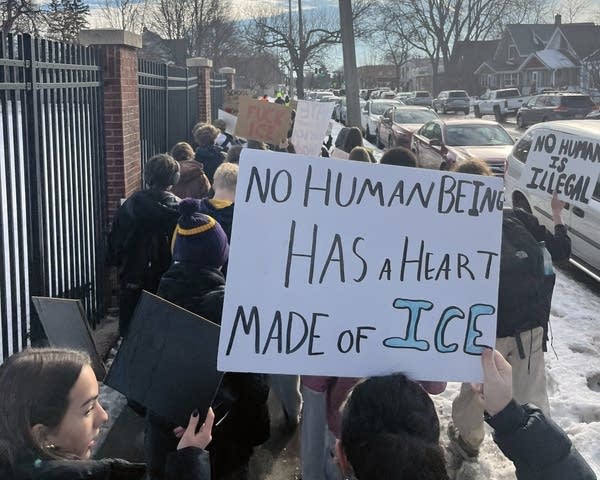
“Most of the incidents were people I didn’t know personally, and so to see it impact the students and the teachers at my school, and to see my favorite teacher getting shoved by ICE, and to see a student that I know crying — it was so surreal,” Anderson said. “I think it really just showed me: this is real and this is impacting so many people.”
After the incident, Minneapolis Public Schools canceled two days of classes.
It was important to the newspaper’s editors to counter misinformation about what was happening in Minneapolis — not coming from students, but from the federal government.
The students were shocked to see that a favorite teacher who had been arrested was featured on the federal government’s social media. The teacher was initially charged with assaulting a federal officer, although that charge was later dropped.
Dominguez said the first job was to figure out what exactly happened. They gathered videos from students who recorded the fracas.
“It was really important to talk to people at school and figure out what really had happened and just communicate the truths, because it was a very confusing time for a lot of people,” Dominguez said.
The early story from the U.S. Department of Homeland Security was that federal agents had been pursuing a car that stopped near the school. It was later reported by FOX 9 that border patrol agents rammed the vehicle of a woman who was observing them near the school.
School felt empty when students finally returned on Monday. Sometimes the teachers would turn the camera around so those in the classroom could wave at their classmates online, who were afraid to leave their homes.

When hundreds of her classmates walked out in protest of ICE, Anderson reported on it for the paper. She remembers hundreds of students pouring out the school’s front doors and over the lawns that just days before had been occupied by federal agents.
“It was just kind of a moment of hope amidst all of the darkness that had happened,” Anderson said. “It was all the students who were fortunate to be there, still coming to school, to show the families that weren’t there that we care about them.”
Signe Boler, editor-in-chief of the newspaper’s print version, wrote about the surge and published a list of mental health resources.
“These next few weeks will especially be difficult here at school, but the rest of our lives will always be littered with the scars of what we have been through,” Boler wrote in her piece. “To everyone who, in the face of fear, took the opportunity to be strong and help protect all of us from evil, thank you.”
But in that issue, Boler also published a piece about the new soccer coach, because she thought it was important for the students to realize there life was going to continue at Roosevelt after ICE.
“That was a lot easier for me, to channel my energy into something that was more personal, instead of just repeating what everybody else on the planet was going to be saying in a couple hours,” Boler said. “I wanted something that my fellow students could actually take back to their personal lives.”
Drayton Cousins is an English teacher at Roosevelt and serves as the newspaper’s advisor. He’s proud of how conscientious the students were in their reporting, ensuring they didn’t put any of their peers in harm’s way. He said the editors weren’t concerned with chasing clout, but dove into the complexities of the situation facing their classmates and the state as a whole.
“It gave the students something to focus on,” Cousins said. “Just like with the other actions that were taking place around the school, about rides and about supplies and about money and about connecting people with legal aid.”
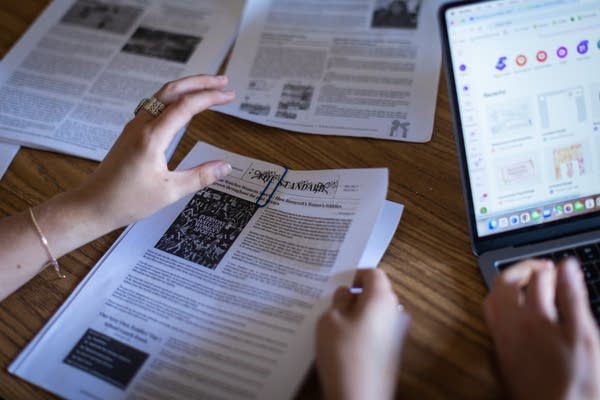
Dominguez said running the newspaper during the surge showed her “the power of truth.”
“Nowadays, so many things are twisted and turned, and you can never know what is true and what's not,” Dominguez said. “Journalism is a very powerful tool.”
The front page of the Roosevelt Standard is mostly back to normal now. However, a few stories about ICE are still nestled beside a piece about students’ favorite off-campus lunch spots.
The newspaper editors are trying to publish another edition next week, but life has moved quickly, and they’re busy now getting ready for tests and prom.