As the Trump administration takes action to loosen regulations on fruity flavored e-cigarettes, anti-tobacco activists in Minnesota are stepping up efforts to ban flavored vapes and other nicotine products at the local level.
Several groups are joining forces to push for a ban or at least restrict the sale of flavored nicotine in Olmsted County, home to Minnesota’s third largest city, Rochester. They’ve formed a coalition called “Love Your Lungs Olmsted,” arguing that flavored tobacco products are designed to entice and hook kids on harmful and addictive nicotine.
“Flavored tobacco is like the product of initiation. That's how young people start, they're drawn in by the flavors,” said Emily Anderson, who is with the Association for Nonsmokers Minnesota.
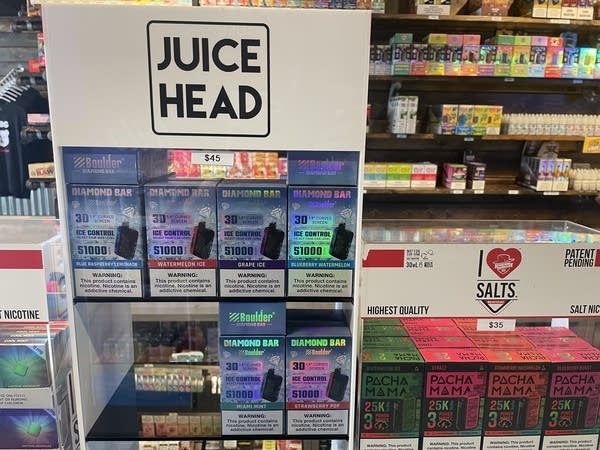
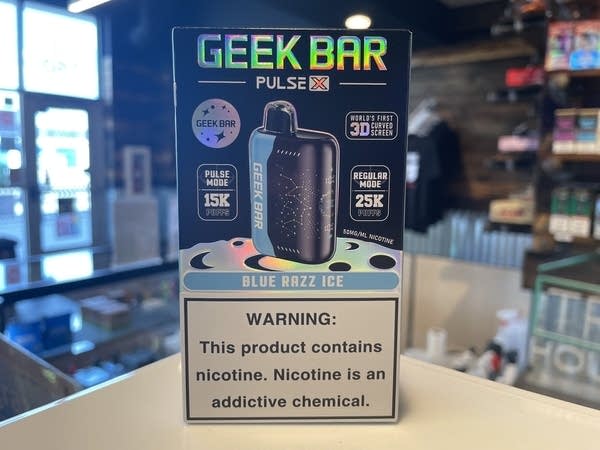
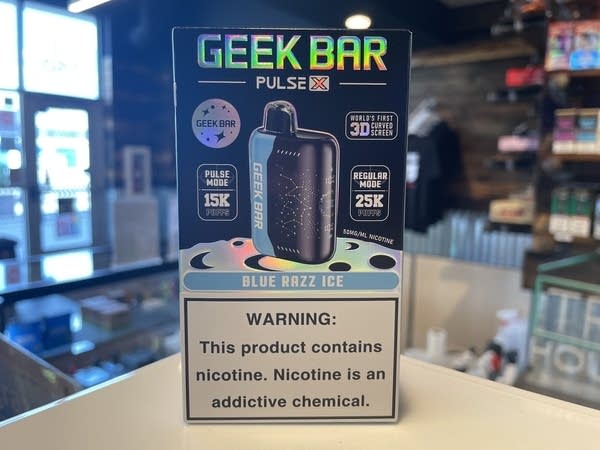
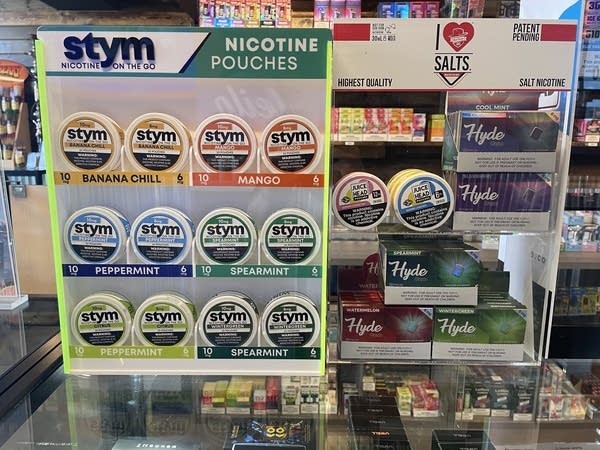
Vape flavors can range from minty menthol to fruity and even dessert flavors like cotton candy and Anderson says those kinds of flavors can be especially enticing to teenagers who would probably not like the taste of tobacco flavored cigarettes and vapes.
“It is not to say that there aren't some adults using flavored tobacco products too, but our focus is on prevention, and we focus on preventing young people from starting in the first place,” said Anderson.
She added that the vast majority of underage tobacco and nicotine users are smoking flavored vapes. Of those underage users, most will continue into adulthood, according to the FDA.
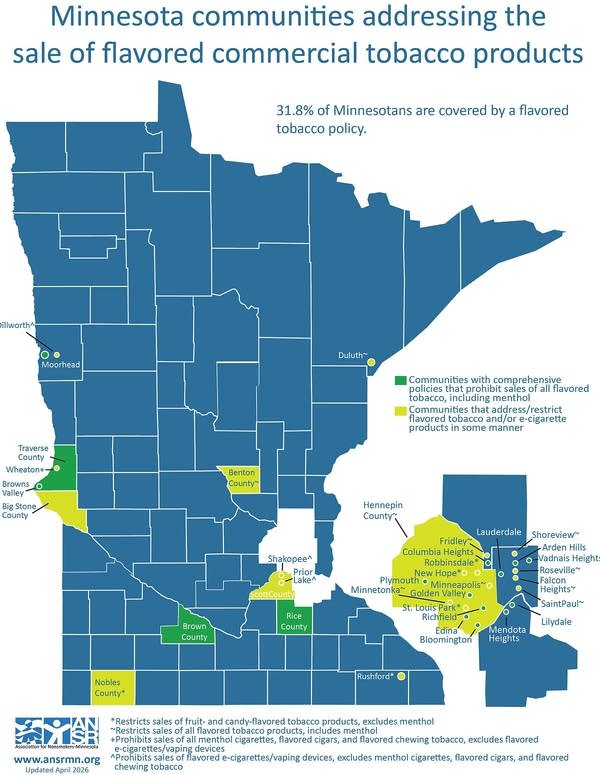
The campaign in Olmsted County is part of a decade-long trend of cities and counties in Minnesota enacting ordinances that restrict the sale of flavored nicotine delivery products like vapes and chewing tobacco. Minneapolis was the first place in Minnesota to pass an ordinance restricting the sale of flavors in 2015, followed closely by St. Paul the next year.
Now, there are 28 cities and 8 counties across the state that have some sort of ban or restrictions on flavored vapes and other nicotine products. The most recent to take such action is the Minneapolis suburb of Plymouth, which approved a ban in April.
There is renewed interest in prohibiting flavored nicotine products among local units of government after the FDA, for the first time, approved the sale of flavored e-cigarettes earlier this month.
FDA allows fruit-flavored vapes
On May 5, the Food and Drug Administration (FDA) released guidance that may allow multiple companies to start marketing and selling fruit-flavored e-cigarettes. The Wall Street Journal and other news organizations reported that the FDA was under significant pressure from President Donald Trump to greenlight fruity flavored vapes, and it is cited as one of the reasons for the ouster of now former FDA Commissioner Marty Makary.
Previously, companies were restricted to menthol or tobacco-flavored vapors, but now, California-based vape manufacturer Glas is cleared to sell other flavors, including blueberry and mango, which will be marketed as “sapphire” and “gold,” respectively.
This brings the number of e-cigarettes authorized by the FDA to 45. All other brands, models, and flavors not on the FDA’s list are not authorized and technically not legal to sell in the United States.
According to their website, Glas sells vapes not derived from tobacco, but they do contain nicotine, which is addictive.
Anti-tobacco groups including the Association for Nonsmokers Minnesota are not surprised by the FDA’s decision.
“I think while it's disappointing, I think we saw some of the industry influence really get to this administration,” said Anderson. “I think it's solely a result of really intense vape industry lobbying.”
Reynolds American, who owns popular cigarette brands including Newport, Camel, and Native American Spirit, was the biggest corporate donor to President Trump’s 2024 campaign, and it is also helping to finance construction of the new White House ballroom.
Anderson says the FDA’s decision is why her organization’s efforts are more focused on enacting anti-vaping policies at the local level, such as Olmsted County, and are less interested in working toward policy change in Washington.
“We're not optimistic that positive things can get done at the federal level,” she said. “Our real action and traction is at the local level. That's where decisions can get made effectively and efficiently and really impact the community, kind of in a months long timeline, not a years or decades long timeline.”
The decision to loosen restrictions on flavored vapes at the federal level is likely not a popular one.
Surveys show that the majority of Americans support efforts at the local level to ban flavored tobacco and nicotine products are supported by a majority of the population. According to the CDC, a majority of Americans even support a ban on menthol cigarettes, a type of flavored cigarette that masks the harsh taste of smoke and nicotine.
Additionally, a slim majority of American adults are in favor of banning all tobacco products in general.
The newly approved vapes use a technology that pairs to the user's phone and is designed to ensure only the person who purchased the vape, who must be 21, is the one using the product.
However, Anderson is skeptical the technology is being implemented in good faith.
“Do we want to believe the tobacco industry when they say they care about young people?" She asked a bit sarcastically. “Because everything else they've ever done shows that they do not care about young people,” said Anderson.
Teen tobacco use is down but still a concern
Nicotine use in teens is not as widespread as it once was.
In 2025, high school nicotine use dropped for the third year in a row, according to the FDA’s National Youth Tobacco Survey.
That survey shows that in 2025, fewer than 10 percent of high school students claimed they used a form of nicotine in the last 30 days, down from a record high of 31 percent in 2019.
Despite nicotine use being on a downward trend among teens, educators and public health officials are still worried about vaping, as it is the most popular way that teens consume nicotine.
Nicole Carlson is a chemical health specialist at Rochester Public Schools.
Part of her job is to support students who are experiencing substance abuse issues, either personally or through friends or family.
Carlson says that vaping is one of many ways students are becoming more disengaged with their schoolwork, for example, taking trips to the bathroom to vape and missing valuable class time.
But, she says vaping can lead to the use and abuse of other drugs as well.
“If we're vaping nicotine, it's really easy to just quickly go over and vape THC, maybe not even knowing that's what it is,’ said Carlson. “All the kids that are referred to me, they've started with nicotine.”
This past school year, she’s received about 70 referrals having to do with nicotine and THC abuse. Carlson says it’s not just high school aged students that have been referred to her, but elementary students as well.
She supports any legislation that would make it more difficult for teens to get hooked on nicotine.
“We need to get to the root problem. And so if it's targeting our kids based on flavors, then let's get rid of the flavors,” said Carlson.
Scarlet Christopherson, 16, is a sophomore at Century High School in Rochester. She plays soccer and softball for her school and when she graduates, she wants to work in the medical field.
She doesn’t vape, but says lots of teens at her school do, even some of her friends.

She also supports a ban on flavored nicotine, saying it would make teens less likely to smoke.
“I think they tried it from their friends, and then they probably had a flavor that they liked, and then they continued to use it because they liked the taste or how it made them feel,” said Christopherson.
Christopherson says she is against vaping because she says she’s seen firsthand the impact vaping can have on young people.
She says she knows a now-graduated student who has breathing issues after vaping all through high school.
“He has, like, lung problems now because he's vaped for so long,” said Christopherson. “He's recently quit and he still has a cough or, like, gets sick sometimes.”
According to the CDC, vapes contain many harmful chemicals that can be especially detrimental to brain development.
Some favor targeted approach over broad bans
Not everyone agrees that broad bans of flavored nicotine and tobacco products is the most effective approach.
Brad Erpelding is the president of Northland Vapor, which has multiple locations in Fargo, North Dakota.
He says a flavor ban would put him completely out of business.
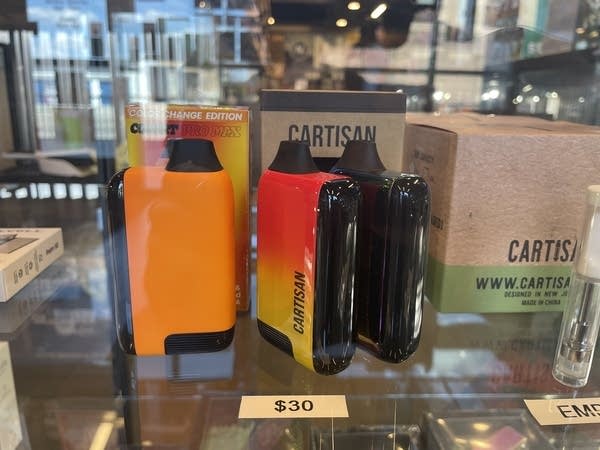
“If [a flavor ban] were enacted today, we would be closing at the end of today's shift and never opening again,” said Erpelding.
In fact, that did happen in Moorhead back in 2021, and Erpelding was forced to close his shop there soon after the ordinance took effect.
He argues there are better alternatives to a flavor ban that won’t put him out of business.
“If you have your flavored nicotine disposable [vape] sitting next to a bag of Skittles at a convenience store, well, you're just encouraging a theft by underage people because they shouldn't even be able to see or even have access to it.”

Erpelding would rather prohibit gas stations and convenience stores from selling flavored vapes and says sales of the nicotine products should be limited to shops like his, which check ID when you walk in, not when you’re buying.
“I think their intentions are good. I think their methodologies are wrong,” said Erpelding.
He also argues that buyers can just move to the next city or county over where flavored products are not yet banned.
“When we closed our store in Moorhead, we immediately opened up our store on Main Avenue in Fargo, opened it on a Monday, and we were profitable by Friday,” said Erpelding, as a lot of his Moorhead customers just crossed the border to buy flavored nicotine products.