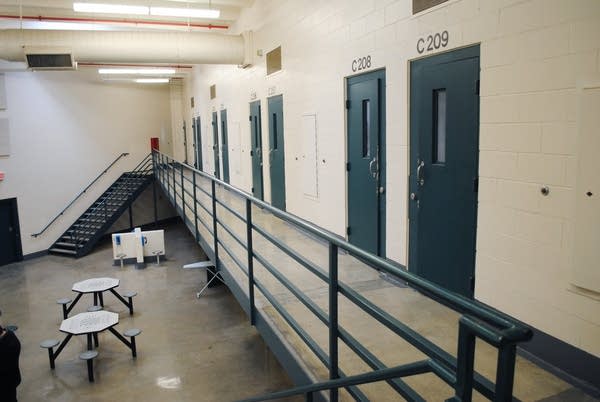
The Department of Homeland Security has posted a proposed contract for Immigration and Customs Enforcement to use a private prison facility in western Minnesota to hold up to 1,600 immigrant detainees.
The former private prison in Appleton is owned by CoreCivic, which operates about 80 detention centers around the country, including almost a dozen that house ICE detainees. The company runs the Dilley Processing Center, where many Minnesota detainees have been sent after their arrests, including 5-year-old Liam Conejo-Ramos and his father.
The contract summary says the company will provide guards, meals, medical care and transportation. It will serve the ICE Enforcement and Removal Operations that’s based in the agency’s St. Paul field office.
“This required geographical area is essential for ERO to accomplish its apprehension and detention, and removal mission in the most cost efficient and timely manner,” according to the contract’s description.
Appleton City Manager John Olinger said the city wasn’t aware of imminent plans for the facility. He said the company and federal government don’t need approval from the city because its use is allowed in zoning.
A view of one of the pods in the Prairie Correctional Facility on February 9, 2016 in Appleton, Minn.
Tom Cherveny | West Central Trib
The Washington Post reported last August that the Appleton facility was being considered for an ICE facility as part of the agency’s plans to double the number of people detained. The former private prison was shuttered in 2010.
Neither ICE nor CoreCivic immediately responded to questions from MPR News about plans for the facility.
This is a developing story. Check back for further updates.
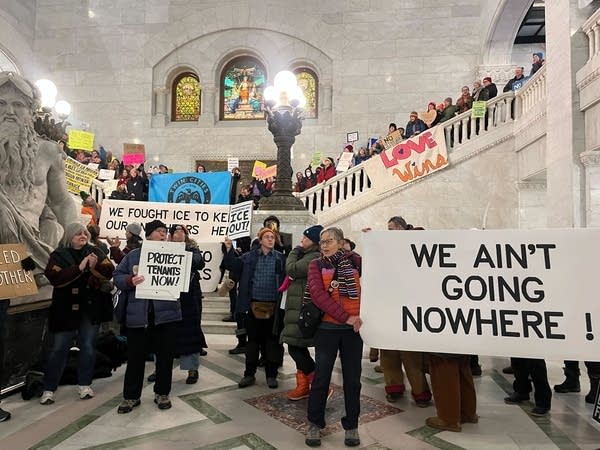
On Thursday, the Minneapolis City Council will decide whether to give renters impacted by the ICE surge more time to make overdue rent. Nine votes are needed to override Mayor Jacob Frey’s second veto of a measure that would temporarily extend the grace period prior to an eviction.
That means that at least one of the five council members who voted against the extension — Michael Rainville, LaTrisha Vetaw, Pearll Warren, Elizabeth Shaffer or Linea Palmisano — would have to change course to pass the override.
The political fight comes as eviction filings creep up. Many immigrant renters are still struggling to make ends meet after the federal government caused job loss, months without income and family separation.
Eight council members, Robin Wonsley, Elliott Payne, Jason Chavez, Jamal Osman, Jamison Whiting, Aisha Chughtai, Aurin Chowdhury and Soren Stevenson voted in favor of the ordinance, which Frey vetoed. It’s the second time the mayor has axed a move to give renters more time, arguing that doing so would cause too much rent debt and strain affordable housing providers. The current proposal extends the city’s 30-day grace period to 45 days. The previous proposal extended that period to 60 days.
“Eviction extensions and moratoriums will create a larger debt trap for our already vulnerable neighbors facing housing insecurity as a result of Operation Metro Surge,” Frey said in a statement after the recent veto, while also highlighting his support for increasing rent assistance.
But some housing advocates, academics and rent relief organizers say the extension is crucial for people to stay housed and get connected to community resources and new citywide rent-relief.
“The data we do have says that extending filing periods is going to keep people housed and then what happens after that is a political question,” said Nick Graetz, an assistant professor of sociology at the University of Minnesota and former researcher at Princeton University’s Eviction Lab.
Graetz said the most important data is the well-documented evidence of how devastating evictions can be on one’s life trajectory.
“From an evidence-based standpoint, if we can delay and avoid eviction as much as possible, especially in the fallout of this acute, traumatic event in the cities, I think that’s worth doing,” said Graetz, who noted that there is no research proving longer eviction notice periods lead to more evictions down the line.
A slate of affordable housing providers who publicly opposed the City Council’s first attempt at temporarily giving renters a 60-day buffer have argued that the longer notice period would keep people from accessing aid while rent accrues. The providers, including leaders at Beacon Interfaith and Catholic Charities, noted applications for county aid usually require an official eviction filing, not an eviction notice.
“There is also the reality that we need to acknowledge rent is the primary revenue source for affordable housing. When rent goes unpaid for months, the financial impact does not disappear,” said Laura Russ at a public hearing in March. Russ is the chief real estate officer at Aeon, an affordable housing provider that filed evictions during the surge. “Buildings still need maintenance. Staff still need to be paid.”
Edward Goetz, the director of the Center for Urban and Regional Affairs at the University of Minnesota called the joint opposition from affordable housing providers “inexplicable.” Goetz studies nonprofit housing developers and has served on the board of directors for two nonprofit housing development corporations.
“They’re supposed to be in the business of providing housing for people who are marginalized in the market,” he said. “I was really quite surprised that they would take this stance against what I think is a reasonable accommodation to allow tenants the time necessary to correct arrearages.”
Goetz said his support is based, in part, on a 2024 master’s thesis by Jack Post Gramlich, who is now a research scientist for the state. That research indicated that a 30-day pre-eviction notice in Brooklyn Center did not cause problems and reduced evictions, and concluded that while evictions spiked across the state after COVID-19 eviction protections were lifted, the city of Brooklyn Center “flattened the eviction curve.”
The Minneapolis City Council allocated a total of $3.8 million toward emergency rental assistance earlier this year. The first $2 million became available late April. Renters must have a household income at or below 30% of the Area Median Income to be eligible and can qualify with a pre-eviction notice.
While community groups say direct aid from neighbors has slowed, larger philanthropic donations have ramped up in recent months, providing rent relief to some groups with fewer barriers to access.
Alibella Rodriguez said she just needs more time to pay her rent.
Rodriguez is a Minneapolis resident who stopped leaving her house in December, and said she still relies on community aid to make ends meet. Her husband stopped taking up painting jobs, leaving their household without income.
About a month ago, Rodriguez finally started venturing out, but with extra precautions like asking other people for rides. With businesses shuttered, she said, there’s less work available.
Rodriguez, who is also a tenant leader and member of Inquilinxs Unidxs por Justicia, a renter advocacy group, said she felt disillusioned by each veto of a longer pre-eviction notice period.
“I’m thinking about the kids,” said Rodriguez whose 12-year-old begged her and her husband to stay home during the surge. “Not just my own kids, but all the kids who went through this are traumatized from being through the occupation. And to think that they go from that to the risk of losing their homes is really frustrating.”
To provide the best experiences, we use technologies like cookies to store and/or access device information. Consenting to these technologies will allow us to process data such as browsing behavior or unique IDs on this site. Not consenting or withdrawing consent, may adversely affect certain features and functions.
Functional
Always active
The technical storage or access is strictly necessary for the legitimate purpose of enabling the use of a specific service explicitly requested by the subscriber or user, or for the sole purpose of carrying out the transmission of a communication over an electronic communications network.
Preferences
The technical storage or access is necessary for the legitimate purpose of storing preferences that are not requested by the subscriber or user.
Statistics
The technical storage or access that is used exclusively for statistical purposes.The technical storage or access that is used exclusively for anonymous statistical purposes. Without a subpoena, voluntary compliance on the part of your Internet Service Provider, or additional records from a third party, information stored or retrieved for this purpose alone cannot usually be used to identify you.
Marketing
The technical storage or access is required to create user profiles to send advertising, or to track the user on a website or across several websites for similar marketing purposes.