ICE denies having a protester database. But a letter to Congress sheds more light


Demonstrators attend an anti-ICE rally in Lewiston, Maine on January 24, 2026. Federal officials have acknowledged collecting information on some protesters, even as they deny maintaining a database tracking U.S. citizens.

Demonstrators attend an anti-ICE rally in Lewiston, Maine on January 24, 2026. Federal officials have acknowledged collecting information on some protesters, even as they deny maintaining a database tracking U.S. citizens.
Joseph Prezioso/AFP via Getty Images

Last January, when federal immigration agents started an immigration crackdown in Portland, Maine, pediatric occupational therapist Xenia Pantos was driving using their spouse's car to work when they saw masked federal agents and vehicles with tinted windows parked in the road. Worried about immigrant community members, Pantos stopped for a few minutes to observe.

Pantos told NPR they stayed at least 10 feet away from the agents and did not interact with them, but noticed an agent taking photos of another observer's license plate.

Hours later, Pantos' spouse, Carly Williams, a nonprofit consultant, said she received a call from a blocked number. A deep male voice on the other end of the line asked for her by name and identified himself as calling from the Department of Homeland Security.

Williams said the caller asked if anyone else drives her vehicle. When Williams mentioned her spouse sometimes did, the caller asked Williams if she knew her spouse had stopped at an incident that morning.

"What he basically said was, 'You should let her know to not do that anymore because people who are doing that type of thing are getting added to a domestic terrorist watch list,'" Williams recalled in an interview with NPR. (While the caller referred to Pantos as "she" and "her," Pantos uses they/them pronouns).

"That was a pretty terrifying phone call to receive, as you can imagine," Williams said.

DHS declined to comment on the couple's account when asked by NPR.

For months, Department of Homeland Security officials have repeatedly denied having a database tracking U.S. citizen protesters or a database of "domestic terrorists", even as anecdotes like what happened to Pantos and Williams suggest federal agents are collecting observers' information in some capacity.

In a previously unpublicized letter sent to members of Congress in April, recently departed acting ICE director Todd Lyons acknowledged the agency gives itself wide latitude to collect information on individuals suspected of potential violations of law, including interference with ICE operations or officer safety matters, and maintains records on people who were never arrested.

In the letter, Lyons denied that ICE maintains a database of protesters or that DHS maintains a "separate, standalone database" of individuals who were encountered but not arrested or detained. But he said at protests that involved alleged criminal conduct, ICE has collected "information to identify individuals reasonably believed to be involved in, or directly supporting, potential violations of federal law and to address officer safety and facility security concerns." The letter said ICE collects "essential biographic and biometric information and situational details."

Lyons wrote: "If individuals who interact with ICE officers are not arrested or detained, any information collected during those encounters is maintained consistent with applicable law and DHS and ICE policies and is treated as an official government record."

NPR is the first news organization to review the letter, which is dated April 21.

It was sent in response to Rep. Maxwell Frost (D-Fla.) and 11 other Democratic members of Congress who wrote to DHS in February asking questions about what data the department collects on protesters.

Civil liberties experts told NPR Lyons' letter appears to be the clearest official acknowledgement yet by federal immigration officials that they may be routinely collecting and preserving information on protesters and observers who are not arrested.

"This letter is evidence of the fact that ICE is knowingly collecting and maintaining official government records on any protestor or lawful observer that its agents claim is potentially interfering with them or threatening agent safety," said JoAnna Suriani, a lawyer at the nonprofit legal and advocacy organization, Protect Democracy.

Suriani is representing Pantos, Williams and other observers in Maine in a federal lawsuit that alleges their First Amendment rights were violated by federal agents who tried to intimidate them by recording their faces and license plates and threatening to add them to a domestic terrorism database.

"Anyone who has seen the videos of our clients' interactions with ICE agents can see they aren't impeding anything and pose no threat to anyone, so why was their information collected?" Suriani said.

Protesters photographed, filmed and threatened with charges

Since the Trump administration's immigration crackdown began last year, peaceful protesters and observers recording federal immigration operations on their cell phones have been threatened with criminal charges for impeding or interfering with law enforcement operations. However, many cases where charges were brought against activists have been dismissed or resulted in acquittals. DHS officials have also previously asserted that recording federal agents and posting the videos amounts to "doxxing" and is a threat to their safety.

Observers in several states, including Minnesota and Tennessee, complained that agents photographed their faces and license plates and later determined their identities and where they lived. Federal agents have access to a suite of surveillance tools, including facial recognition technology, and can access vehicle registration records using a car's license plate.

An activist stands outside across from what appears to be an U.S. Immigration and Customs Enforcement SUV in Portland, Maine on January 23, 2026.
Joseph Prezioso/AFP via Getty Images

A number of observers have also said their Global Entry status was revoked after interacting with federal immigration officials. The program is run by U.S. Customs and Border Protection, another DHS agency, and allows expedited processing for pre-approved, low-risk travelers.

In January, a DHS official sent a memo to some federal immigration agents temporarily assigned to Minneapolis instructing them to collect personal information about protesters and agitators, including license plates, identifications and images, according to CNN reporting.

Frost told NPR he has been concerned about law enforcement tracking protesters since he was part of the Black Lives Matter movement and learned police were collecting information on him and other protesters.

He said while it may be typical for law enforcement to conduct investigations and determine if someone broke the law and then move on, it is concerning if information on people who are exercising their rights is kept by a large federal department.

"That's the concern, is that we have an agency that's been tasked with immigration enforcement having a database … relating to Americans exercising the First Amendment, which is wrong," Frost told NPR.

ICE letter provides nuance after blanket denial

At a February congressional hearing, Lyons denied his agency was surveilling U.S. citizens and said: "There is no database for protesters."

DHS has repeatedly provided a statement to the media that says, "There is NO database of 'domestic terrorists' run by DHS. We do of course monitor and investigate and refer all threats, assaults and obstruction of our officers to the appropriate law enforcement. Obstructing and assaulting law enforcement is a felony and a federal crime. Our law enforcement methods follow the U.S. constitution."

A mobile billboard that reads "ICE agents aren't above Maine Law. Illegal conduct can be prosecuted" is seen on January 30, 2026 in Portland, Maine.
Scott Eisen/Getty Images North America

A department spokesperson provided that statement in response to NPR's inquiry asking if the Lyons' letter still reflected current policy, and again in response to a request for comment about Pantos and Williams' account.

At a congressional hearing last week, Secretary of Homeland Security Markwayne Mullin said his department had used facial recognition technology on people gathered outside of Delaney Hall, an immigration detention center in New Jersey that has been the site of recent protests that have led to intense clashes between some individuals and federal agents. Dozens of people have been arrested in connection with the demonstrations, including some who are accused of assaulting federal officers.

"I have zero tolerance," Mullin said in the hearing. "If you verbally assault our officers, you go after our vehicles, you assault our property, you assault one of our officers, we will find you, we will arrest you."

Lyons' April letter began by saying, "U.S. Immigration and Customs Enforcement (ICE) does not maintain any kind of database of U.S. citizens protesting ICE activities." It also asserted that "DHS policies and practices are designed to respect lawful protests and constitutionally protected activities."

The letter continued, "Where individuals decide to go beyond protected speech and commit crimes against federal personnel and property or threaten, or forcibly impede, assault, or interfere with lawful operations, ICE remains steadfast in exercising its authority to investigate and prosecute violators."

While the letter suggested personal information is only collected if there is potential unlawful activity, Scarlet Kim, a senior staff attorney at the American Civil Liberties Union, said the Trump administration has set a precedent of characterizing lawful First Amendment activities as possible crimes.

"We know that very high level officials within DHS and Lyons himself have explicitly equated First Amendment-protected activities like video recording, gathering information about federal agents, and sharing that information publicly as essentially potential criminal acts that threaten officer safety," said Kim, who is representing observers in Memphis and Minneapolis in federal lawsuits against agencies involved in immigration enforcement.

"So their own definition of what potentially violates the law and could trigger surveillance against an individual includes activities that are squarely protected by the First Amendment," Kim said.

While Lyons writes, "DHS is not creating or maintaining a separate, standalone database for individuals encountered that haven't been arrested or detained," Kim said the letter "strongly suggests" that even if DHS does not have a standalone database of U.S. citizens engaged in First Amendment-protected activities, federal agents are likely collecting and maintaining that information in existing data systems.

"He did not deny that, essentially, that information would not be placed in other existing databases," Kim said.

The letter from Frost and his fellow Democrats was addressed to the Secretary of Homeland Security and asked about policies at DHS, but the response came just from ICE, which is just one agency within the department, raising questions about what may be happening in other parts of the department.

The Democrats' letter questioned whether DHS maintains or accesses information from lists or programs called "Bluekey, Grapevine, Hummingbird, Reaper, Sandcastle, Sienna, Slipstream, and Sparta" among others. A January article by independent journalist Ken Klippenstein reported DHS and FBI have secret watchlists with those code names to track anti-ICE and pro-Palestinian protesters, as well as "Antifa."

The letter from Lyons said in response: "ICE does not maintain, add, or access information from the programs mentioned in your letter."

Frost told NPR he plans to continue pressing the department as he has many more questions about how the information ICE is collecting is used and how it is shared with other parts of DHS.

Last month, the organization FIRE, which advocates for freedom of expression, announced that it is suing DHS and ICE for access to records on whether it is maintaining a database of protesters.

Maine couple left with unanswered questions

Pantos told NPR they had no idea their information might be collected by federal agents when they made the decision to pull over and peacefully observe that morning in January, and that what they had done was protected by the First Amendment.

But after the unexpected phone call threatening that Pantos could be added to a domestic terrorist database, Pantos said they felt too scared to observe ICE activity again. They worried about their family's safety.

"We are a queer couple, which brings additional risks," Pantos said. "There has been an ICE surge in Portland and I've felt really overwhelmed and powerless."

In March, two months after the incident, the couple drove to Quebec City in Pantos' car to celebrate their anniversary. When they tried to re-enter the U.S., a Customs and Border Protection officer pulled them aside for additional questioning and took their phones and keys for about an hour, they said.

To their surprise, one of the officer's first questions was to ask Williams if she had her car registration with her, despite the fact that they were traveling in Pantos' car. After Williams said she didn't have it with her, the officer asked her to describe her car and to recite her license plate number if she remembered it, according to the couple's account.

"He was clearly looking at a computer screen," Williams said, adding that the officer "seemed to be verifying what I was saying."

The couple told NPR that was the moment they realized their data must have been retained in some kind of federal system after Pantos stopped to observe federal agents in January.

"I have to think, because he asked about Carly's vehicle when we were in my vehicle, that there is some sort of an alert when you run our passports that brings attention to us in a way that it didn't used to before all of this happened," Pantos told NPR.

"I feel really concerned about what has happened with my data and the data of so many other people," Pantos said.

Copyright 2026, NPR


Source link

Leave a Reply

Subscribe to Our Newsletter

Get our latest articles delivered straight to your inbox. No spam, we promise.

Recent Reviews


Food delivery app development means engineering a three-sided platform connecting customers, restaurants, and drivers through a single real-time system. A production-ready MVP takes 4–6 months and costs $30,000–$120,000 depending on feature scope. The global market for online food delivery is projected to surpass $1.85 trillion by 2030 (Statista, 2025), making this one of the highest-ROI verticals in mobile commerce. This guide covers everything product and engineering teams need to build, launch, and scale a competitive food delivery platform in 2026.

Building a Food Delivery App in 2026? Start With a Free Architecture Review.

The Food Delivery Market in 2026: Size, Growth, and Opportunity

The global online food delivery market generated approximately $1.07 trillion in gross merchandise value in 2025 and is forecast to reach $1.85 trillion by 2030 at a CAGR of 10.4% (Statista, 2025). Online food orders have outpaced traditional dine-in by over 300% since 2014, a structural shift accelerated by COVID-19 that has since become permanent consumer behaviour.

Bloomberg Second Measure data from Q1 2026 shows DoorDash controlling approximately 67% of the US food delivery market by order volume. In India, Swiggy and Zomato dominate a market expected to reach $21 billion in GMV by 2026 (NRAI, 2025). The food industry contributes roughly 12% of India’s GDP and accounts for close to 40% of employment, underscoring the commercial weight behind digital food platforms.

Users aged 18–34 account for over 51% of all food delivery app orders globally (Statista, 2025). This mobile-first demographic makes native or cross-platform mobile performance a non-negotiable baseline for any new market entrant.

 Three Business Models for Food Delivery App Development

Food delivery app development supports three commercially proven business models. The choice made before development begins determines architecture, revenue structure, and the unit economics path. These models are not interchangeable mid-build.

  1. Aggregator Model: The app lists partner restaurants and routes orders to them; delivery is handled by each restaurant. Revenue comes from listing commissions, typically 15–30% per order. Lower technical complexity but limited margin control. Suitable as a starting point for regional platforms. Examples: early-stage Grubhub, regional Indian aggregators.
  2. Logistics Model (Order and Delivery): The platform manages both order routing and last-mile delivery using its own contracted driver network. Revenue comes from commissions plus delivery and service fees. This is the most technically complex model and the most defensible at scale because the platform controls the full customer experience. Examples: DoorDash, Uber Eats, Swiggy.
  3. Cloud Kitchen Model: The platform operates its own kitchen infrastructure under multiple virtual brand names from a single location with no physical storefront. Cloud kitchen revenue in India is projected to reach $2 billion in 2025 (NRAI, 2024). This model requires food operations expertise alongside the technology build.

Must-Have Features for Food Delivery App Development in 2026

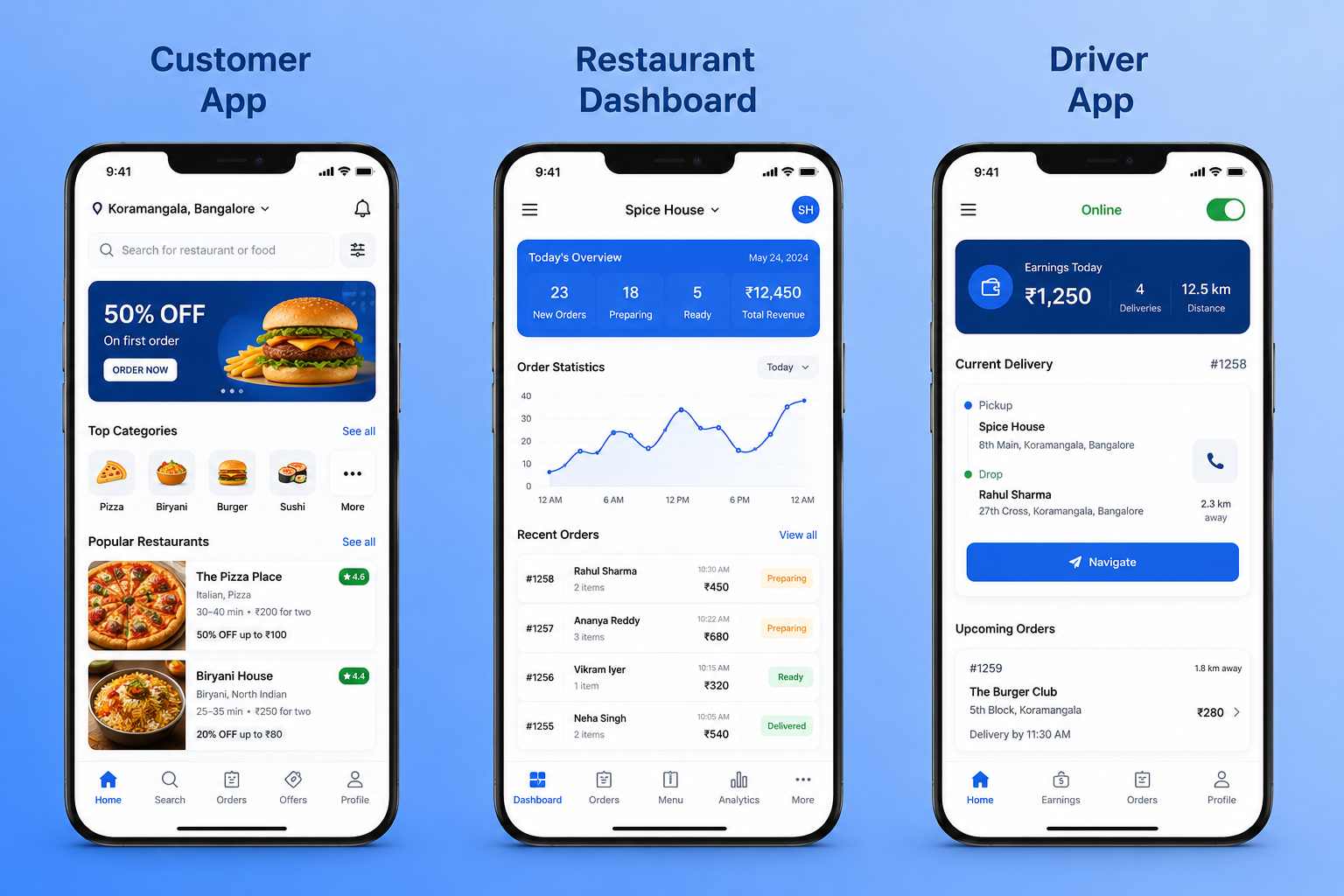
A production-ready food delivery app development project requires features across three panels: the customer app, the restaurant dashboard, and the driver app. Missing a core feature in any single panel creates funnel friction that degrades order completion rates platform-wide, even if the other two panels are well-built.

Food delivery app development

Customer App

  • Restaurant discovery with advanced filters: cuisine type, dietary restrictions, delivery time, estimated cost, and distance
  • Real-time GPS order tracking with dynamically updated ETA calculations, accurate to within 2 minutes
  • In-app payment supporting cards, UPI, mobile wallets, and BNPL options with PCI DSS compliance
  • AI-powered recommendations surfacing reorders, personalised dish suggestions, and time-aware menus (powered by AI and ML development)
  • Push notifications for order status milestones, promotions, and re-engagement campaigns
  • Ratings and reviews with photo upload support and restaurant response capability

 Restaurant Dashboard

  • Live order management queue with accept, reject, and item-level modification controls visible in under 3 seconds
  • Menu management: item-level pricing, availability toggles, image uploads, and category organisation
  • Performance analytics covering order volume, peak hours, cancellation rate, average order value, and revenue trends
  • Automated out-of-stock updates that propagate to customer-facing menus in real time, preventing failed orders
  • Promotional tools including discount codes, bundle offers, and sponsored placement; designed for high conversion by Ailoitte’s UI/UX design practice

Driver App

  • Automated order dispatch with AI-based route optimisation via Google Maps Platform Directions API or Mapbox
  • In-app navigation with live traffic rerouting and turn-by-turn directions including last-metre guidance
  • Earnings dashboard with real-time totals, per-trip breakdown, incentive progress, and payout history
  • Masked customer contact numbers for privacy-compliant in-app calling without number exposure
  • Delivery proof capture via photo and optional e-signature to reduce refund disputes

Recommended Technology Stack for Food Delivery App Development

The recommended stack for food delivery app development is React Native or Flutter for mobile, Node.js (NestJS) for the API layer, PostgreSQL for transactional data, Redis for real-time caching, and Google Maps Platform for routing. These choices determine how well the platform handles peak-hour concurrency, how quickly it ships new features, and what it costs to operate at scale.

Mobile Frontend

React Native or Flutter deliver near-native performance from a shared iOS/Android codebase. React Native is preferred for teams with deep JavaScript experience; Flutter is preferred where pixel-perfect UI fidelity matters most. According to Google I/O 2025, Flutter adoption in on-demand and food delivery apps grew significantly in 2025, driven by superior animation performance on lower-end Android devices.

Backend API Layer

Node.js (Express or NestJS) handles the primary API layer with its event-driven, non-blocking I/O architecture, well-suited for concurrent real-time order events. Python (FastAPI or Django) is deployed for ML-based services including recommendation engines and demand forecasting. PostgreSQL manages transactional order data; Redis handles session management, real-time caching, and queue processing.

Real-Time Communication

WebSockets via Socket.io propagate live order status across all three app panels. Firebase Realtime Database is a suitable managed alternative for teams at earlier infrastructure maturity stages. Sub-second latency on status updates is a baseline user expectation in 2026.

Cloud Infrastructure

AWS (ECS or EKS), Google Cloud Platform, or Azure for hosting. Docker and Kubernetes handle containerisation and auto-scaling during peak demand windows. A CDN such as AWS CloudFront or Cloudflare serves menu images and static assets, targeting sub-100ms response times globally.

Key Third-Party Integrations

  • Google Maps Platform: Directions API, Distance Matrix API, and Places API for routing and location search
  • Firebase Cloud Messaging (FCM): unified push notification delivery for iOS and Android
  • Payments: Stripe (global), Razorpay (India), or PayPal, all PCI DSS compliant
  • Analytics: Mixpanel or Amplitude for behavioural product analytics; Firebase Crashlytics for crash monitoring

Food Delivery App Development Cost and Timeline

Food delivery app development costs range from $30,000 to $250,000 or more, depending on platform scope, number of markets, compliance requirements, and whether the build includes a cloud kitchen management layer. The table below shows Ailoitte’s three standard scoping tiers based on engagements completed between 2023 and 2026.

Tier Scope Cost Range Timeline
MVP (Startup scale) Customer + Driver apps, basic restaurant panel $30,000–$60,000 16–20 weeks
Full Platform v1 All three panels, real-time tracking, payments $60,000–$120,000 24–32 weeks
Enterprise (Enterprise build) Multi-city, AI recommendations, analytics dashboard $120,000–$250,000+ 9–18 months

Note: All figures are estimates from Ailoitte’s internal project data (2023–2026). Actual costs vary by team location, feature complexity, and compliance requirements. [Estimate based on Ailoitte internal project data, 2023–2026]

The single largest cost driver in food delivery app development is the real-time system architecture. Supporting live GPS tracking, dynamic ETAs, concurrent driver assignment, and sub-second push notification delivery at scale requires careful upfront architectural investment. Teams that underinvest here at the MVP stage routinely face expensive re-architecture within 12–18 months of launch.

 Get a Precise Cost Breakdown for Your Food Delivery App

The table above is a starting point. Share your feature wishlist and target market and Ailoitte will return a scoped estimate with a fixed-price delivery option within 48 hours. No obligation.

►  Request Your Custom Estimate  →  ailoitte.com/food-delivery-app-development

What Changed in 2026: Key Shifts for Food Delivery App Development

The three most important changes affecting food delivery app development in 2025–2026 are: AI personalisation becoming a baseline expectation, delivery windows compressing to under 20 minutes in Tier 1 markets, and sustainable packaging compliance entering regulatory scope in EU jurisdictions. Any product team starting a build today must account for all three.

AI powered Food Delivery app

AI-Powered Personalisation Is Now a Baseline Expectation

Platforms without recommendation engines are losing retention to those that surface personalised reorders, dietary-based suggestions, and time-aware menus. Major platforms attribute a significant share of order volume to AI-driven surfacing [Estimate based on industry observation, no primary source available]. Ailoitte’s AI development practice recommends building a lightweight ML recommendation layer from the first sprint rather than retrofitting it post-launch, when training data has accumulated without the correct logging infrastructure in place.

Delivery Windows Have Compressed to Under 20 Minutes in Tier 1 Markets

The standard delivery SLA in major metros has fallen from 45 minutes to under 20 minutes in several food categories, driven by quick-commerce entrants like Blinkit and Zepto entering the food segment. This demands tighter driver dispatch algorithms, predictive stocking for cloud kitchens, and backend infrastructure capable of sub-second latency on driver assignment calls. Any food delivery app development targeting Tier 1 Indian or European cities must account for this in the initial architecture brief.

Sustainable Packaging Compliance Is Entering Regulatory Scope

Several EU member states are mandating that food delivery platforms offer plastic-free packaging options and disclose per-order packaging material data to consumers (EU Single-Use Plastics Directive 2019/904). Platforms targeting European markets in 2025–2026 need to include packaging metadata fields in the restaurant menu schema from day one, not as a future addition. 

In our food delivery app development engagements, the two components teams most consistently underestimate are the restaurant-side order management interface and the driver dispatch logic. A poorly designed restaurant panel produces elevated cancellation rates, a problem that damages customer retention before it becomes visible in top-line analytics.  

We now recommend that any client building a logistics-model platform allocate at minimum 30% of the front-end development budget to the restaurant and driver panels, not solely to the customer app.

FAQs

How long does food delivery app development take?

A food delivery app MVP takes 16–24 weeks from kickoff to launch: 2–3 weeks for discovery and architecture, 10–14 weeks for core development, and 4–6 weeks for QA, performance testing, and app store submission. A full three-panel platform with AI personalisation takes 6–9 months. See Ailoitte’s on-demand app development page for typical sprint breakdowns.


How much does it cost to build a food delivery app?

Food delivery app development costs $30,000–$60,000 for a single-market MVP, $60,000–$120,000 for a full three-panel platform with real-time tracking, and $120,000–$250,000 or more for a multi-city enterprise build with AI personalisation. The most significant cost drivers are real-time architecture complexity, Google Maps Platform API usage at scale, and driver dispatch algorithm sophistication.

What is the best technology stack for a food delivery app?

React Native or Flutter for mobile, Node.js (NestJS) for the API layer, PostgreSQL for transactional data, Redis for real-time caching, and Google Maps Platform for routing. This combination covers the full feature surface of a production food delivery app and benefits from the largest available engineering talent pool for ongoing hiring.

Can I build a food delivery app without a driver network?

Yes. The aggregator model allows restaurants to manage their own delivery, eliminating the need for a driver app and dispatch system. This is a common starting point for regional platforms. The trade-off is lower per-order margin and dependence on restaurant-side delivery capacity. See Ailoitte’s on-demand app development solutions for aggregator-specific architecture patterns.


What differentiates winning food delivery apps in 2026?

Speed, personalisation, and reliability. Users in competitive markets expect sub-30-minute delivery with live tracking and AI-driven recommendations. Platforms that hit delivery SLAs consistently outperform on long-term retention regardless of promotional discounting. The infrastructure to deliver this reliably, including routing algorithms, driver incentive design, and kitchen communication tooling, is where food delivery app development investment pays the highest long-term dividend.

Discover how Ailoitte AI keeps you ahead of risk

Sunil Kumar

Sunil Kumar is CEO of Ailoitte, an AI-native engineering company building intelligent applications for startups and enterprises. He created the AI Velocity Pods model, delivering production-ready AI products 5× faster than traditional teams. Sunil writes about agentic AI, GenAI strategy, and outcome-based engineering. Connect on

LinkedIn


Source link