Minnesota's 300-mile Superior Hiking Trail turns 40


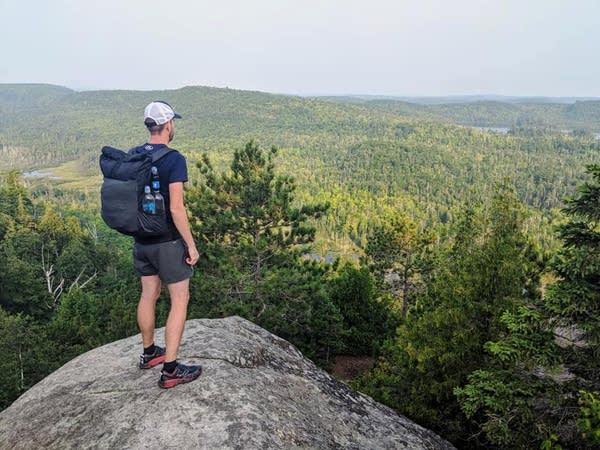
Ajay Pickett looks out from the top of Mount Trudee near Silver Bay.

“I’m having so much fun!” exclaimed Celeste Moore on a recent May morning as she hiked a section of the Superior Hiking Trail that winds through a lush forest and over rushing creeks that tumble down the steep hillside in western Duluth near Spirit Mountain.

She had driven north from the Twin Cities with her mom, Cynthia Martinson, for a guided hike on the trail with a naturalist.
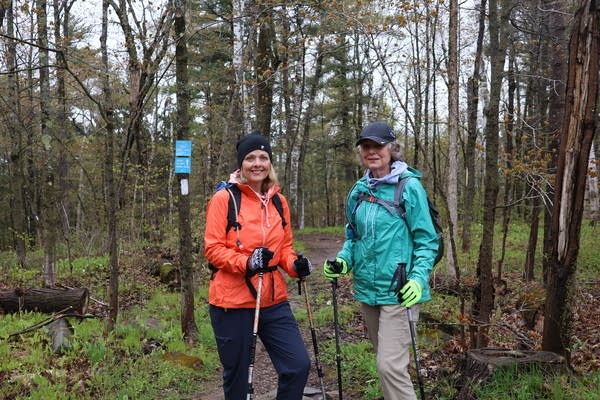
A hiker in an orange jacket and a hiker in a teal jacket pose for a photo in the woods.
Celeste Moore (left) and Cynthia Martinson of the Twin Cities prepare to depart on a hike on the Superior Hiking Trail in Duluth on May 23.
Dan Kraker | MPR News

Martinson marveled at spring ephemeral flowers, bright white trilliums and anemones that blanketed the forest floor. For a few short weeks, they were taking advantage of the lack of forest canopy to soak up the sun.

"This is such an accomplishment,” Martinson said of the trail. The 83-year-old is an avid hiker who has walked a stretch of the Appalachian Trail and several parts of the Superior.

“It's Minnesota, it's home. It's wonderful, and we're so lucky to have this."
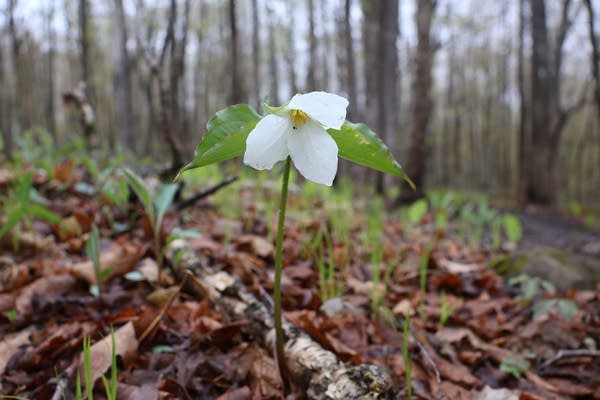
A single white wildflower grows in the forest.
A trillium, an ephemeral wildflower that only appears for a few weeks in the spring, blooms on the forest floor next to the Superior Hiking Trail in Duluth on May 23.
Dan Kraker | MPR News

The rugged trail spans more than 300 miles atop the steep ridgeline along Lake Superior's North Shore, from an overlook north of Hovland, Minn., near the Canadian border, through Duluth to the far southern terminus near Jay Cooke State Park at the Wisconsin border, where it meets the North Country Trail.

Thousands of hikers flock to the Superior Hiking Trail every year, totaling about 400,000 user visits from May through October.

About three quarters of those hikers are day users. But the trail was first conceived as a long through-hiking trail. There are nearly 100 primitive, backcountry campsites along the route.

Hikers navigate a narrow wooden bridge across a creek in the woods.
Hiker Celeste Moore crosses a bridge on the Superior Hiking Trail in Duluth on May 23.
Dan Kraker | MPR News

The idea for the trail was first floated in the 1970s in outdoor recreation plans from the U.S. Forest Service and Minnesota Department of Natural Resources. The thinking was, “How can we have our own mini-Appalachian Trail right here?" said Lisa Luokkala, Executive Director of the Two Harbors-based Superior Hiking Trail Association.

“Backpacking was a thing that was trending in outdoor recreation,” Luokkala said. “People were going out on these bigger expeditions” on the Appalachian, Pacific Crest and other major trails.

But the trail didn't get off the ground until 1986, when Lee Schar, a Superior National Forest ranger, wrote a feasibility study for the trail that became its guiding framework. That same year, business and resort owners and other North Shore residents joined with county, state and federal land managers to form the Superior Hiking Trail Association to oversee its development.

Trail construction began in earnest the following year when the Legislative Commission on Minnesota Resources kicked in nearly $400,000.
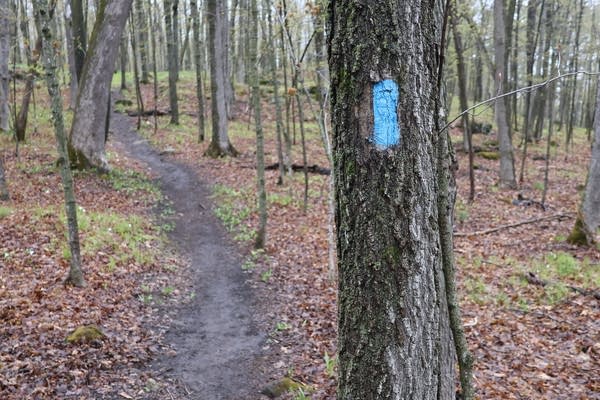
A blue marker is painted on a tree next to a hiking trail.
The Superior Hiking Trail is marked with blue blazes along its entire 300 mile length along the North Shore of Lake Superior, as shown here in Duluth on May 23.
Dan Kraker | MPR News

By 1989, 100 miles of the trail were complete, marked with blue blazes on trees along the path. Minnesota and Youth Conservation Corps members constructed many of those early trail miles. Laid-off workers from the taconite plant in Silver Bay were also hired.

"They were just great,” recalled Tricia Ryan, the trail association's first paid director, hired in 1991. “They were a bunch of hard-working Finnish guys who had fun and were very, very skilled at their jobs."

A Minnesota DNR staffer named Tom Peterson laid out much of the trail route, “way back before Google Maps,” said Ryan. He used topographic maps, a compass and pencil to locate prime overlooks along the contour lines.

Then he'd bushwhack through the woods, tying pink ribbons on trees to mark where the trail should be built, linking those spots together. The result is a sometimes rough footpath that climbs up and down steep slopes, connecting scenic vistas of Lake Superior with stunning waterfalls.
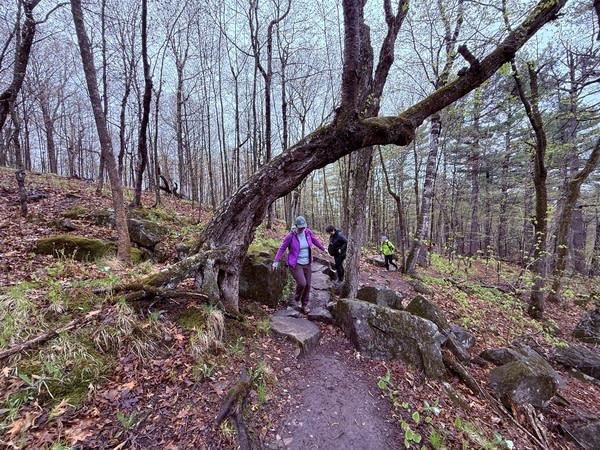
A tree arches over a hiking trail as hikers walk under it.
Hikers scramble under an angled tree on the Superior Hiking Trail in the Magney-Snively Natural Area in Duluth on May 23.
Dan Kraker | MPR News

"Tom Peterson would come to every board meeting and say the same thing at every single one of them. He'd say, 'That trail section we built last week is the best one yet,'" recalled Rudi Hargesheimer, an early trail association board member who's written two books on the trail.

Hargesheimer would then take the next day off to hike it.

"So my claim to fame — If it's true or not, I don't know — is that I'm the first person to hike 90 percent of the Superior Hiking Trail."

More than 40 miles of trail were added through Duluth’s urban wilderness in the early 2000s. The last section of trail that ends at the Wisconsin border was completed 10 years ago.

But work on a trail like this one is never done, said Luokkala. There's a lot of ongoing maintenance, almost all of which is completed by a small army of 600 volunteers. Last year alone, they donated about 10,000 hours of work.
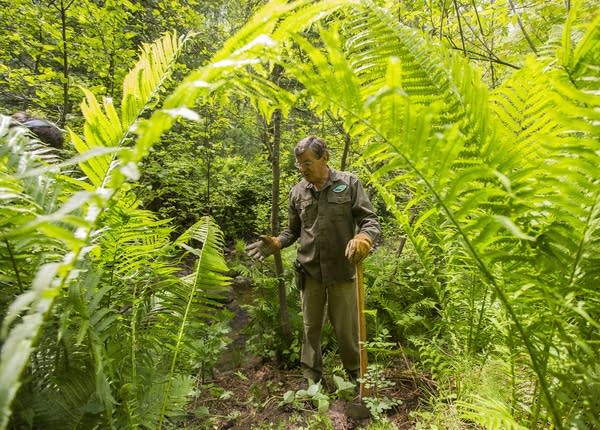
Larry Samson, maintenance and construction
Larry Samson, maintenance and construction supervisor with the Superior Hiking Trail, talks about a bridge that will need to be built across a small creek near what will be the end of the Superior Hiking Trail on June 9, 2016, near Duluth.
Derek Montgomery for MPR News

"If you reflect back on 40 years, thinking of the collective impact and investment of our community in this trail, it's just an astronomical investment and really, truly a gift back to our community,” said Loukkala.

There are other challenges, including maintaining what Luokkala calls the trail’s "Instagram-famous locations" — most notably the trail to the overlook of Bean and Bear lakes above Silver Bay.

A rock staircase along a hiking trail
Trail work along the popular Bean and Bear Lakes Loop trail near Silver Bay, Minn., in summer 2024 included using natural materials for structures like this rock staircase.
Courtesy Superior Hiking Trail Association

Two years ago, crews repaired damage to the trail from severe erosion and years of heavy use.

The trail association is also constantly seeking to protect the scenic beauty that surrounds the trail as the North Shore becomes more and more popular, as well as the current alignment of the trail, which travels across terrain owned by many different private landowners.

"We have some sections as we get further north where we have large sections of trail, that if we were to lose one parcel, one land owner” the cascading effect could affect miles and miles of the trail, explained Luokkala. “It could be pretty crippling.”

To celebrate 40 years of the Superior Hiking Trail on June 6, National Trails Day, organizers are asking hikers to sign up to hike a section of the trail. The goal is to have hikers trod every inch of the more than 300 mile trail.

Birthday parties are scheduled from 4 to 7 p.m. at Voyageur Brewing Company in Grand Marais, Bluefin Bay Resort in Tofte, Castle Danger Brewery in Two Harbors, and Ursa Minor Brewing in Duluth.



Source link

Leave a Reply

Subscribe to Our Newsletter

Get our latest articles delivered straight to your inbox. No spam, we promise.

Recent Reviews


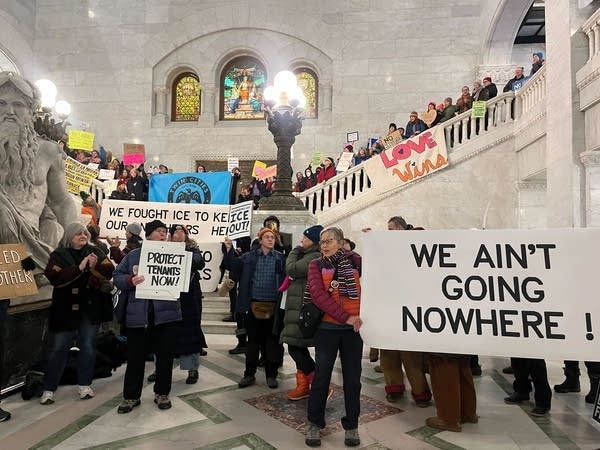
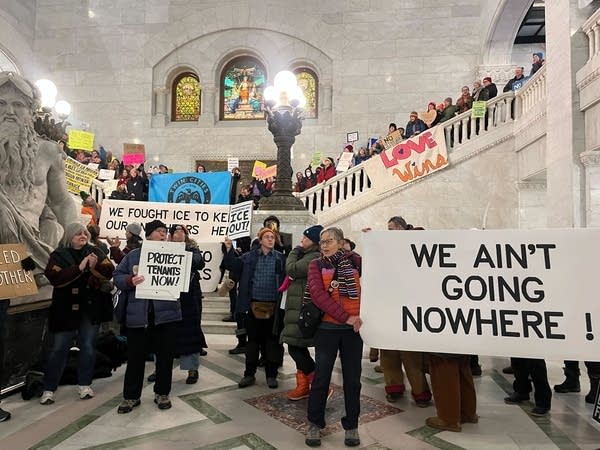
People stand a protest and sing

On Thursday, the Minneapolis City Council will decide whether to give renters impacted by the ICE surge more time to make overdue rent. Nine votes are needed to override Mayor Jacob Frey’s second veto of a measure that would temporarily extend the grace period prior to an eviction.

That means that at least one of the five council members who voted against the extension — Michael Rainville, LaTrisha Vetaw, Pearll Warren, Elizabeth Shaffer or Linea Palmisano — would have to change course to pass the override.

The political fight comes as eviction filings creep up. Many immigrant renters are still struggling to make ends meet after the federal government caused job loss, months without income and family separation.

Eight council members, Robin Wonsley, Elliott Payne, Jason Chavez, Jamal Osman, Jamison Whiting, Aisha Chughtai, Aurin Chowdhury and Soren Stevenson voted in favor of the ordinance, which Frey vetoed. It’s the second time the mayor has axed a move to give renters more time, arguing that doing so would cause too much rent debt and strain affordable housing providers. The current proposal extends the city’s 30-day grace period to 45 days. The previous proposal extended that period to 60 days.

“Eviction extensions and moratoriums will create a larger debt trap for our already vulnerable neighbors facing housing insecurity as a result of Operation Metro Surge,” Frey said in a statement after the recent veto, while also highlighting his support for increasing rent assistance.

But some housing advocates, academics and rent relief organizers say the extension is crucial for people to stay housed and get connected to community resources and new citywide rent-relief.

“The data we do have says that extending filing periods is going to keep people housed and then what happens after that is a political question,” said Nick Graetz, an assistant professor of sociology at the University of Minnesota and former researcher at Princeton University’s Eviction Lab.

Graetz said the most important data is the well-documented evidence of how devastating evictions can be on one’s life trajectory.

Research shows evictions drive poverty and homelessness, smudge renters’ records and limit future housing opportunities. Evictions during pregnancy are associated with adverse birth outcomes. Evictions and eviction filings are associated with increased risk for premature death.

“From an evidence-based standpoint, if we can delay and avoid eviction as much as possible, especially in the fallout of this acute, traumatic event in the cities, I think that’s worth doing,” said Graetz, who noted that there is no research proving longer eviction notice periods lead to more evictions down the line.

A slate of affordable housing providers who publicly opposed the City Council’s first attempt at temporarily giving renters a 60-day buffer have argued that the longer notice period would keep people from accessing aid while rent accrues. The providers, including leaders at Beacon Interfaith and Catholic Charities, noted applications for county aid usually require an official eviction filing, not an eviction notice.

“There is also the reality that we need to acknowledge rent is the primary revenue source for affordable housing. When rent goes unpaid for months, the financial impact does not disappear,” said Laura Russ at a public hearing in March. Russ is the chief real estate officer at Aeon, an affordable housing provider that filed evictions during the surge. “Buildings still need maintenance. Staff still need to be paid.”

Edward Goetz, the director of the Center for Urban and Regional Affairs at the University of Minnesota called the joint opposition from affordable housing providers “inexplicable.” Goetz studies nonprofit housing developers and has served on the board of directors for two nonprofit housing development corporations.

“They’re supposed to be in the business of providing housing for people who are marginalized in the market,” he said. “I was really quite surprised that they would take this stance against what I think is a reasonable accommodation to allow tenants the time necessary to correct arrearages.”

Goetz said his support is based, in part, on a 2024 master’s thesis by Jack Post Gramlich, who is now a research scientist for the state. That research indicated that a 30-day pre-eviction notice in Brooklyn Center did not cause problems and reduced evictions, and concluded that while evictions spiked across the state after COVID-19 eviction protections were lifted, the city of Brooklyn Center “flattened the eviction curve.”

The Minneapolis City Council allocated a total of $3.8 million toward emergency rental assistance earlier this year. The first $2 million became available late April. Renters must have a household income at or below 30% of the Area Median Income to be eligible and can qualify with a pre-eviction notice.

While community groups say direct aid from neighbors has slowed, larger philanthropic donations have ramped up in recent months, providing rent relief to some groups with fewer barriers to access.

Alibella Rodriguez said she just needs more time to pay her rent.

Rodriguez is a Minneapolis resident who stopped leaving her house in December, and said she still relies on community aid to make ends meet. Her husband stopped taking up painting jobs, leaving their household without income.

About a month ago, Rodriguez finally started venturing out, but with extra precautions like asking other people for rides. With businesses shuttered, she said, there’s less work available.

Rodriguez, who is also a tenant leader and member of Inquilinxs Unidxs por Justicia, a renter advocacy group, said she felt disillusioned by each veto of a longer pre-eviction notice period.

“I’m thinking about the kids,” said Rodriguez whose 12-year-old begged her and her husband to stay home during the surge. “Not just my own kids, but all the kids who went through this are traumatized from being through the occupation. And to think that they go from that to the risk of losing their homes is really frustrating.”


Source link