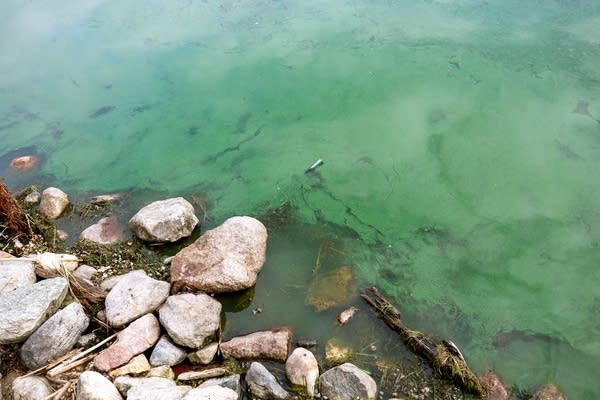
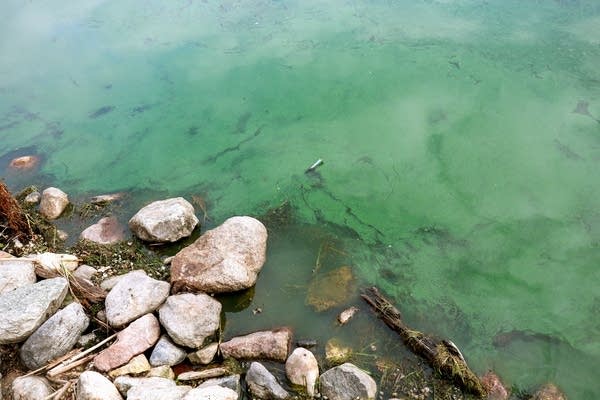
Minnesota researchers plan to test a promising technique that uses clay to remove potentially toxic algae from lakes and ponds.
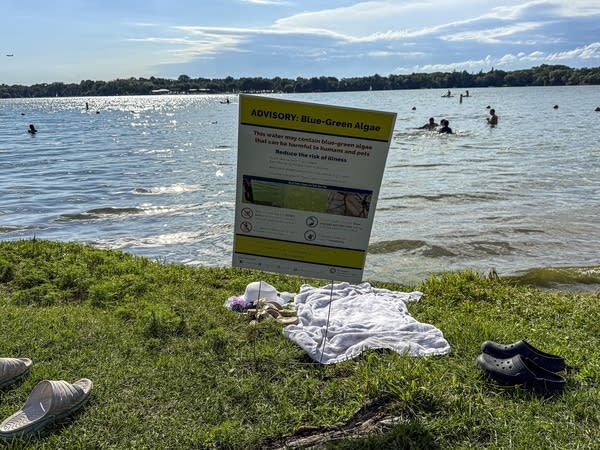
Harmful algal blooms are a problem in many lakes, ponds and streams across the U.S.
The main cause isn’t a type of algae at all, but a form of bacteria called cyanobacteria that thrives in warm, nutrient-rich water. It can produce toxins that can affect water quality and harm people, animals and ecosystems.
Clay is widely used as a treatment method in other countries, but it hasn’t gotten as much attention in the U.S.
Now researchers from the University of Minnesota are proposing to test its use in Minneapolis stormwater ponds with a history of algal blooms.
The project stems from a 2020 federal law that directed the U.S. Army Corps of Engineers to develop methods to prevent and reduce harmful algal blooms.
“This whole program is really looking at new techniques to reduce these algal blooms and try to look at a holistic and natural way at reducing them throughout the nation,” said Trevor Cyphers, a fisheries biologist at the Army Corps of Engineers’ St. Paul office.
University of Minnesota researchers Miki Hondzo and Judy Yang have been leading the research into using clay to treat harmful algal blooms.
The Minneapolis demonstration project is a “real-world situation” to test clay-based treatment techniques that could be used on both large and small lakes, Cyphers said.
“I think it could produce a lot of good, useful tools that we could use to reduce these negative algal blooms in the future,” Cyphers said.
Under the proposal, researchers would spray a mix of natural clay and water on the surface of one stormwater pond. Another pond would be sprayed with a mixture of water and a synthetic clay called laponite, which naturally degrades and is generally considered non-toxic.
The clay particles and the cyanobacteria cells clump together and sink to the bottom.
“Once the algae is underwater, it then dies,” Cyphers said.
Chris Filstrup, a lake and stream scientist at the U of M’s Natural Resources Research Institute in Duluth, said the treatment method has shown success in removing cyanobacteria in the lab. They also tested it in larger tanks at Ohio State University, Filstrup said.
“We're really curious to continue to evaluate how it does when you upscale it to bigger and bigger ecosystems, like natural stormwater ponds” and eventually lakes, he said.
Researchers found that the synthetic clay, or laponite, actually removed more cyanobacteria at a lower dosage rate than traditional clay, Filstrup said. And because it’s translucent — meaning it allows light to pass through — it doesn’t cloud up the water, he said.
After the treatment, researchers plan to take samples of the water and sediment to measure how effective the clay-based treatment was. They’ll also look at whether it has any toxic effects.
The results will help inform scientists about whether the treatment methods could be used on a larger scale, such as Lake Erie, where harmful algal blooms are a costly annual problem.
“There's no limit of where it could be used if these clay-based treatments are useful, and they don't cause any major problems,” Cyphers said.
Stormwater ponds are an ideal place to test the treatment method because there are few fish or other aquatic creatures and no currents moving the water, Cyphers said.
Scientists are doing additional studies in the lab of the potential effects of clay on freshwater mussels or other aquatic organisms, he said.
The public has until June 29 to comment on an environmental review of the proposed project. If no significant impacts are found, the work would begin this summer or in 2027.
While clay treatments offer promise, Filstrup noted that they only treat cyanobacteria blooms — which are often a symptom of larger issues affecting a lake’s health, such as nutrient runoff or climate change.
“We’ve got to have those techniques, but I think you also have to look at the underlying problems and (be) trying to solve those as well,” he said.