

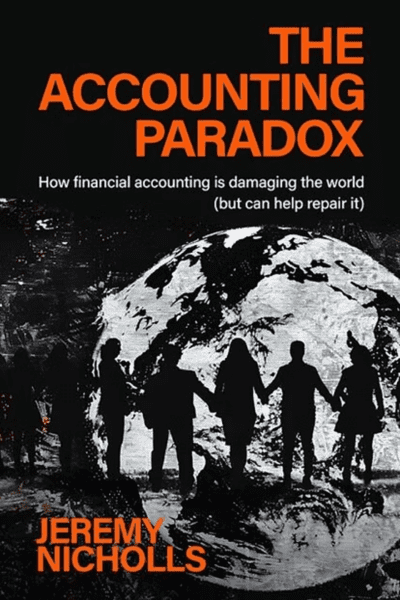
Jeremy Nicholls
Instead of helping businesses, investors, and governments confront today’s social, ecological, and biodiversity crises, conventional accounting often excludes the costs that companies impose on people and the planet. Those costs do not disappear. They are simply carried by workers, communities, ecosystems, public institutions, and especially future generations.
In his fourth book, The Accounting Paradox, Nicholls argues that the way we calculate profit is one of the economy’s most powerful hidden design choices. If financial statements recognize revenue and legally enforceable costs but leave out uncompensated harm, then markets will continue to reward activities that generate private returns while shifting real costs onto others.
Nicholls is not calling for the end of markets. Rather, he argues that accounting should be redesigned around a different assumption: that investors, businesses, and societies expect financial returns within a broader framework focused on avoiding — or at least compensating for — unintended harm. Such a shift, he believes, could create a competitive advantage for impact enterprises and help align private decision-making with public wellbeing.
Impact Entrepreneur spoke with Nicholls about capitalism, accounting norms, investor expectations, the Golden Rule, human creativity, impact washing, and what it would mean to build an accounting system fit for the impact economy.
Impact Entrepreneur: Early in the book, you discuss the debate over whether capitalism is the problem or the solution for today’s various crises. In which camp do you put yourself, if any? Do we need to rein in the “excesses of capitalism,” or do markets need to be “allowed to run truly free”?
Jeremy Nicholls: We should not conflate a competitive market economy with capitalism. What we call capitalism is really the result of behaviors caused by the basic assumption that underpins our accounting system.
That assumption is that users of accounts have an expectation of financial returns without any other regards, caveats, or expectations. The result is that the costs of compensating for harm done in pursuit of those returns are not included in the calculation of profit.
This means that investments and debt flow to activities that may generate financial returns, but externalities accumulate. The efficiency of markets is undermined. The rate at which capital replaces labor is not mediated by the costs imposed on displaced labor. And there is no feedback loop from the accumulation of personal wealth.
To be clear, I am not arguing that there should not be variations in personal wealth ownership, or that new technologies should not emerge that replace labor with capital. But if the costs imposed on others were recognized, there would be a more equitable distribution of wealth and ownership, and the excesses of our current system — which we call capitalism — would be avoided.
Impact enterprises might well have a competitive advantage in that kind of system.
IE: You write that the accounting system could be designed around something closer to the Golden Rule — that people do as they would be done to by others and that businesses should be held accountable for harm and compensate those who experience it. Is that idea compatible with a market economy?
Nicholls: Yes. In fact, I think this is where we have to focus a bit less on what businesses care about and a bit more on what those who provide resources to businesses care about.

Photo by Valery Tenevoy
If the accounting system were based on an assumption about investors’ expectations that was closer to the Golden Rule, businesses would respond to that metric. Human creativity and entrepreneurialism would then be directed toward creating products and services that meet needs without causing harm — or at least only causing harm that is properly compensated.
Impact businesses currently face a competitive disadvantage when impact is not incentivized. The changes I and others are proposing would shift that. They would make it possible for businesses that reduce harm, compensate those affected, and support wellbeing to gain a competitive advantage.
IE: One of the strongest claims in the book is that the current system is designed as if users of accounts have “no empathy, no guilt, and no remorse if others are harmed or mistreated.” Can systems really be designed to be empathetic?
Nicholls: Absolutely they can. That is one of the main messages of the book.
The accounting system is designed as if users are not empathetic. It is based on the assumption that they are interested in financial returns without any other regards, caveats, or expectations.
The deeper solution is to change the way profit is calculated.
We could just as easily build an accounting system on the assumption that people are interested in the consequences of their decisions on themselves and others. One consequence might be financial returns. Another might be compensating for harm done.
I believe this would reflect our religious, cultural, and legal expectations much better than the current system does. It would also give a voice to those who are not treated as users of accounts — including future generations — and help align private and public interests.
IE: Every business recognizes that “the less costs you pay, the more profit you can make.” But, as you point out, excluded costs do not vanish; they accumulate in the system. Someone else still pays. How does that distort markets?
Nicholls:

Photo by Sweet Life
The current incentive system drives behaviors and creates conflicts of interest that result in unethical decisions. It is not simply a question of individual companies gaming the rules, though that can happen. The larger issue is that the rules themselves create incentives to limit costs to those that are legally enforceable.
When companies can impose costs on others without recognizing them in profit, those costs become externalities. They accumulate until society starts calling for reparations, regulation, taxes, or public spending to clean up the damage.
But often the profits made are not adequate to pay for the harm done. If those costs had been included from the start, some business models would never have begun, and different ones would have emerged.
If we want to avoid future calls for reparations, we need to change the basis of our accounting system.
IE: If investors try to take these costs into account voluntarily, would they be at an advantage or a disadvantage?
Nicholls: In the current system, it depends.
If you mean investment managers seeking short-term returns, or investors who do not care about the consequences of their investments on others so long as they receive financial returns, then they might feel they are at a disadvantage.
But if you mean institutional investors balancing returns over the short and long term — where long term includes future generations — or investors who face invisible systemic risk in their portfolios, then they may be at an advantage.
Excluded costs do not vanish; they accumulate in the system.
There are also investors who want financial returns, but only if any harm done to others has been compensated. Perhaps I could come back to talk about the results of our global survey on investor expectations when they are available.
In the meantime, investors can ask whether accounts are fairly presented, or whether they give a true and fair view where company law requires it. They can ask directors to explain how they have considered their duties under current law.
It would be much better for accounts to include this information and have it audited by someone acting in the interests of investors than for investors to try to calculate it themselves.
IE: You also comment on how the continuous pursuit of GDP growth is driven by “abusing the planet’s limited resources and by abusing people’s human rights.” Is it possible to fix the accounting system without abandoning GDP as a measure of economic growth or prosperity?
Nicholls:

Photo by Vitaly Gariev
GDP is the result of the data fed into its calculation. If that data included information on harm being done, represented as compensation, then many of the issues currently missing from GDP would be included.
There has been a focus on replacing GDP, or at least adding another metric alongside it, rather than changing the basis on which it is calculated. Adding new measures can avoid the fundamental problem, which is — and I may seem like a stuck record now — how profit is calculated.
There are increasing national-level initiatives focused on measuring and managing wellbeing. Aligning our accounting system with wellbeing — which is, ironically, already the purpose behind existing international public-sector accounting standards, if not always the practice — would shift us toward a wellbeing economy while maintaining private financial returns within that wider purpose.
IE: You write that “accounting is political,” and that the people who experience the consequences of economic decisions must be involved in reforming the system. What would that look like in practice?
Nicholls: It comes down to governance.
The accounting system is currently governed within a public-interest remit, but by organizations that focus on financial markets without recognizing the need for people who experience the consequences of those markets to be directly involved in the system’s design and oversight.
Even if the people employed in the existing system care about those consequences, the organizations are not designed to handle these conflicts of interest.
One example of a different approach is the International Labour Organization, which is constituted to separately represent employee and employer interests within the United Nations governance framework. Nothing is perfect, but some approaches are less imperfect than others.
If those experiencing harm were represented, with power, then an expectation that profits would be calculated after compensation for harm done would begin to flow through the wider economic system.
We have started to explore, for example, what might happen if the transfer of an economic resource — the language accounting uses for meeting an obligation — were met not by payment alone but by issuing shares, giving representatives of those experiencing harm a stake in ownership.
IE: Impact investing is often built around positive intentions. But you emphasize the lack of focus on “unintended consequences.” How important is it for impact investors to account for the harm their investments may cause, even when their intentions are positive?
Nicholls: Very important.
Even for impact investing with positive intentions, compensating for negative impacts, for harm done, is a critical positive step. Anything else just adds to impact washing.
IE: A great deal of impact measurement focuses on positive impacts. But you write that positive impacts are difficult for accounting because they are “not owned or controlled by a business” and therefore cannot simply be treated as assets. What can impact investors and accountants learn from each other here?
Nicholls: I think they can help each other.
Many current approaches to what is called impact accounting are not really accounting. Impact measurement has tended to focus on accuracy of measurement rather than on generating useful information, with clarity about useful for whom and for what.
Anything else just adds to impact washing.
Information would look quite different if it were designed to be useful to those experiencing the consequences of business activity. Those people would then be able to hold companies to account for performance in relation to those consequences. Performance that is likely to relate to removing or compensating for harm done and for increasing the rate at which positive impacts, as recognized by those people, are being created.
This is also linked to the UNDP SDG Impact Standards and ISO 53001 and 53002.
IE: The field of impact valuation, or impact monetization, is still evolving. Is that work a prerequisite for the kind of accounting system you are proposing?
Nicholls: One of the great things about our current accounting system is that in many countries it is already possible for directors to take responsibility for harm done and compensate for it.
The amount of compensation has to be consistent with the commitment made, but it does not have to be the same in every company. Even where information is added as a note to the accounts, it simply has to meet the requirements of a reasonable estimate.
 As practice develops, especially if this becomes a general expectation, the range within which reasonable estimates are made would generalize very quickly.
Existing work in impact valuation is a useful guide for directors taking this approach. But there is still work to do. For example, the level of compensation for harm done by a company emitting carbon within an allocation that would be consistent with planetary limits could reasonably be expected to be very much lower than the compensation required from a company emitting the same amount beyond its allocation.
Compensation is context specific.
IE: As you write in the book, the solution is not only to legislate against actions that cause harm, or raise taxes to address the damage, or make future plans to do less damage — though all of these may help. If you had to name the essential shift, what is it?
Nicholls: The deeper solution is to change the way profit is calculated, and then rely on human creativity, imagination, and entrepreneurialism to respond to a new measure of profit.
That would play to what is best in being human: our ability to be kind, to consider others, and to create joy.
For Nicholls, accounting reform is not a technical fix at the margins of the economy. It is a way of asking what kind of economy our numbers are quietly building — and whether they might be redesigned to reward enterprise that creates value without shifting harm onto others.