
IT staff augmentation is the practice of hiring external technology professionals (developers, data scientists, QA engineers, DevOps specialists) on a contract basis to fill specific skill gaps within your existing team. The augmented professionals work under your direct management, follow your processes, and integrate into your delivery pipeline immediately. Unlike outsourcing, you retain full control over technical decisions and IP from day one.
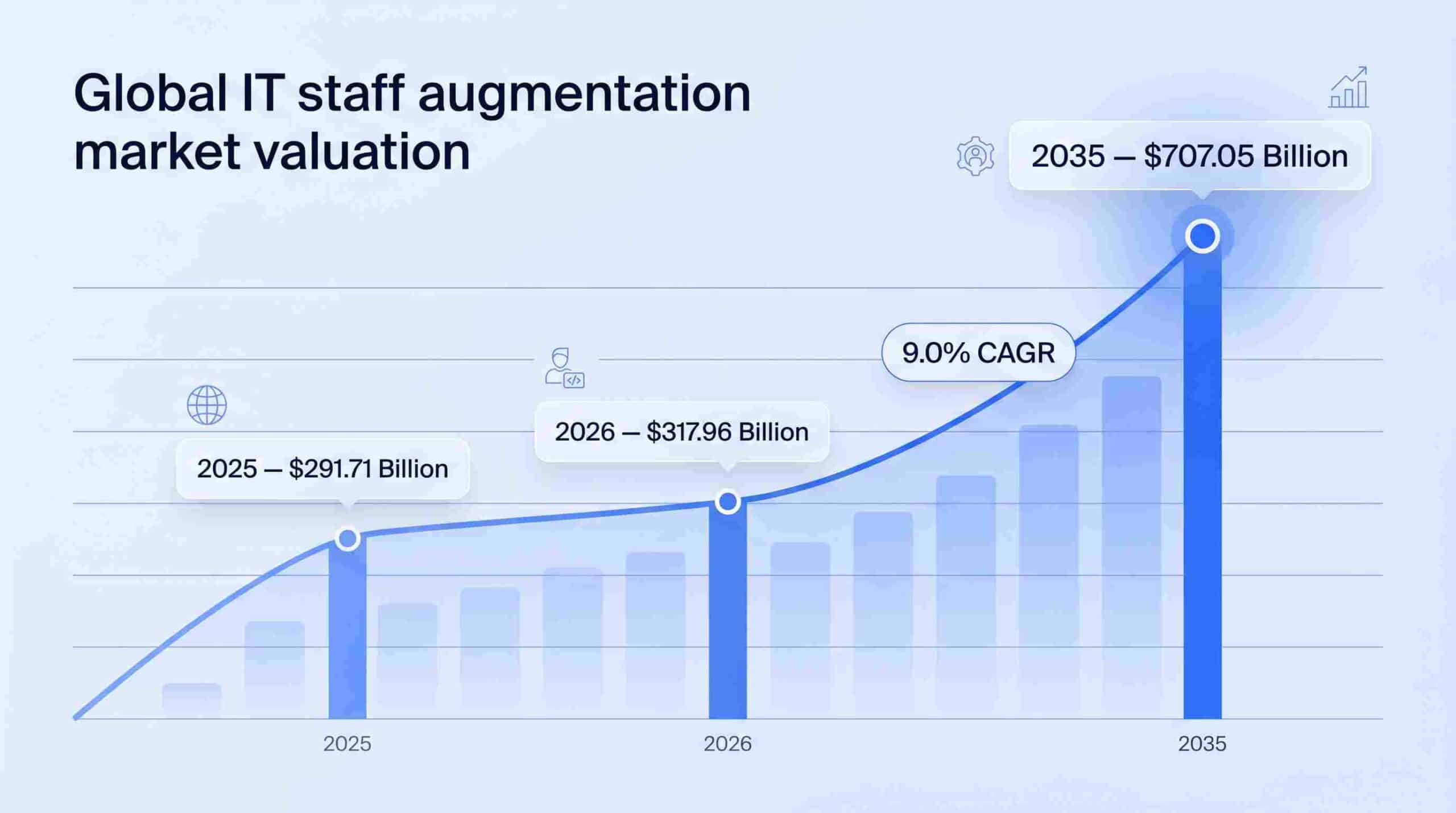
The global IT staff augmentation and managed services market was valued at $291.71 billion in 2025 and is projected to reach $317.96 billion in 2026, expanding to $707.05 billion by 2035 at a CAGR of 9.0% . That growth is structural: the average time to fill a specialised technical role through traditional hiring is 88 days, a timeline that collapses product roadmaps and misses market windows.
This guide covers what IT staff augmentation is, the six engagement models, how to implement it step by step, how the cost structure works in 2026, and how to decide whether it’s the right model for your specific situation.

Through this blog, we can get into what this relatively new term is and how it is a big tool for IT companies.
What’s New in IT Staff Augmentation in 2025-2026
Three structural shifts have changed how IT staff augmentation works compared to 18 months ago:
AI-driven talent matching has collapsed placement timelines. Vendors now screen candidates on technical depth, communication profile, and time-zone compatibility in parallel, reducing time-to-placement from 2-4 weeks (industry average in 2023) to 48-72 hours for well-specified briefs. Ailoitte’s own AI-driven matching system is a direct response to this shift.
Outcome-based contracts are replacing pure time-and-materials billing. Enterprises running long-term IT staff augmentation programmes increasingly negotiate deliverable milestones rather than hourly billing, transferring delivery risk back to the vendor. If you are signing a staff augmentation contract in 2026, expect to negotiate this structure for engagements longer than three months.
Nearshore is taking share from offshore. Offshore IT staff augmentation still commands over 52% of global market revenue (Verified Market Research, March 2026), but nearshore models, particularly India-origin teams serving MENA and European clients, grew sharply as organisations prioritised real-time collaboration windows over pure cost savings.
What is IT Staff Augmentation?
IT staff augmentation places qualified external professionals inside your existing team to supplement capacity and skills for a defined period. The client organisation directs the work; the vendor handles sourcing, technical vetting, employment administration, and payroll.
The term covers a wide range of arrangements: a single Flutter developer joining a mobile team for eight weeks, a four-person AI engineering pod embedded in an enterprise transformation programme for 18 months, or a QA specialist filling in during a permanent hire search. What unifies them is the management model: the client runs the work.
When you hire dedicated developers through a staff augmentation model, the professionals join your Slack, your sprints, your standups. They are functionally your team, with the operational flexibility to scale up, scale down, or exit as project demands change.
Skip the 88-day hiring queue. Ailoitte places pre-vetted developers inside your team within 48 hours.
IT Staff Augmentation vs. Outsourcing vs. Dedicated Teams
This is the question CTOs ask most frequently, because the governance model, IP structure, and risk profile differ significantly across these three models.
|
Model |
Who manages the work? |
Who owns the IP? |
Best for |
|---|---|---|---|
|
IT Staff Augmentation |
You (client) |
You |
Filling a specific skill gap while maintaining full technical control |
|
Dedicated Development Team |
Shared (client + vendor) |
You |
Long-running products needing consistent, cross-functional capacity |
|
Full Project Outsourcing |
Vendor |
Negotiated |
Defined-scope projects where you can delegate technical decisions |
|
Freelance Platform |
You |
You |
Short, isolated tasks with low integration requirements |
IT staff augmentation is the right choice when your technical architecture is defined and your primary constraint is capacity or a specific skill gap. Full project outsourcing makes sense when you lack the internal bandwidth to manage delivery and are comfortable delegating architectural decisions. For organisations that want expert delivery with more oversight than traditional outsourcing, Ailoitte’s dedicated development team model offers a collaborative middle path: a cross-functional team aligned to your product goals and managed jointly.
Why Demand for IT Staff Augmentation is Accelerating in 2026
The numbers tell a clear story. As of 2026:
- 74% of enterprises use IT staff augmentation services specifically to overcome talent shortages (Global Growth Insights, 2026)
- 68% of organisations report using augmented IT teams to enhance operational efficiency (Global Growth Insights, 2026)
- 54% of companies with augmented teams report measurably improved delivery speed (Global Growth Insights, 2026)
- 74% of global employers say they struggle to find qualified technical talent, a shortage more acute in technology than any other sector (ManpowerGroup Talent Shortage Survey)
The software industry accounts for approximately 40% of total IT staff augmentation demand globally, followed by banking, financial services, and insurance (BFSI), healthcare technology, and retail (DataToBiz, 2025).
The driver is not purely cost. Traditional hiring for a senior mobile developer or AI engineer takes 88 days on average and costs 1.5-2x the annual salary when you account for recruiter fees, onboarding investment, and the 4-8 week ramp-up period before a new hire reaches full productivity. IT staff augmentation compresses the access timeline to days while keeping permanent headcount lean, a trade-off that appeals directly to startups building under funding pressure and enterprises managing headcount caps during transformation programmes.
6 IT Staff Augmentation Models: Which Fits Your Situation?
Not every project calls for the same engagement structure. Here is a decision-oriented breakdown of the six most common models.

1. Skill-Based Augmentation
The most common model: you have identified a specific technology gap (no one on your team has production experience with LLM orchestration, FHIR R4 integration, or Flutter) and you bring in a specialist for that exact capability. This model works best when the gap is well-defined and the augmented professional can slot into an existing delivery workflow immediately.
Particularly relevant when building AI-native mobile apps or implementing generative AI features where the internal skill set has not yet caught up with the product roadmap.
2. Project-Based Augmentation
Augmented staff join for the duration of a defined deliverable and exit on completion. Well-suited to startup MVP builds, new product launches, or compliance-driven technical projects with hard deadlines. The engagement scope is finite; the vendor and client agree on exit criteria before the engagement begins.
3. Short-Term vs. Long-Term Time-Based Augmentation
Short-term (two weeks to three months) covers sprint overflows, emergency coverage after a key engineer departure, or a regulatory deadline that the permanent team cannot absorb alone.
Long-term (six months to 24+ months) is functionally a dedicated capacity arrangement and is common in enterprise software development programmes where multi-year digital transformation roadmaps require consistent technical capacity without equivalent permanent hiring.
4. Hybrid On-Site / Remote Augmentation
Combines periodic on-site presence for architecture sessions, stakeholder workshops, and high-sensitivity work with remote delivery for execution. Common in healthcare software development where compliance requirements (HIPAA, GDPR, ISO 27001) may require on-site presence for certain work streams, alongside distributed remote execution.
5. Onshore / Nearshore / Offshore Augmentation
All three serve different cost-collaboration trade-offs:
- Onshore: Same country, minimal communication overhead, highest cost. Suitable for highly regulated industries or situations requiring in-person co-location.
- Nearshore: Adjacent time zones (e.g., India for the MENA and European markets). Strong working-hours overlap, moderate cost savings of 40-60% versus local rates.
- Offshore: Cross-continental talent (e.g., India-based engineers serving US/UK product teams). Offshore IT staff augmentation remains dominant, commanding over 52% of global market revenue as of 2026 (Verified Market Research, 2026). Maximum cost savings of 60-75% versus onshore; requires structured asynchronous processes to manage successfully.
When evaluating geography, the question is not purely cost. For AI/ML development projects where daily architectural decisions are frequent, nearshore or well-structured offshore partnerships outperform pure cost-optimised offshore models.
6. Commodity / Operational Augmentation
For non-specialist support work (QA test execution, data annotation, basic testing, manual regression) where skills are standardised and volume is the primary variable. This model does not require niche expertise; it scales headcount for operational throughput.
How to Implement IT Staff Augmentation: 5 Steps
Step 1: Define the Skill Gap with Precision
Before approaching a vendor, document the exact technical requirement. This means: technology stack and version, required years of production experience, any domain knowledge requirements (e.g., FHIR for healthcare, PCI-DSS for fintech), time-zone overlap needed, and anticipated engagement duration.
Vague briefs produce mismatched candidates and wasted evaluation cycles. A well-specified technical brief, one that a qualified engineer could read and self-assess their fit against, typically cuts time-to-shortlist from 2-3 weeks to under 72 hours.
Step 2: Select the Right IT Staff Augmentation Partner
Evaluate vendors on three criteria: their technical vetting process (do they test candidates with real assessments, or rely on CV review alone?), their domain depth (a partner that has shipped React Native applications at scale understands your constraints differently from a generalist staffing firm), and their demonstrated time-to-placement track record.
Ailoitte’s AI-driven talent matching system screens candidates on technical expertise, communication profile, and project-type fit simultaneously, deploying pre-vetted professionals to client teams within 48 hours.
Step 3: Structure the Contract Correctly
The engagement contract must address four elements clearly: IP ownership (all code and deliverables belong to the client), confidentiality obligations, scaling terms (how many days’ notice is required to add or remove resources), and pricing structure (time-and-materials or milestone-based).
As of 2026, outcome-based contracts, where billing is tied to defined deliverables rather than hours logged, are standard for engagements longer than three months. Negotiate this structure from the outset.
Step 4: Onboard Augmented Staff into Your Pipeline
Treat onboarding as seriously as you would a permanent hire. Give augmented professionals access to your repository, CI/CD pipeline, architecture documentation, communication channels, and a named internal point of contact for questions and escalations.
Teams that invest in a structured first-week onboarding plan (documented access, codebase walkthrough, sprint introduction) typically achieve full sprint velocity within 8-10 days. Teams that skip this step spend the first two sprints firefighting context gaps instead of shipping features.
Step 5: Integrate, Monitor, and Iterate
Assign clear sprint responsibilities from day one using the same performance metrics applied to your permanent team: velocity, code review pass rate, test coverage, and PR turnaround time. Augmented professionals who perform well can be retained across subsequent engagements, providing continuity without the permanent hire commitment. This is particularly valuable for ongoing enterprise software development programmes with multi-year roadmaps.

Cost Structure of IT Staff Augmentation in 2026
|
Role |
Offshore (India) |
Nearshore |
Onshore (US/UK) |
|---|---|---|---|
|
Mid-level Developer |
$20-$35/hr |
$40-$65/hr |
$80-$150/hr |
|
Senior / Lead Developer |
$35-$55/hr |
$55-$85/hr |
$100-$175/hr |
|
AI / ML Engineer |
$40-$65/hr |
$65-$100/hr |
$120-$200/hr |
|
QA Engineer |
$15-$25/hr |
$30-$50/hr |
$60-$100/hr |
|
DevOps / Cloud Engineer |
$30-$50/hr |
$50-$80/hr |
$90-$160/hr |
Note: Rates based on Ailoitte internal benchmarking and industry observation. Specific rates vary by vendor, project scope, and technology specialisation.
Compared to a full-time permanent hire, offshore IT staff augmentation typically delivers 40-70% cost savings when you account for salary, employer taxes, benefits, equipment, recruitment fees, and the 4-8 week ramp-up period before a new hire is fully productive. The coordination overhead of a distributed model, which structured async-first processes largely offset, is the primary trade-off.
For startup app development teams with constrained runway, even a 40% labour cost reduction can extend a funding cycle by months. For enterprise programmes operating under headcount caps, the off-balance-sheet flexibility of IT staff augmentation is often as valuable as the cost saving itself.
Tell Ailoitte your stack, timeline, and team size. We’ll send a specific cost breakdown within 24 hours.
Across Ailoitte’s augmentation engagements in 2025, the single biggest predictor of early-sprint performance was not the developer’s technical score at screening; it was the quality of client onboarding in the first five days. Augmented engineers who received documented repository access, a codebase walkthrough, and a named escalation contact reached full sprint velocity in under 8 days on average. Those who did not averaged 22 days to the same milestone. If you are implementing IT staff augmentation, budget three days for structured onboarding. The return is four to six weeks of recovered delivery time.
When Should You Use IT Staff Augmentation?
IT staff augmentation is the right model in the following situations:
- Your product roadmap requires a technology your team does not currently have (AI agent development, Flutter, cloud-native architecture, FHIR integration) and you cannot wait 88 days for a traditional hire
- A key engineer has departed and their replacement is 8-12 weeks away; the sprint cannot pause
- You are building a time-sensitive MVP and need to compress the timeline without establishing a permanent team (see Ailoitte’s startup app development services)
- A compliance programme, product launch, or platform migration has a hard external deadline that your current team cannot absorb
- You are running a long-term enterprise programme that needs consistent engineering capacity without the headcount commitment (see enterprise software development)
Conclusion
IT staff augmentation gives technology leaders a direct path around the two biggest constraints in product delivery: time and skill availability. The 88-day average to fill a specialised technical role through traditional hiring is not just inefficient; for product teams operating on quarterly release cycles, it is a strategic liability.
The model works when the brief is specific, the vendor has genuine technical vetting capability, and onboarding is treated as seriously as it would be for a permanent hire. Done well, it is the fastest way to close a skill gap, hit a compliance deadline, or accelerate a roadmap without the overhead of building permanent headcount.
Whether you need to hire dedicated AI developers, iOS developers, Android developers, Python engineers, or build a complete dedicated software development team, Ailoitte’s AI-driven staff augmentation model deploys pre-vetted professionals in 48 hours, with domain depth that translates to contribution from day one.
FAQs
What is IT staff augmentation?
IT staff augmentation is the process of hiring external IT professionals. A business can use this unconventional method of hiring to fill the skill gap in its business and complement the team. This method is particularly effective for fulfilling short-term goals with expert professionals.
How does IT staff augmentation differ from outsourcing?
IT augmentation takes the power of expertise while hiring external professionals over a temporary period of time to meet a specific deadline for a project. On the other hand, outsourcing involves delegating entire projects to an external company that manages the project with the help of its own team and procedures.
What are the benefits of IT staff augmentation?
IT staff augmentation is a temporary method of hiring potential IT professionals for a short period of time. It offers a number of benefits like access to a variety of specialists and professionals, cost-effectiveness, and improved project efficiency.
When should a company consider IT staff augmentation?
IT staff augmentation is the best method for companies when they need quick service. It can reduce the skill gap required for a specific project which makes it easier to reach the deadlines as soon as possible.
What is the cost structure of IT staff augmentation?
The expenses depend on how many staff members you are hiring and for how long. No matter what the time period, it is more cost-effective as you don’t have to pay the hired professionals like your permanent employees.

Discover how Ailoitte AI keeps you ahead of risk

Brijesh Kumar
Brijesh is a Marketing Strategist specializing in future-ready growth frameworks, product positioning, and data-driven acquisition strategies for startups and fast-growing tech brands.
Source link

Stephan is the sports journalist for the Maple Grove Report.