A northern Minnesota utility broke ground this week on a $900 million electric transmission project that’s expected to play a critical role in the state’s clean energy transition.
Duluth-based Minnesota Power is upgrading and expanding a 50-year old high voltage direct current (HVDC) transmission line that runs 465 miles from Center, N.D., to Solway Township, just outside Duluth.
It’s one of just two HVDC lines in Minnesota, and there are only a few across the country. They’re valuable because they transmit electricity more efficiently over long distances than more common alternating current, or AC, lines.
The project is expected to play an important role as Minnesota transitions to an energy future powered largely by renewable electricity that’s often produced in far-flung rural areas, including wind farms in the Dakotas and elsewhere around the upper Midwest.
"This line is primarily driving a lot of our clean energy investments from North Dakota, where wind is most efficient, to here in Duluth,” said Dan Gunderson, Vice President of transmission planning for the utility. “So it's really helping with Minnesota’s clean energy goals."
Utilities in Minnesota are required to produce 100 percent of their electricity from carbon-free sources such as wind and solar by 2040. Minnesota Power currently generates about 60 percent of its electricity from such clean energy sources.
The project does not entail stringing new electric transmission lines. Rather, crews are building new electric substations and converter stations at both ends of the line that will allow Minnesota Power to nearly double the amount of energy the line delivers. The stations will convert the HVDC power to AC so it can flow onto the existing electric grid.
“When they built this line, they manufactured the largest possible cable that they could in the world,” Gunderson said. “This was a record-breaking cable that was on here in the 70s, and so they built it with that future capacity in mind.”
The new converter stations will also allow electricity to flow in either direction. The project will connect to a proposed new 67-mile long power transmission line that will run between the Iron Range and this part of St. Louis County just outside Duluth that Minnesota Power is building out as an electricity transmission hub.
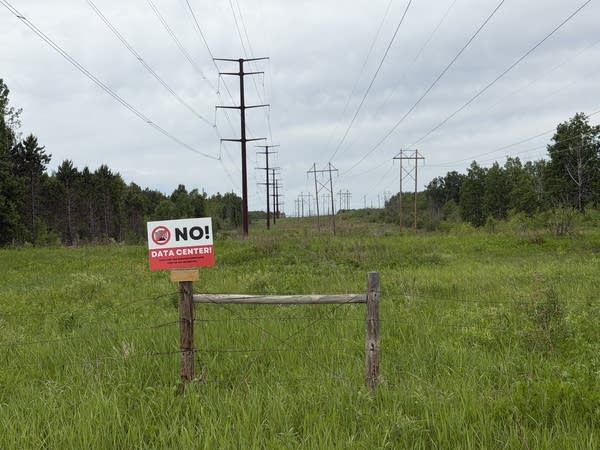
A sign opposing a proposed Google data center in Hermantown is posted along an electric transmission line corridor off of St. Louis River Rd., near where the data center would be built. Seen Tuesday.
Dan Kraker | MPR News
The data center has been proposed for a rural corner of Hermantown adjacent to where the new electric transmission infrastructure is being built. Data centers require enormous amounts of electricity — often as much as small cities — and they are often proposed for locations near sources of large supplies of available electricity.
Planning for this transmission project began over a decade ago, long before Google proposed its data center project for the region. But the improvements the project will provide to the regional electricity grid would support the data center if it’s built, Gunderson said.
“We've always been a utility that served large customers. That's what we do,” Gunderson added. “So we know how to design systems around that, whether it be mining, natural resources or other customers. We want to have a system capable of supporting that.”
The project received $25 million in support from the state, as well as $50 million in federal funding through the bipartisan infrastructure law passed during the Biden administration.
The Trump administration revoked that funding last year as part of its broader effort to cancel $8 billion in grants that the Biden administration awarded to 16 states aimed at accelerating the green energy transition.
But the Department of Energy returned the funding earlier this year after Minnesota Power appealed. “The original grant was very much a bipartisan effort between the delegations from Minnesota and North Dakota, because we have facilities in both areas, and we just reaffirmed that in the appeal,” Gunderson said.
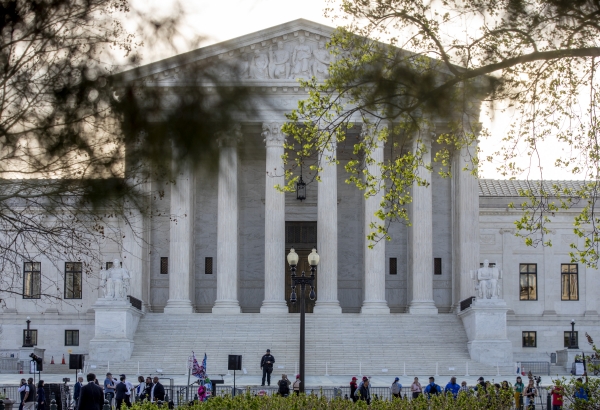
The Supreme Court is heading into its crunch time, the part of the year when the justices are racing to finish decisions and dissents in the cases that remain undecided.
There are 23 cases left, out of the 58 that have been argued. Two major cases have already been decided: One essentially gutted what remained of the landmark 1965 Voting Rights Act, prompting Republicans in a number of Southern states to redraw congressional maps to diminish or eliminate majority-Black districts that have elected Black members of Congress.
The second major case that has been decided struck down President Trump's tariff program because the court said Congress had not authorized it, and Trump exceeded his authority in doing it on his own.
Many of the most difficult and controversial cases, however, remain to be decided in the coming weeks, with the justices aiming to conclude their work by the end of June or early July. The Supreme Court is next expected to release decisions on Thursday, June 11.
So what's left?
Birthright citizenship
Trump v. Barbara
Trump has long maintained that the Constitution does not guarantee birthright citizenship for babies born on U.S. soil, and on the first day of his second term in office, he signed an executive order barring citizenship for children born in the U.S. if parents entered the country illegally or if the parents are living and working in the U.S. legally with temporary visas. The executive order never went into effect because every lower court judge to review it concluded, in the words of one, that the order was "blatantly unconstitutional." Specifically, the Fourteenth Amendment to the Constitution, enacted after the Civil War, says that, "All persons born or naturalized in the United States and subject to the jurisdiction thereof, are citizens of the United States."
While almost all scholars interpret that language broadly, and as applying to all babies born in the U.S., Trump himself maintains that it applies only to the children of former slaves, and definitely not to the children of those in the U.S. illegally or the children of noncitizens living here legally.
At issue are laws recently enacted in about half the states that ban trans girls and women from participating in women's sports at publicly funded schools. Before the court are two cases – one involving varsity competition at colleges and universities, and the other involving sports in high schools. Supporters of the bans say the laws are needed to prevent athletes whose assigned sex at birth was male from having an unfair advantage in women's sports. Opponents of the bans say they discriminate based on sex, in violation of both federal law and the Constitution's guarantee to equal protection of the law. And for athletes at every level, the issue is deeply personal, with tennis greats Billie Jean King and Martina Navratilova on opposing sides, along with hundreds of other athletes.
Will independent government agencies remain independent?
Trump v. Slaughter
Donald Trump is not the first president to try to fire the heads of independent agencies. President Franklin D. Roosevelt tried to fire one of the five Federal Trade Commissioners then serving in office. But In 1935 the Supreme Court ruled unanimously against the president; the court declared that under the federal law, commissioners could only be fired "for cause," meaning "inefficiency in office, neglect of duty, or malfeasance."
Every Supreme Court since then has reaffirmed that decision. If the conservative supermajority sides with Trump, he, as well as future presidents, will be able to fire, at will, agency leaders in all or almost all previously independent agencies.
Ironically, the commissioner in the crosshairs this time was also a member of the Federal Trade Commission. Trump appointed Rebecca Slaughter to the FTC in his first term and fired her in his second. The Supreme Court allowed the firing to go through on a temporary basis, over staunch dissents from the court's three liberal justices.
But the odds are that the court's six conservative justices will rule definitively in Trump's favor, the result being that independent agencies will no longer be independent.
So does that mean he can fire members of the Federal Reserve Board?
Trump v. Cook
Trump threatened to fire the head of the Fed, Jerome Powell, and tried to fire Lisa Cook, the first Black woman to serve on the Fed board. But the Supreme Court so far has refused to allow her removal. Cook's case, now awaiting decision by the court, has prompted considerable anxiety among economists, business leaders and others. When the Slaughter case was argued in December, some of the conservative justices seemed to suggest that the Fed had more protections than other agencies. Just how the court will thread that needle remains to be seen.
In the case before the court, Mississippi defends late-arriving ballots, noting that the Constitution gives states the right to run their own elections. That said, the Trump administration and the Republican party take the opposite position. They maintain that under federal law the election has to happen on Election Day, and anything that happens after that is not part of the election.
Congress enacted the Temporary Protected Status law in 1990 to allow fully vetted and eligible migrants to live and work legally in the U.S. if they cannot return safely to their countries because of natural disasters, armed conflicts and other extraordinary conditions. Since the law was enacted 36 years ago, every president, Republican and Democrat, has embraced it. Except Trump. In his first term, he tried and failed to kill off TPS. But in the 16 months since he returned to office, he may well be more successful. Currently, there are 17 countries whose migrants have been designated with TPS status, and so far Trump is seeking to eliminate 13 of those countries from the TPS list.
The two test cases before the Supreme Court involve migrants from Haiti and Syria. The Haitians – more than 300,000 of them – have been living legally in the U.S. since a devastating earthquake in 2010, followed by a deadly cholera epidemic, domestic terrorism, including widespread kidnappings and killings by marauding gangs, and political assassinations that have continued to this day. The Syrians are a much smaller group ofroughly 3,800.
The Trump administration argues that decisions about TPS are entirely up to the president, and that the courts have no power to review those decisions. If the court agrees, that could well lead to mass deportations.
Geofencing entails drawing a virtual geographical fence around an area where a crime was committed. In this case, the area within the geofence line included not just a bank where a robbery took place but also a church and a senior citizens home. The government sought a warrant that required Google to search its data and turnover any of the names of users who were within the geofence line at the time of the crime.
Essentially the question for the justices is whether this new technique is ingenious, Orwellian, or both? The government contends that because people are free NOT to give their location data to their tech provider, the data that the tech company does have, must be turned over to police pursuant to a warrant. Countering that argument, opponents of geofencing contend that because the warrant directs the tech company to search millions of users' location history, millions of people were subjected to a search despite never having done anything suspicious.
In most states gun owners can bring firearms onto private property, unless the property owner tells them otherwise. But five states – Hawaii, California, Maryland, New York and New Jersey – have passed laws that require gun owners to get permission in advance. The question facing the justices is whether that requirement for advance permission violates the Second Amendment right to bear arms.
In a second case, the question is whether a federal law that makes it a felony for drug users to possess a gun violates the Second Amendment.. The law is akin to one that resulted in the prosecution and conviction of Hunter Biden. Biden was convicted of the gun law in this case, along with two other charges, in connection with his purchasing a firearm in 2018.
In 2022 , the court issued a broad ruling declaring that gun regulations henceforth would be deemed unconstitutional if they had no analog to a similar gun regulation that existed at the founding. Lower courts have found the decision confusing and difficult to administer, and they have unsubtly complained about the lack of guidance on gun issues from the Supreme Court. The two gun cases this term may answer at least some of those questions.
To provide the best experiences, we use technologies like cookies to store and/or access device information. Consenting to these technologies will allow us to process data such as browsing behavior or unique IDs on this site. Not consenting or withdrawing consent, may adversely affect certain features and functions.
Functional
Always active
The technical storage or access is strictly necessary for the legitimate purpose of enabling the use of a specific service explicitly requested by the subscriber or user, or for the sole purpose of carrying out the transmission of a communication over an electronic communications network.
Preferences
The technical storage or access is necessary for the legitimate purpose of storing preferences that are not requested by the subscriber or user.
Statistics
The technical storage or access that is used exclusively for statistical purposes.The technical storage or access that is used exclusively for anonymous statistical purposes. Without a subpoena, voluntary compliance on the part of your Internet Service Provider, or additional records from a third party, information stored or retrieved for this purpose alone cannot usually be used to identify you.
Marketing
The technical storage or access is required to create user profiles to send advertising, or to track the user on a website or across several websites for similar marketing purposes.